
Programmable Logic Controller (PLC) Market Overview :
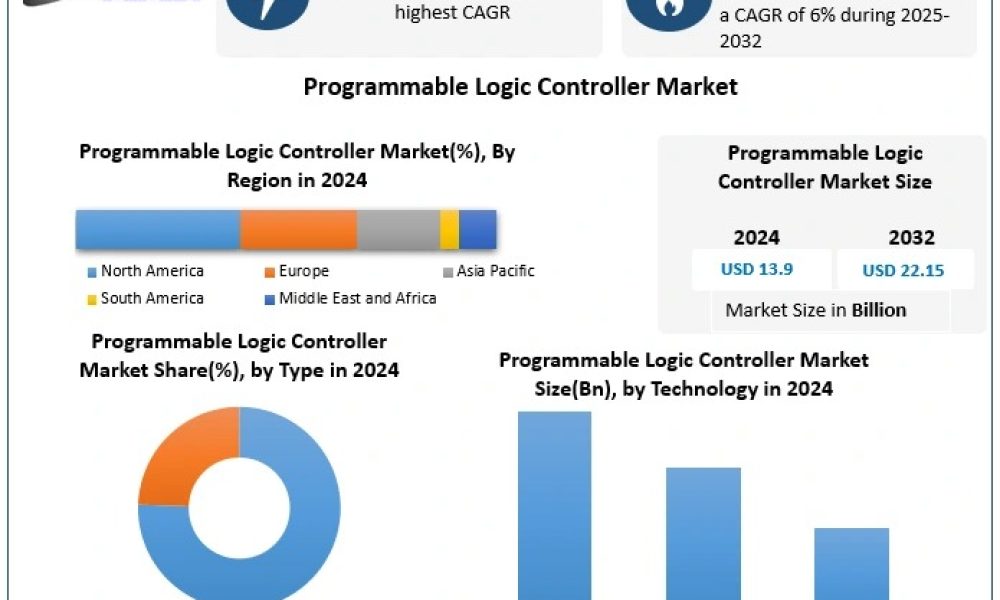
Programmable Logic Controller (PLC) Market was valued at approximately USD 13.9 billion in 2024. The market is projected to grow steadily at a compound annual growth rate (CAGR) of 6% from 2025 to 2032, reaching an estimated size of USD 22.15 billion by 2032 [attached file]. This growth is driven by the accelerating adoption of automation technologies across the manufacturing and process industries, fueled by Industry 4.0 initiatives and the digital transformation wave shaping modern industrial environments.
Market Overview
PLCs are vital automation devices used to control and monitor real-time industrial operations across sectors such as automotive, chemical, petrochemical, energy, food and beverage, oil and gas, and others. These controllers provide scalable solutions, from compact PLCs suited for small systems to modular PLCs designed for complex industrial processes requiring multi-level control.
Drivers and Trends
Industry 4.0 and Digital Transformation: The emergence of Industry 4.0 has intensified the implementation of smart, connected factories where PLCs play a pivotal role. Modern PLCs integrated with IoT, cloud computing, and AI enable predictive maintenance, real-time data analytics, and enhanced process control, significantly improving operational efficiency.
Automotive Industry Demand: The automotive sector remains a key end-user, with the adoption of PLC-driven automation for assembly lines, paint shops, welding, and quality control. PLCs help increase production throughput, precision, and downtime reduction.
Technological Innovations: Advances in PLC technologies include modular systems allowing easy scalability, edge computing capabilities for localized processing, and cybersecurity features critical for secure industrial communications.
Rising Manufacturing Activities in Asia-Pacific: Countries like China, India, Japan, and South Korea are increasing their manufacturing base, driving substantial demand for advanced PLCs to automate production and improve competitiveness.
Segment Analysis
By Type:
Modular PLCs dominate the market, offering high scalability and customization for complex systems.
Compact PLCs cater to space-constrained applications in packaging, consumer goods, and small-scale manufacturing.
By End-User:
Automotive: The largest sector by revenue, leveraging PLCs for automated manufacturing processes.
Chemical and Petrochemical: Require robust PLCs for process control and safety compliance.
Energy and Power: PLCs control and monitor energy generation and distribution equipment.
Food and Beverage: Demand PLCs for packaging automation and quality control.
Oil and Gas: Use PLCs for safety, monitoring, and operational efficiencies.
Regional Insights
Asia-Pacific: Holds a significant market share with rapid growth, fueled by government initiatives promoting smart manufacturing and automation, alongside robust industrial investment. Emerging hubs like Vietnam are gaining traction due to favorable policies and cost advantages.
North America: Dominates in terms of revenue share primarily due to the advanced industrial landscape and high adoption rates in automotive, aerospace, and energy sectors. Leading companies are headquartered here, driving innovation.
Europe: Steady growth supported by stringent industry standards, increasing investments in modern manufacturing, and a shift towards sustainable production methods.
Other Regions: Latin America and the Middle East & Africa show promising growth driven by expanding industrialization and infrastructure developments.
Competitive Landscape
Leading players in the global PLC market include:
Siemens AG
Rockwell Automation
Mitsubishi Electric
ABB Ltd.
Schneider Electric
Emerson Electric
Omron Corporation
Honeywell International
These companies emphasize continuous R&D, mergers and acquisitions, partnerships, and development of AI and IoT-enabled PLC solutions to enhance market position.
Technological Advancements & Market Developments
Companies are rapidly integrating AI and edge computing into PLCs to enhance adaptability, predictive maintenance, and operational safety.
Vendor offerings now include secure automation solutions with embedded cybersecurity protocols addressing rising concerns over industrial cyber threats.
Modular PLC systems continue to expand, aligning with the need for flexible manufacturing and scalable automation architectures.
Recent product innovations, including Siemens’ SIMATIC series and Rockwell Automation’s FactoryTalk incorporating AI-powered CoPilot for simplified programming, set new industry standards.
Challenges
Cost of advanced PLC systems and integration complexity can deter small and medium enterprises.
Maintaining cybersecurity resilience amidst increasing digital connectivity in industrial environments is critical.
Skilled workforce shortage in designing, programming, and maintaining complex PLC systems remains a barrier.
Outlook
The Programmable Logic Controller market is poised for robust growth driven by the ongoing industrial automation boom, digitalization trends, and the imperative for smarter manufacturing. Asia-Pacific’s accelerating industrial base and North America’s innovation leadership, combined with increasing adoption across verticals, will significantly contribute to market expansion. The rise of Industry 4.0 and IoT integration stands as a major catalyst, promising enhanced efficiency, reduced downtime, and flexible production models for manufacturers globally.
Conclusion
The expanding need for automation along with technological advancements in PLC capabilities will drive the market towards a valuation exceeding USD 22 billion by 2032. Adoption in the automotive and process industries will dominate, aided by the integration of AI and cloud technologies enhancing manufacturing efficacy and safety. As industries continue embracing digital transformation globally, the Programmable Logic Controller market will remain a core enabler of industrial progress and competitiveness.




