
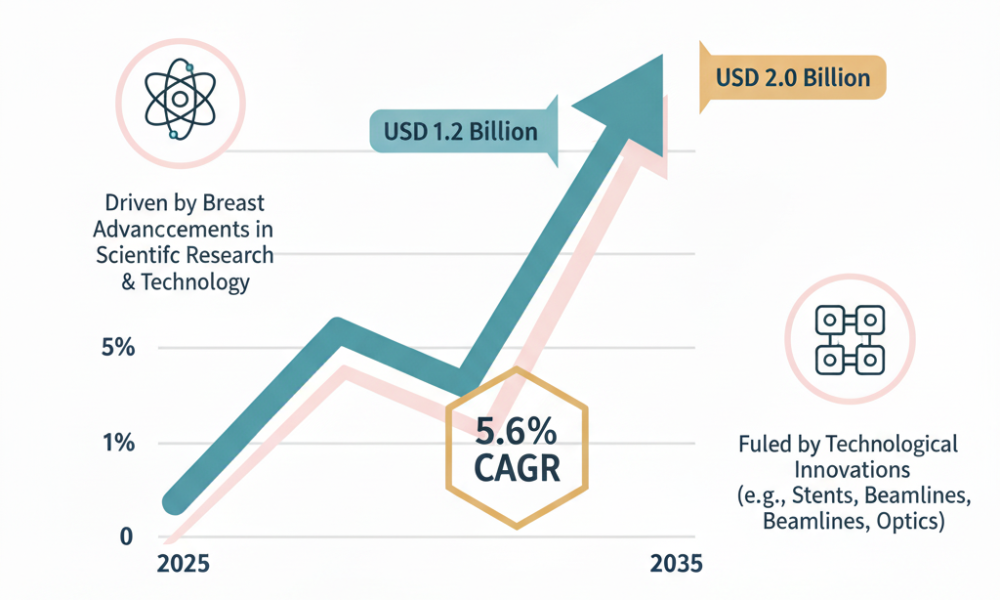
The Synchrotron Instrumentation Market is set for steady expansion, growing from USD 1.2 billion in 2025 to an estimated USD 2.0 billion by 2035. This growth, at a CAGR of 5.6%, is supported by rising demand across diverse fields including nanotechnology, pharmaceuticals, energy research, and advanced materials science. Synchrotron facilities have become crucial for scientists seeking high-resolution imaging, precise material characterization, and real-time structural analysis of complex substances.
Growing research investments, alongside collaborations between academic institutes and industry players, are accelerating market development. Established corporations and emerging manufacturers are competing to refine technologies that enhance the speed, precision, and adaptability of synchrotron systems.
Driving Forces Behind Growth
One of the most important factors fueling demand is the rising use of synchrotron-based techniques in nanoparticle and biomolecule analysis, where real-time structural insights are essential. From designing more efficient drug delivery systems to exploring renewable energy materials, synchrotron facilities have become central to next-generation innovation.
Full Market Report available for delivery. For purchase or customization, please request here: https://www.futuremarketinsights.com/reports/sample/rep-gb-17226
The oil and gas sector also remains a vital end user, applying synchrotron technologies to corrosion analysis, catalytic process optimization, and resource exploration. As energy companies face greater pressure to adopt sustainable practices, synchrotron instrumentation is providing the detailed data needed for safer and cleaner operations.
These broad applications position synchrotron systems as indispensable to both fundamental science and applied industrial research.
Segmental Insights
Optical Devices Lead Product Demand
Optical devices are projected to dominate the market with a 38.6% share by 2025. These instruments remain at the heart of synchrotron beamline operations, ensuring stability, enhanced resolution, and precision in experiments. Their adaptability across spectroscopy, imaging, and structural analysis has made them a mainstay of global facilities.
Continuous innovation in optics design, including improved durability and performance reliability, is helping both leading manufacturers and specialized startups maintain strong growth in this segment.
Nanoparticles and Colloids as Core Application
Applications involving nanoparticles and colloids are expected to hold a 41.2% share by 2025, underlining their dominance. Synchrotron instrumentation offers unmatched capabilities in analyzing particle size distribution, structural behavior, and stability. This is critical in sectors such as healthcare, electronics, and nanomaterials, where precision research shapes product innovation.
As nanotechnology advances, synchrotron systems are expected to become even more indispensable, fueling adoption worldwide.
Oil and Gas as a Key End-Use Sector
By 2025, the oil and gas industry will account for 36.9% of total revenue, highlighting its leadership in end-use adoption. The sector increasingly relies on synchrotron technologies to analyze materials under extreme conditions, study corrosion at the molecular level, and optimize refining processes.
With global demand for safer, more efficient, and environmentally conscious operations, synchrotron tools have become central to achieving breakthroughs in energy exploration and production.
Regional Growth Patterns
North America
The United States will remain the global leader with a projected 21.5% share in 2025, supported by world-class facilities and government-backed research initiatives. Investments in upgrading existing infrastructure, such as the APS Upgrade project, are expanding capabilities and fueling demand for advanced instruments.
Asia-Pacific
Japan represents a lucrative hub with an 18.3% share in 2025, driven by the SPring-8 facility, one of the largest and most advanced synchrotron centers worldwide. Expanding government funding and collaborations with global technology providers are accelerating market growth.
China, too, is emerging as a critical player as it scales investments in nanotechnology, biotechnology, and advanced materials research.
Europe
Germany leads the European market with 27.3% share in 2025, driven by technological innovations and a robust manufacturing base. German research institutes and companies are at the forefront of synchrotron advancements, reinforcing Europe’s status as a key contributor to global growth.
Competitive Landscape
The synchrotron instrumentation market is shaped by both established multinationals and innovative new entrants. Industry giants such as ZEISS, Rigaku Corporation, Agilent Technologies, Thermo Fisher Scientific, and Shimadzu Corporation continue to set benchmarks with advanced optical devices, diffractometers, and detectors.
Meanwhile, emerging firms like TOP-UNISTAR (HK) Science & Technology Co. Ltd., Alemnis, Xenocs, and JJ X-Ray A/S are making notable strides by focusing on specialized instruments tailored to modern research needs.
Recent innovations highlight the dynamism of the market. For example, Proto Manufacturing introduced the iXRD Mini in March 2025, a cost-effective and portable tool designed to make residual stress analyses more accessible. Similarly, Anton Paar’s launch of a powder diffractometer in December 2024 underscores the race among players to bring versatile, user-friendly solutions to market.
Collaborations and acquisitions are also shaping competition. AgfaLabs’ acquisition of an Agilent Cary 620 system and Rigaku’s participation in global synchrotron conferences are examples of how companies are working to expand both technological reach and market visibility.
Opportunities for Expansion
The market offers strong opportunities for both established and new manufacturers. Key growth avenues include:
- Nanotechnology research: Expanding demand for atomic-level analysis is fueling instrument adoption.
- Renewable energy: Synchrotron systems are helping optimize catalytic processes and develop advanced storage materials.
- Interdisciplinary science: Growing collaborations across materials science, biology, and environmental research are broadening market scope.
Manufacturers who embrace partnerships, invest in R&D, and deliver cost-effective, adaptable instruments are likely to thrive.
Request Market Research Draft Report: https://www.futuremarketinsights.com/reports/brochure/rep-gb-17226
Challenges to Overcome
Despite positive momentum, the high cost of synchrotron instrumentation remains a major hurdle. Smaller research institutions and universities often struggle to afford advanced equipment, limiting accessibility and slowing adoption in developing economies.
Affordability challenges may also constrain the pace of innovation and reduce funding availability for new projects. Overcoming these barriers will require collaborative funding models, scalable designs, and strategic public-private partnerships.
Future Outlook
Looking ahead, the synchrotron instrumentation market is poised to remain a cornerstone of global scientific discovery. With strong momentum in nanotechnology, advanced materials, and energy research, demand will continue to grow steadily through 2035.
Established manufacturers are expected to refine precision and performance, while new entrants will play a critical role in delivering cost-effective, user-friendly tools. As synchrotron research expands to new domains, from healthcare to environmental science, the market will continue to evolve in step with global scientific ambitions.
By aligning with these trends, manufacturers—whether seasoned industry leaders or agile innovators—are well-positioned to capture opportunities in this expanding field.
About Future Market Insights (FMI)
Future Market Insights, Inc. (ESOMAR certified, recipient of the Stevie Award, and a member of the Greater New York Chamber of Commerce) offers profound insights into the driving factors that are boosting demand in the market. FMI stands as the leading global provider of market intelligence, advisory services, consulting, and events for the Packaging, Food and Beverage, Consumer Technology, Healthcare, Industrial, and Chemicals markets. With a vast team of over 400 analysts worldwide, FMI provides global, regional, and local expertise on diverse domains and industry trends across more than 110 countries.
Contact Us:
Future Market Insights Inc.
Christiana Corporate, 200 Continental Drive,
Suite 401, Newark, Delaware – 19713, USA
T: +1-347-918-3531
For Sales Enquiries: [email protected]



