
The esophageal implant industry is at the forefront of innovation in gastrointestinal healthcare, addressing conditions that affect millions of patients worldwide. Once dominated by invasive surgeries and long-term medications, the treatment landscape is now being reshaped by advanced esophageal implants designed to restore function, alleviate symptoms, and improve patient quality of life.
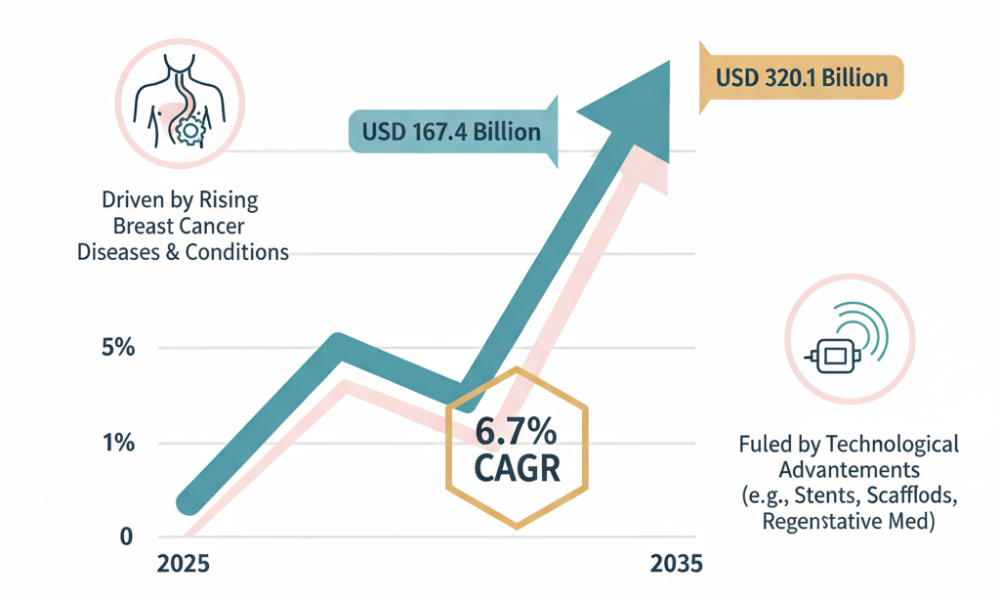
By 2025, the market is estimated at USD 167.4 billion, and projections indicate it will nearly double to USD 320.1 billion by 2035. This steady 6.7% CAGR underscores a critical shift: healthcare providers and patients alike are embracing advanced, minimally invasive solutions over traditional approaches.
Behind this momentum lies a combination of lifestyle-driven disease prevalence, such as obesity and poor dietary habits, and demographic shifts like aging populations. Esophageal cancer, gastroesophageal reflux disease (GERD), and dysphagia are increasingly common, creating a surge in demand for innovative implantable devices that provide durable relief.
Full Market Report available for delivery. For purchase or customization, please request here: https://www.futuremarketinsights.com/reports/sample/rep-gb-17242
Technology Advancements and Market Dynamics
The esophageal implant industry is a striking example of how material science, surgical expertise, and patient-centric design converge to produce life-changing innovations. Modern implants now feature biocompatible materials, improved stent designs, and drug-eluting capabilities that reduce complications and speed recovery times.
Self-expanding metallic stents (SEMS), for instance, have transformed from rigid devices into highly flexible, anatomically adaptive products that maintain functionality with fewer risks. Bioabsorbable and biodegradable stents are emerging as promising alternatives, reflecting the industry’s shift toward sustainability and patient safety.
Regulatory approvals and ongoing clinical trials further boost confidence in these devices. This climate of innovation has drawn both established global leaders and agile new entrants into the competitive arena.
Leading Applications and End Users
Among application segments, GERD treatment dominates, projected to account for 48.7% of market revenue by 2025. With obesity and stress-related disorders fueling the prevalence of GERD worldwide, the demand for durable and effective implants is intensifying. Implants are increasingly recognized as viable alternatives to long-term pharmaceutical therapy, aligning with the global trend toward reducing dependence on chronic medications.
On the end-user front, hospitals remain the primary drivers, capturing 54.2% of the market in 2025. Hospitals’ advanced surgical infrastructure, access to skilled specialists, and established reimbursement systems make them central to esophageal implant adoption. Patients’ trust in specialized care centers further reinforces hospitals’ leadership.
Regional Insights
North America continues to lead the global esophageal implant market, thanks to high awareness, robust healthcare infrastructure, and the presence of key manufacturers. Within this region, the United States stands out, forecasted to reach USD 320.1 million by 2035 with a 7.3% CAGR. Favorable regulations, product launches, and strong clinical adoption are all contributing to this growth.
Europe follows closely, with the United Kingdom projected at USD 14.1 million by 2035, driven by rising esophageal cancer cases and subsequent demand for stents.
Asia-Pacific is the fastest-growing region, where markets such as China (USD 21.3 million, 8.6% CAGR) and Japan (USD 4.4 million, 7.5% CAGR) are surging due to aging populations, increased dysphagia cases, and rising demand for minimally invasive procedures. South Korea, backed by strong government support for medical device innovation, is also emerging as a key growth hub.
Competitive Landscape: Established Leaders and Emerging Innovators
The esophageal implant industry hosts a diverse mix of multinational corporations and specialized regional manufacturers. Boston Scientific, Medtronic, Cook Medical, Olympus Corporation, Johnson & Johnson, and Baxter International dominate with their scale, R&D resources, and global distribution channels.
Meanwhile, agile innovators such as Taewoong Medical, Ella-CS, M.I. Tech, Merit Medical, and EndoStim are carving niches by introducing specialized devices with unique design advantages. Startups and mid-sized firms like Micro-Tech (Nanjing), Apollo Endosurgery, and NDO Surgical are leveraging collaborations, localized strategies, and targeted innovations to gain competitive ground.
Strategic mergers and acquisitions are shaping the competitive landscape. For example, Boston Scientific’s acquisition of Apollo Endosurgery and Olympus’s acquisition of Taewoong Medical reflect a push to strengthen portfolios and expand into high-demand product categories. Similarly, partnerships with hospitals and research institutes are enabling manufacturers to accelerate clinical adoption and improve patient outcomes.
Request Market Research Draft Report: https://www.futuremarketinsights.com/reports/brochure/rep-gb-17242
Opportunities and Challenges
Despite robust growth, the esophageal implant market faces challenges. High device costs and limited reimbursement policies in developing economies restrict adoption, while complications such as stent migration pose ongoing risks. Additionally, in price-sensitive regions, competing lower-cost therapies often slow implant uptake.
Yet, opportunities abound. The development of biodegradable and drug-eluting implants, cost-effective manufacturing strategies, and rising adoption in emerging economies create fertile ground for growth. Increasing cases of esophageal fistulas, coupled with the expanding preference for minimally invasive interventions, will keep demand resilient.
Market Trends and Future Outlook
Several trends define the next decade of the esophageal implant market. The growing popularity of bioabsorbable stents, increasing collaborations between manufacturers and healthcare providers, and the rise of esophagectomy and reconstruction procedures point to a dynamic future.
From 2020 to 2025, the market expanded steadily at a CAGR of 5.6%, driven by adoption of implants for both malignant and benign conditions. Looking ahead, the acceleration to 6.7% CAGR through 2035 reflects an era where innovation, patient-centric solutions, and global expansion strategies converge.
The future will be defined by two forces: global giants scaling advanced solutions across markets, and emerging innovators pushing the boundaries of design and affordability. Together, they are shaping a competitive ecosystem that balances innovation with accessibility.
About Future Market Insights (FMI)
Future Market Insights, Inc. (ESOMAR certified, recipient of the Stevie Award, and a member of the Greater New York Chamber of Commerce) offers profound insights into the driving factors that are boosting demand in the market. FMI stands as the leading global provider of market intelligence, advisory services, consulting, and events for the Packaging, Food and Beverage, Consumer Technology, Healthcare, Industrial, and Chemicals markets. With a vast team of over 400 analysts worldwide, FMI provides global, regional, and local expertise on diverse domains and industry trends across more than 110 countries.
Contact Us:
Future Market Insights Inc.
Christiana Corporate, 200 Continental Drive,
Suite 401, Newark, Delaware – 19713, USA
T: +1-347-918-3531
For Sales Enquiries: [email protected]



