
Hydrogen Storage Tank Market Overview :
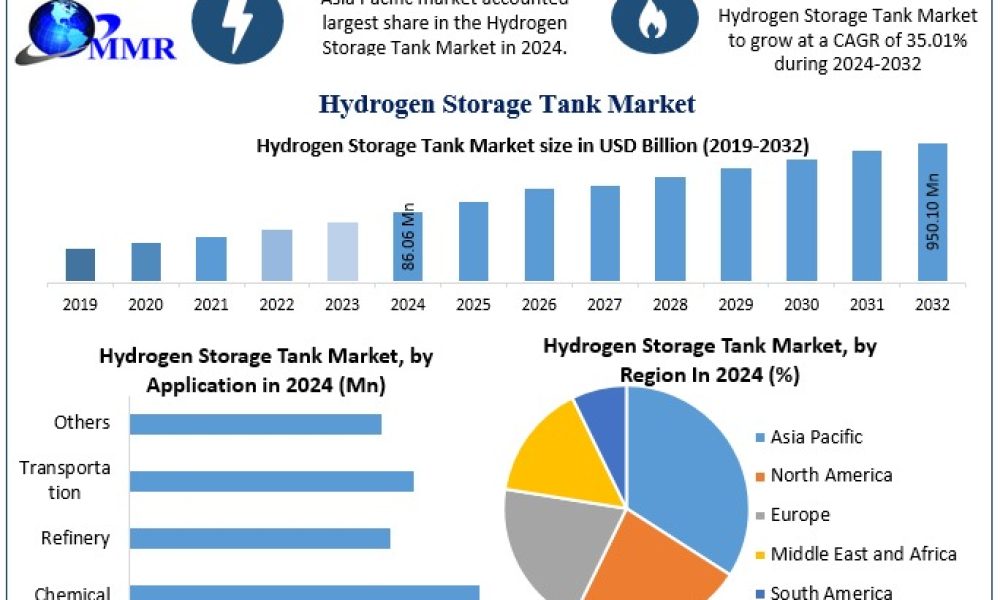
Hydrogen Storage Tank Market is experiencing exponential growth, with its size valued at USD 86.06 million in 2024 and projected to reach nearly USD 950.10 million by 2032, at a staggering CAGR of 35.01% over the forecast period. Hydrogen tanks—critical for safely storing hydrogen in gaseous or liquid form—are fundamental to the burgeoning hydrogen economy, supporting new energy, transportation, and industrial applications across the globe.
Key Highlights & Market Insights
Dominating Region:
Asia Pacific is set to dominate the global hydrogen storage tank market through 2032, driven by ambitious government targets, massive investments in hydrogen infrastructure, and rapid adoption across China, Japan, and South Korea. These countries aim to integrate millions of hydrogen-powered vehicles into their transport systems and are investing heavily in hydrogen refueling networks and green hydrogen projects.Leading Segment:
By Product Type: Composite tanks (notably Types III and IV) are advancing fastest, owing to their lightweight, high-strength performance—especially for transportation and mobility applications.
By Application: The transportation sector is leading demand, as fuel cell electric vehicles (FCEVs), hydrogen trucking, and public transit fleets ramp up. Industrial and energy storage applications also contribute significantly.
Key Driver:
Massive global decarbonization efforts, positive investor sentiment, and government roadmaps are fueling interest in hydrogen as a clean energy carrier, thus driving the need for advanced hydrogen storage tanks. Technological innovation, specifically in lightweight composite materials and safety systems, is further accelerating adoption.
Recent Developments (2023–2025)
In April 2023, the Southwest Research Institute (SwRI) rolled out a high-capacity 17,000-gallon liquid hydrogen tank for R&D, offering new avenues for scale and cost-effectiveness in hydrogen projects.
Solvay and Air Liquide have launched new hydrogen material technology platforms and made major investments in composite tank manufacturing and research across Europe and North America.
Investments surpassing $300 billion have been announced worldwide, with flagship hydrogen mobility projects, industrial integration, and green hydrogen hubs emerging throughout Europe, Asia, and Australia.
Market Dynamics
Drivers:
Global net-zero pledges and clean energy policies
Major government funding driving hydrogen technology adoption, especially in Europe, Asia-Pacific, and the U.S.
Rapid advancements in tank design—high-pressure, cryogenic, and solid-state storage technologies
Growing transportation market for FCEVs, buses, trucks, and commercial fleets
Challenges:
High overall costs of composite and specialty hydrogen tanks
Safety, engineering, and regulatory hurdles associated with ultra-high-pressure (up to 875 bar) and cryogenic storage
Supply chain immaturity—dependence on advanced carbon fiber and other high-cost materials
Environmental concerns over hydrogen production pathways (fossil vs. renewables) still affect broad green hydrogen adoption
Opportunities:
Infrastructure investments: hydrogen refueling stations, large-scale storage for renewables
Partnerships between tank manufacturers and OEMs in automotive, aerospace, and industrial sectors
Accelerated deployment in Europe’s heavy industry and energy storage, plus expansion into U.S. and Asian markets
Regional Analysis
Asia Pacific: Globally dominant, led by China’s industrial might, Japan’s hydrogen innovation strategy, and South Korea’s investment and policy support for hydrogen vehicles. Region expects exponential growth as hydrogen adoption for energy, transportation, and industrial use accelerates.
Europe: Strong policy push and public-private partnerships, especially in Germany, France, and the UK, focused on integrating hydrogen into renewable and grid-scale projects.
North America: Significant research, commercial pilot programs, and refueling network development, with California, Texas, and Canada emerging as hubs for hydrogen mobility and power storage.
Rest of World: Middle East, Latin America, and Australia are increasingly integrating hydrogen into future energy planning, with pilot projects and early-stage investments underway.
Product Segmentation
By Product Type: Type I (metal), Type II (metal/composite), Type III (fully composite with metal liner), Type IV (fully composite with polymer liner)
By Material: Metal, carbon fiber, glass fiber, and hybrid composites
By Application: Transportation, chemical/refinery, industrial, energy storage, aerospace, medical
By End-Use: Automotive, industrial, aerospace & defense, medical, others
Key Trends
Surge in government and private investment for green hydrogen projects and storage tank R&D
Shift to lightweight, high-pressure composite tanks for automotive and mobility sectors
Integration of hydrogen storage in renewable energy storage systems for grid balancing and long-term energy shifting
Industry partnerships for developing safe, scalable, cost-effective tanks to support the commercial hydrogen rollout in mobility and power sectors
Quote
Asia Pacific’s proactive investment and strong policy support are making it the global epicenter for hydrogen storage tank innovation. As the world pivots towards a low-carbon economy, advanced hydrogen storage solutions will play a foundational role in the clean energy revolution, supporting resilient, scalable, and sustainable power and mobility networks.
With rapid advances and massive investments, the hydrogen storage tank market is at the heart of the global energy transformation, unlocking new frontiers in clean power, sustainable transportation, and industrial decarbonization




