
Masterbatch Market Overview :
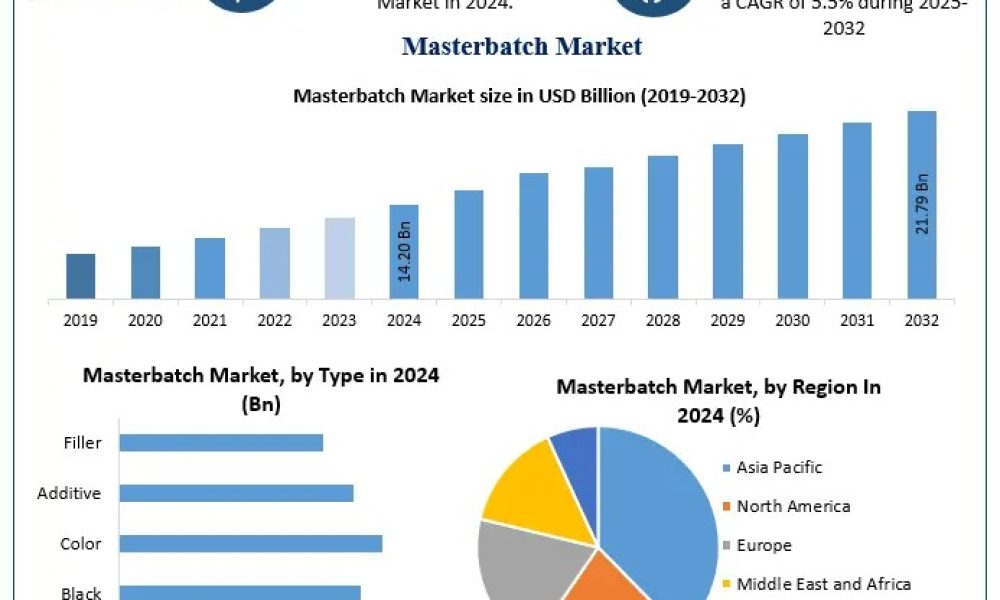
Masterbatch Market, valued at USD 14.20 billion in 2024, is forecast to reach approximately USD 21.79 billion by 2032—expanding at an estimated CAGR of 5.5% over the forecast period. Masterbatch, a concentrated mixture of pigments and additives encapsulated in a carrier resin, plays an essential role in coloring plastics, imparting functional properties such as UV stabilization, flame retardancy, antistatic, and more. The market’s impressive expansion is fueled by growth in the packaging, automotive, construction, and consumer goods industries, as well as a persistent push toward sustainability and product innovation.
Key Market Highlights & Insights
Dominating Region:
Asia Pacific is the unambiguous global leader, expected to secure over 36% of worldwide market share by 2025 and retaining its dominance through 2032. This leadership stems from rapid industrialization, burgeoning packaging and automotive sectors, expanding infrastructure development, and rising demand for innovative and cost-effective plastic solutions in countries such as China, India, and South Korea. Notably, the region’s large and dynamic manufacturing base provides both supply and demand-side momentum.Leading Segment:
By Type: Black masterbatch leads the type segment with more than 26% revenue share, owing to its use in construction, agriculture, packaging, and tire production. Color masterbatch is also fast-growing, with increasing demand from consumer goods, food & beverage, and branding-related packaging design.
By Carrier Polymer: Polypropylene (PP) accounted for the highest revenue share in 2024, valued for its superior mechanical strength, flexibility, and reduced weight, particularly in automotive and packaging applications.
By End Use: The packaging industry takes the largest market share, as both rigid and flexible plastic packaging solutions proliferate across retail, foodservice, and consumer goods sectors. Automotive, building & construction, consumer goods, and agriculture are also major consumers.
Key Driver:
The primary growth drivers include increasing consumption of plastics in packaging, automotive lightweighting, urban infrastructure buildout, and the continuous quest for customized plastic materials with vibrant colors, improved durability, and specialized properties. Additionally, regulatory mandates and trends toward bio-based and biodegradable plastics are propelling innovation and adoption of specialty masterbatches.
Recent Developments and Trends
2024–2025: Leading companies such as Avient, Ampacet, Clariant, and Cabot Corporation continue to launch sustainable, bio-based, and high-performance masterbatch solutions. Innovations include color-masterbatch-carrier systems compatible with high-temperature engineering plastics, antimicrobial masterbatches for healthcare and packaging, and additive masterbatches promoting recyclability and compostability.
Customized masterbatch formulations for 3D printing, smart electronics, and IoT-connected consumer products are gaining traction.
R&D investments in biodegradable and eco-friendly masterbatch help brand owners comply with circular economy and regulatory demands, especially in Europe and North America.
Market Dynamics
Growth Drivers:
Expansion of e-commerce and organized retail, fueling demand for innovative packaging.
Lightweighting in the automotive sector for fuel efficiency and design flexibility.
Urbanization and governmental infrastructure projects raising plastics demand in construction.
Product differentiation imperatives in consumer goods, electronics, and healthcare intensifying color and functional masterbatch usage.
Challenges:
Stringent environmental regulations on non-biodegradable plastics and microplastic pollution.
Rising raw material and oil prices, affecting cost structures and profitability.
Quality inconsistencies from lower-tier manufacturers, particularly impacting developing market competition.
Opportunities:
The proliferation of biodegradable and recycled-plastic masterbatches for food and pharma packaging.
Upsurge in functional additives: antimicrobial, anti-UV, anti-static, retardant.
Growing adoption of masterbatch in nonwoven textiles, smart materials, and new mobility solutions.
Regional Analysis
Asia Pacific:
Fastest-growing and largest market by volume and revenue, credited to diverse downstream sectors and a surging middle class. Strong growth in packaging, automotive, and infrastructure—particularly in China, India, and Southeast Asia—propels the region.Europe:
Second in global share, with a major focus on sustainability, recycling, and high-spec engineering plastics.North America:
Stable growth due to established automotive, healthcare, and packaging sectors, as well as increasing adoption of smart and sustainable packaging.Other Regions:
Latin America, the Middle East & Africa offer steady expansion opportunities as local plastics industries develop and align with global standards.
Product Segmentation
By Type: Black, white, color, additive, filler
By Carrier Polymer: Polypropylene (PP), Polyethylene (PE), Polyvinyl Chloride (PVC), PET, biodegradable plastics, others
By End Use: Packaging, automotive & transportation, building & construction, consumer goods, agriculture
Key Trends
Strong momentum in bio-based, compostable, and recycled-content masterbatch
Development of masterbatch solutions for smart applications—IoT, 3D printing, and connected devices
Focus on brand enhancement: color trends, visual effects, and traceability in packaging
Greater regulatory scrutiny and investment in compliance
Competitive Landscape
Major global leaders include Americhem, Ampacet Corporation, Cabot Corporation, Clariant, Gabriel-Chemie, RTP Company, Polyplast Muller, Avient, Plastiblends India, and others. Competitive strategies center on M&A, R&D, product customization, and strategic alliances.
Outlook
With continued innovation, a focus on sustainability, and relentless growth in end-use industries, the masterbatch market is poised for continued expansion. Asia Pacific will remain at the forefront, while advanced functionality, environmental regulation, and e-commerce will drive global market evolution through 2032.




