
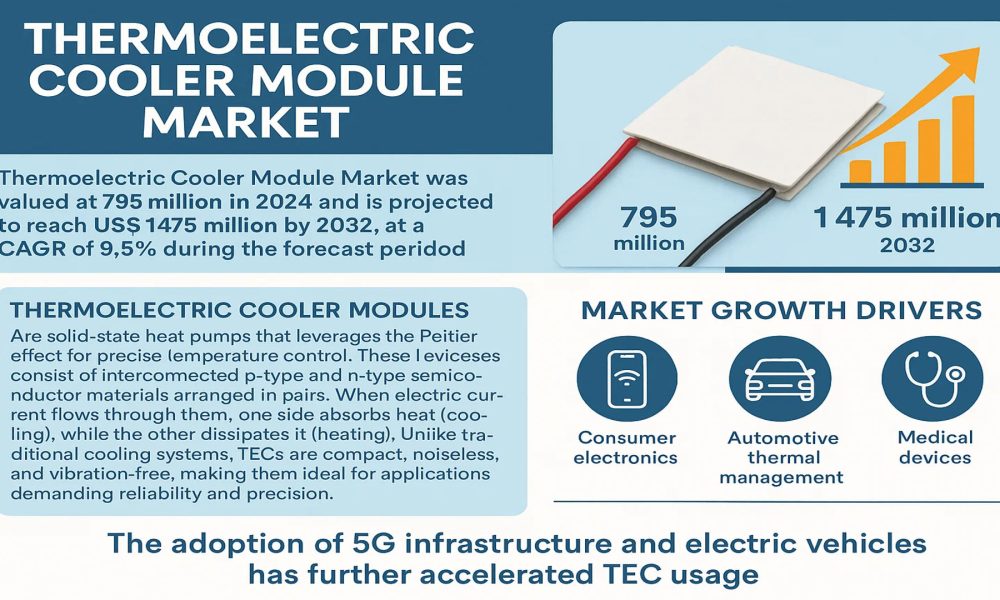
Thermoelectric Cooler Module Market was valued at 795 million in 2024 and is projected to reach US$ 1475 million by 2032, at a CAGR of 9.5% during the forecast period.
Thermoelectric cooler modules (TECs) are solid-state heat pumps that leverage the Peltier effect for precise temperature control. These devices consist of interconnected p-type and n-type semiconductor materials arranged in pairs. When electric current flows through them, one side absorbs heat (cooling), while the other dissipates it (heating). Unlike traditional cooling systems, TECs are compact, noiseless, and vibration-free, making them ideal for applications demanding reliability and precision.
Market growth is driven by rising demand in consumer electronics, automotive thermal management, and medical devices. The adoption of 5G infrastructure and electric vehicles has further accelerated TEC usage. Leading manufacturers like Ferrotec and Laird Thermal Systems dominate the competitive landscape, collectively holding over 50% market share. Asia-Pacific leads regional demand, accounting for more than half of global consumption in 2024.
Access Your Free Sample Report Now- https://semiconductorinsight.com/download-sample-report/?product_id=117811
MARKET DYNAMICS
MARKET DRIVERS
Rising Demand for Energy-Efficient Cooling Solutions to Propel Market Expansion
The global push for energy-efficient thermal management systems is driving significant adoption of thermoelectric cooler modules across multiple industries. With traditional compressor-based cooling systems consuming substantially more power, TECs are gaining traction due to their solid-state nature and precise temperature control capabilities. In consumer electronics alone, shipments of thermoelectric cooling modules exceeded 60 million units in 2024 as manufacturers seek compact cooling solutions for high-performance devices. The automotive sector also shows accelerating demand, particularly in electric vehicle battery thermal management systems where temperature precision is critical for safety and performance.
Emerging Medical Applications and Miniaturization Trends Fuel Market Growth
The medical sector presents a high-growth frontier for thermoelectric coolers, especially in portable medical devices and laboratory equipment requiring stable temperature conditions. Recent advances in medical imaging systems, portable insulin cooling cases, and DNA amplification equipment increasingly incorporate TEC technology. The global market for medical thermoelectric cooling applications is projected to grow at over 11% CAGR through 2030, outpacing many other sectors. Miniaturization trends across industries further drive demand for compact thermal solutions, with micro-TECs now enabling precise cooling in space-constrained applications like fiber optic components and semiconductor test equipment.
5G Infrastructure Deployment Drives Accelerated Adoption
The rapid global rollout of 5G networks is creating substantial demand for thermoelectric cooling solutions in base station equipment and optical communication systems. With 5G components generating significant heat in compact form factors, TECs provide reliable thermal management where conventional cooling methods prove inadequate. Telecommunications infrastructure investments exceeded $200 billion globally in 2024, with Asia-Pacific accounting for over 50% of deployments. This concentrated infrastructure buildout directly benefits thermoelectric module manufacturers catering to the telecom sector, particularly for cooling high-power amplifiers and laser diodes in network equipment.
Recent Developments in the Thermoelectric Cooler Module Market
- Advancements in Miniaturized Modules
Companies are developing compact thermoelectric cooler (TEC) modules for use in wearable devices, medical diagnostics, and consumer electronics. The focus is on reducing size and power consumption while improving cooling efficiency. - Integration with AI and IoT Systems
Manufacturers are incorporating smart control features using AI and IoT to regulate cooling performance. This development enhances energy efficiency and extends the lifespan of TEC modules in industrial and consumer applications. - Adoption in Electric Vehicles (EVs)
Recent innovations highlight the use of TEC modules in EV battery thermal management systems to improve performance and safety. Automakers are collaborating with TEC suppliers to integrate reliable cooling solutions. - High-Performance Materials
Researchers are introducing advanced thermoelectric materials with higher figure-of-merit (ZT values), which significantly enhance cooling efficiency and reduce energy waste. This is expected to expand applications in high-demand industries. - Partnerships and Expansions
Leading players such as Ferrotec, TEC Microsystems, and Laird Thermal Systems are investing in manufacturing expansions and strategic collaborations to meet growing demand from automotive, healthcare, and telecom industries.
MARKET OPPORTUNITIES
Emerging Electric Vehicle Thermal Management Systems Present Growth Potential
The accelerating transition to electric vehicles creates substantial opportunities for thermoelectric cooling applications, particularly in battery temperature regulation systems. With global EV sales projected to surpass 45 million units annually by 2030, the demand for reliable thermal management solutions will grow accordingly. TECs are increasingly employed in battery cooling systems where their precise temperature control helps maintain optimal operating conditions and extend battery life. Automakers are also exploring thermoelectric applications for cabin comfort systems and electronic component cooling, potentially opening additional revenue streams for module manufacturers.
Advancements in IoT and Edge Computing Drive Cooling Demand
The proliferation of IoT devices and edge computing infrastructure creates growing demand for compact, reliable cooling solutions in distributed environments. As computing moves closer to data sources, thermoelectric modules provide ideal thermal management for edge servers, 5G small cells, and industrial IoT sensors operating in uncontrolled environments. The global edge computing market is forecast to exceed $250 billion by 2028, with corresponding growth potential for thermal management solutions. This trend benefits TEC manufacturers capable of delivering modules with the right balance of performance, reliability, and form factor for decentralized computing applications.
Development of Advanced Thermoelectric Materials Opens New Applications
Ongoing research into novel thermoelectric materials presents significant opportunities for performance improvements and market expansion. Recent developments in skutterudites, half-Heusler compounds, and quantum dot superlattices show promise for achieving higher ZT values (figure of merit) compared to traditional bismuth telluride-based materials. These advances could enable new applications in waste heat recovery systems and high-temperature industrial processes currently beyond the reach of conventional TECs. Manufacturers investing in material science R&D may gain first-mover advantages as these technologies mature and transition from laboratory to commercial production.
Access Your Free Sample Report Now- https://semiconductorinsight.com/download-sample-report/?product_id=117811
List of Key Thermoelectric Cooler Module Manufacturers
- Ferrotec Corporation (Japan)
- KELK Ltd. (Komatsu Group) (Japan)
- Coherent Corp (U.S.)
- Laird Thermal Systems (U.K.)
- Z-MAX Co., Ltd. (Japan)
- KYOCERA Corporation (Japan)
- Thermonamic Electronics (China)
- TE Technology, Inc. (U.S.)
- Kryotherm Industries (Russia)
- Guangdong Fuxin Technology (China)
- Wakefield Thermal Solutions (U.S.)
- Pelonis Technologies (U.S.)
Segment Analysis:
By Type
Single-stage Thermoelectric Cooler Modules Lead the Market Due to Cost-Effectiveness and Widespread Adoption
The market is segmented based on type into:
- Single-stage Type
- Subtypes: Standard single-stage, High-performance single-stage
- Multi-stage Type
- Subtypes: Two-stage, Three-stage, and others
By Application
Consumer Electronics Segment Dominates Owing to Increasing Demand for Compact Cooling Solutions
The market is segmented based on application into:
- Consumer Electronics
- Communication
- Medical
- Automotive
- Industrial
- Aerospace & Defense
- Others
By Cooling Capacity
Low-Capacity Modules Maintain Strong Position Due to Demand from Electronics Sector
The market is segmented based on cooling capacity into:
- Low-capacity (below 50W)
- Medium-capacity (50W-200W)
- High-capacity (above 200W)
By Material Type
Bismuth Telluride-based Modules Continue to Dominate the Thermoelectric Cooler Market
The market is segmented based on material type into:
- Bismuth Telluride (Bi2Te3)
- Lead Telluride (PbTe)
- Silicon-Germanium (SiGe)
- Others
Other Topic- Plug and Play IGBT Driver Market
CONTACT US:
City vista, 203A, Fountain Road, Ashoka Nagar, Kharadi, Pune, Maharashtra 411014
[+91 8087992013]




