
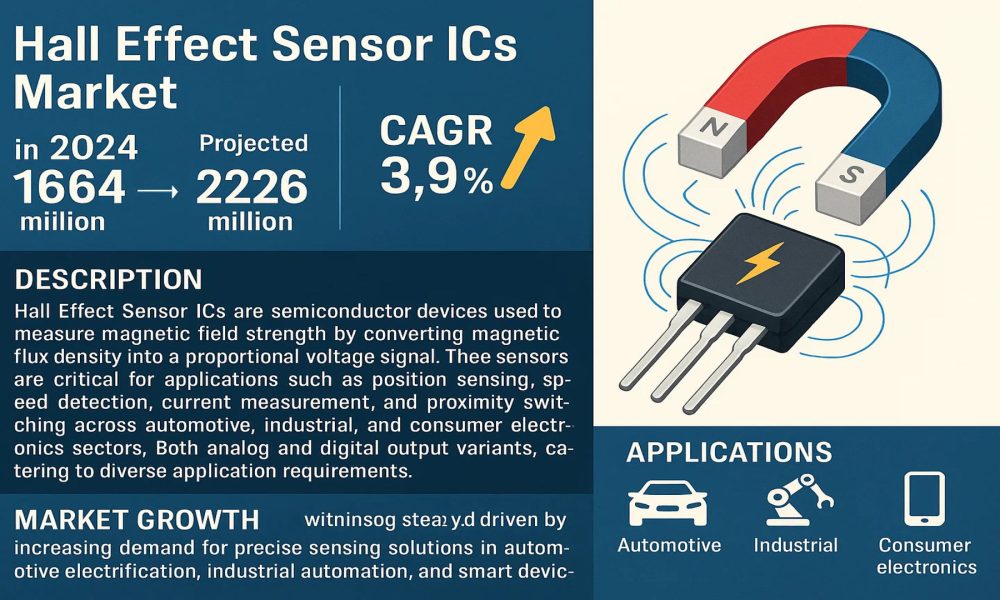
Hall Effect Sensor ICs Market was valued at 1664 million in 2024 and is projected to reach US$ 2226 million by 2032, at a CAGR of 3.9% during the forecast period.
Hall Effect Sensor ICs are semiconductor devices used to measure magnetic field strength by converting magnetic flux density into a proportional voltage signal. These sensors are critical for applications such as position sensing, speed detection, current measurement, and proximity switching across automotive, industrial, and consumer electronics sectors. The market offers both analog and digital output variants, catering to diverse application requirements.
The market is witnessing steady growth driven by increasing demand for precise sensing solutions in automotive electrification, industrial automation, and smart devices. The proliferation of electric vehicles (EVs) and renewable energy systems is creating new opportunities, as Hall sensors are essential for motor control and power management. Major players like Allegro MicroSystems, Infineon, and TDK dominate the market, leveraging their technological expertise to develop high-performance, energy-efficient solutions. Recent innovations focus on integrated signal processing and miniaturization for IoT applications.
Unlock Your Free Sample Report Here- https://semiconductorinsight.com/download-sample-report/?product_id=117813
MARKET DYNAMICS
MARKET DRIVERS
Expanding Automotive Electronics Sector to Accelerate Hall Effect Sensor IC Adoption
The automotive industry’s rapid technological transformation is generating substantial demand for Hall Effect Sensor ICs. Modern vehicles incorporate over 200 sensors in powertrain, chassis, and infotainment systems, with magnetic sensors representing approximately 15% of the total sensor count. Electric vehicle production, projected to grow at 22% CAGR through 2030, particularly drives this demand as Hall sensors provide critical current monitoring and position detection in battery management systems. Major automotive chip manufacturers have reported 28% year-over-year growth in magnetic sensor shipments as automakers prioritize safety and efficiency features.
Industrial Automation Boom Creating New Growth Frontiers
Industry 4.0 implementations are reshaping manufacturing floor requirements, with Hall Effect Sensor IC shipments for industrial applications growing at 9.3% annually. These components enable precise position detection in robotic arms, speed monitoring in conveyor systems, and current measurement in motor drives. The global industrial sensors market, valued at $21 billion in 2023, increasingly relies on magnetic sensing solutions that offer reliability in harsh environments. Brushless DC motor adoption in industrial equipment, forecast to grow by $4.2 billion through 2027, particularly benefits from the non-contact nature and durability of Hall-based position sensors.
Consumer Electronics Miniaturization Pushing Innovation
Smartphone manufacturers integrate Hall sensors for flip cover detection and compass functionality, with over 1.5 billion units shipped annually containing at least one magnetic sensor. The trend toward thinner wearables and foldable devices drives demand for compact, low-power sensor ICs that consume less than 2μA in standby mode. Recent advancements in 3D Hall technology enable precise angle measurement in joysticks and VR controllers, opening new application possibilities. The global MEMS sensor market expansion, expected to reach $30 billion by 2026, is closely tied to Hall effect component innovations that meet size and power constraints.
Recent Developments in the Hall Effect Sensor ICs Market
- Integration in Automotive Safety Systems: Leading manufacturers are increasingly embedding Hall Effect sensor ICs into advanced driver-assistance systems (ADAS) for functions such as position sensing, speed detection, and current measurement. For example, recent launches from Allegro MicroSystems and Infineon Technologies highlight their focus on automotive-grade Hall sensors that support EV safety and efficiency.
- Advancements in Energy-Efficient ICs: Companies are developing low-power Hall Effect sensor ICs optimized for battery-driven devices, consumer electronics, and IoT applications. This aligns with the global demand for longer battery life and eco-friendly designs.
- Miniaturization and High Precision: Ongoing R&D efforts are resulting in compact Hall sensor ICs with higher sensitivity and improved magnetic performance. This is particularly beneficial for applications in robotics, industrial automation, and medical equipment.
- Adoption in Electric Vehicles (EVs): The surge in EV adoption worldwide is boosting demand for Hall Effect sensor ICs used in current sensing, battery management, and motor control. Companies are scaling production capacity to meet this demand, especially in Asia-Pacific and Europe.
- Mergers and Partnerships: Key players are entering collaborations to expand technological capabilities. For example, partnerships between semiconductor firms and automotive OEMs aim to accelerate smart sensor integration into next-generation vehicles.
MARKET OPPORTUNITIES
Next-Generation Electric Vehicle Platforms Opening New Design-Ins
Automotive OEMs developing 800V architectures require current sensors with enhanced isolation capabilities, creating opportunities for advanced Hall and fluxgate hybrid solutions. The transition to zone-based E/E architectures in vehicles will drive 25% more sensor content per car by 2027, with redundant sensing becoming standard for safety-critical functions. Battery management systems in next-gen EVs demand current measurement accuracy below 0.1%, pushing adoption of precision Hall sensors with integrated signal conditioning.
Industrial IoT Deployment Expanding Sensing Requirements
Predictive maintenance systems require condition monitoring sensors that can operate for years on battery power, creating demand for ultra-low-power Hall ICs with wake-on-event functionality. The industrial wireless sensor network market is forecast to exceed $1.5 billion by 2026, with magnetic sensors playing a key role in vibration and position monitoring applications. Smart building implementations increasingly utilize Hall-effect-based airflow and valve position sensors that offer longer lifespans than mechanical alternatives.
Medical Device Innovation Leveraging Contactless Sensing
Implantable medical devices increasingly incorporate Hall sensors for position detection in drug delivery systems and prosthetic controls, benefiting from the technology’s immunity to fluid exposure. The medical sensor market is projected to grow at 8.9% CAGR through 2028, with magnetic sensing playing a critical role in miniaturized diagnostic equipment. Recent FDA clearances for Hall-based surgical navigation systems demonstrate the technology’s potential in advanced medical applications requiring sub-millimeter accuracy.
Unlock Your Free Sample Report Here- https://semiconductorinsight.com/download-sample-report/?product_id=117813
List of Key Hall Effect Sensor IC Companies Profiled
- Allegro MicroSystems (U.S.)
- Infineon Technologies (Germany)
- TDK Corporation (Japan)
- Asahi Kasei Microdevices (Japan)
- NXP Semiconductors (Netherlands)
- Melexis (Belgium)
- ams OSRAM (Austria)
- Texas Instruments (U.S.)
- Diodes Incorporated (U.S.)
- Suzhou Novosense Microelectronics (China)
- Honeywell (U.S.)
- TE Connectivity (Switzerland)
Segment Analysis:
By Type
Analog Output Hall Sensors Hold Significant Market Share Owing to Wide-Ranging Industrial Applications
The market is segmented based on type into:
- Analog Output Hall Sensor
- Subtypes: Linear output, ratiometric output, and others
- Digital Output Hall Sensor
- Subtypes: Bipolar, unipolar, omnipolar, and others
By Application
Automotive and Transportation Sector Dominates Due to Rising Adoption in EVs and ADAS Systems
The market is segmented based on application into:
- Consumer Electronics
- Industrial and Energy
- Automotive and Transportation
- Others
By Technology
Bipolar Technology Gaining Traction for Precision Current Sensing Applications
The market is segmented based on technology into:
- Bipolar Hall Effect Sensors
- Unipolar Hall Effect Sensors
- Omnipolar Hall Effect Sensors
Other Topic-Embedded Discrete DRAM Market
CONTACT US:
City vista, 203A, Fountain Road, Ashoka Nagar, Kharadi, Pune, Maharashtra 411014
[+91 8087992013]




