
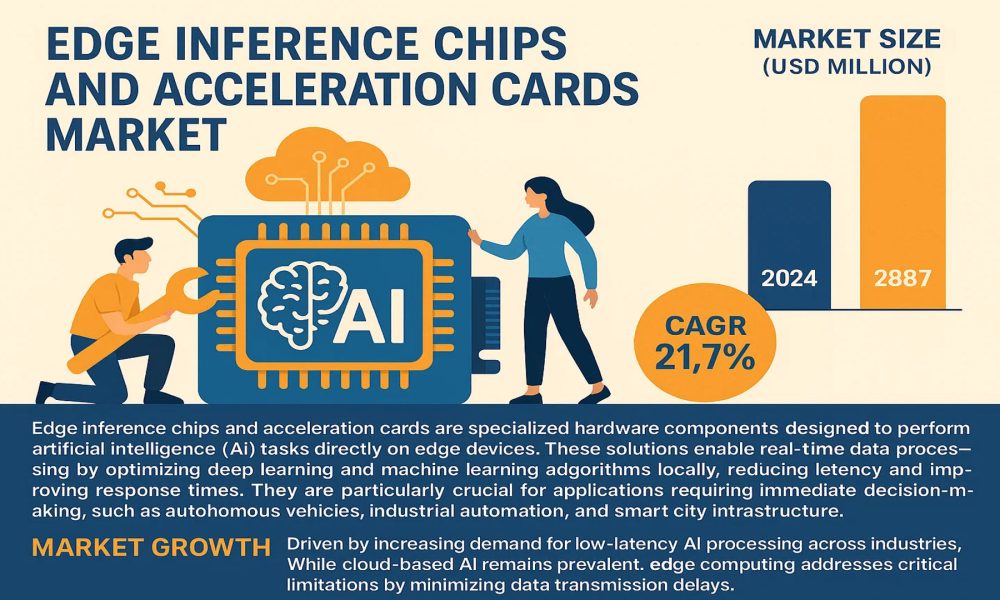
Edge Inference Chips and Acceleration Cards Market was valued at 758 million in 2024 and is projected to reach US$ 2887 million by 2032, at a CAGR of 21.7% during the forecast period.
Edge inference chips and acceleration cards are specialized hardware components designed to perform artificial intelligence (AI) tasks directly on edge devices. These solutions enable real-time data processing by optimizing deep learning and machine learning algorithms locally, reducing latency and improving response times. They are particularly crucial for applications requiring immediate decision-making, such as autonomous vehicles, industrial automation, and smart city infrastructure.
The market growth is driven by increasing demand for low-latency AI processing across industries. While cloud-based AI remains prevalent, edge computing addresses critical limitations by minimizing data transmission delays. Key players like NVIDIA, Intel, and Qualcomm are innovating with more efficient architectures to support diverse edge applications. For instance, in 2023, NVIDIA launched its Jetson AGX Orin platform, specifically designed for edge AI workloads in robotics and autonomous machines, demonstrating the industry’s focus on performance-optimized solutions.
Grab Your Complimentary Sample Report- https://semiconductorinsight.com/download-sample-report/?product_id=117843
MARKET DYNAMICS
MARKET DRIVERS
Real-Time AI Processing Needs Accelerate Demand for Edge Inference Solutions
The exponential growth of AI applications requiring low-latency processing is the primary driver for edge inference chips and acceleration cards. Traditional cloud-based AI inference introduces network delays averaging 100-200ms, while edge solutions reduce this to under 10ms – critical for time-sensitive applications. Autonomous vehicles, for example, require sub-50ms response times for object detection and collision avoidance, fundamentally necessitating edge processing. The global autonomous vehicle market, projected to exceed 60 million units by 2030, creates enormous demand for specialized edge inference hardware.
Smart City Deployments Fuel Industrial Adoption
Massive infrastructure investments in smart cities are driving industrial adoption of edge AI hardware. Traffic management systems utilizing edge inference can process 4K video feeds from thousands of cameras simultaneously, requiring dedicated acceleration cards with 30-50 TOPS (Tera Operations Per Second) performance. Similarly, predictive maintenance in manufacturing relies on vibration and thermal analysis that must happen on-premises before cloud transmission. The industrial segment now accounts for 28% of edge inference hardware demand and is growing at 25% annually as factories transition to Industry 4.0 standards.
Privacy Regulations Compel On-Device Processing
Increasingly stringent data privacy laws are making edge inference solutions commercially essential rather than optional. Regulations like GDPR and CCPA impose heavy penalties for unnecessary data transfers, while sectors like healthcare face even tighter controls. Medical imaging AI now processes 92% of analyses locally before anonymization and cloud upload. Edge chips with built-in encryption achieve HIPAA compliance while maintaining diagnostic speeds – an approach being adopted across financial services, surveillance, and personal device markets.
Recent Developments in the Edge Inference Chips and Acceleration Cards Market
- Rising Demand for AI at the Edge (2024–2025):
Companies are increasingly focusing on low-latency, energy-efficient inference chips for deployment in IoT devices, autonomous vehicles, and smart cameras. Edge AI chips with higher TOPS (Tera Operations per Second) performance are being launched to handle complex workloads locally. - Launch of Next-Gen Acceleration Cards:
Leading semiconductor players such as NVIDIA, Intel, Qualcomm, and AMD have released AI acceleration cards optimized for edge computing. These cards support AI inference in applications like robotics, industrial automation, and healthcare. - Strategic Partnerships and Ecosystem Development:
Vendors are collaborating with cloud service providers and edge platform developers to provide integrated AI solutions. Partnerships are enabling faster adoption in retail, manufacturing, and automotive sectors. - Energy Efficiency Innovations:
Recent advancements are focusing on low-power architectures, making inference chips suitable for battery-operated devices, 5G IoT modules, and wearable technologies. - Adoption of RISC-V and Custom Architectures:
Startups and established players are investing in RISC-V-based edge inference chips to enhance flexibility, reduce costs, and accelerate AI deployment. - Focus on Security-Enhanced Edge AI:
Given the growth of connected devices, vendors are embedding security features directly into inference chips and cards, enabling trusted AI operations at the edge. - Investment and Funding Activity:
AI hardware startups developing custom edge inference accelerators have secured fresh funding in 2024–2025, boosting innovation and competition in the market.
MARKET OPPORTUNITIES
Hybrid Cloud-Edge Architectures Create New Deployment Models
The emergence of 5G network slicing enables seamless workload partitioning between edge and cloud, driving demand for adaptive inference hardware. Telecom providers now offer latency-guaranteed slices (under 10ms) for critical edge processing while offloading non-time-sensitive tasks. This hybrid approach reduces total infrastructure costs by 35-40% compared to pure edge solutions while meeting performance requirements. Early adopters in autonomous mining and remote surgery are demonstrating 90% reduction in bandwidth costs alongside real-time responsiveness.
AI-Specific Silicon Startups Attract Record Investments
Specialized edge AI chip designers raised over $5.2 billion in funding last year as investors recognize the limitations of general-purpose processors. Unlike GPUs originally designed for graphics, these startups architect silicon specifically for transformer models and computer vision primitives. One neuromorphic computing firm achieved 28x better energy efficiency on object detection tasks compared to incumbent solutions. With 40+ new entrants in the space, competition is driving rapid architectural innovation that will benefit end users through better performance-per-dollar metrics.
Vertical-Specific Solutions Address Niche Market Needs
Rather than pursuing generic acceleration, vendors now develop chips tailored to specific industries. A agriculture-focused edge processor might optimize for multispectral image analysis while ignoring NLP capabilities. This specialization reduces chip size and power needs by 45% while improving task-specific throughput. The approach is gaining traction in healthcare (FDA-cleared diagnostic accelerators), retail (vision processors for cashierless stores), and defense (radiation-hardened inference modules) – sectors projected to comprise 60% of the edge AI market by 2030.
List of Key Edge Inference Chips and Acceleration Cards Companies Profiled
- NVIDIA Corporation (U.S.)
- Intel Corporation (U.S.)
- Advanced Micro Devices, Inc. (U.S.)
- Qualcomm Technologies, Inc. (U.S.)
- Hisilicon (a subsidiary of Huawei) (China)
- Cambrian Technologies (China)
- Hailo (Israel)
- Black Sesame Technologies (China)
- Kunlun Core (China)
- Corerain Technologies (China)
The market is witnessing increasing strategic collaborations as traditional chipmakers partner with AI software companies to create optimized solutions. For example, several players are integrating their hardware with popular frameworks like TensorFlow Lite and ONNX Runtime to improve developer accessibility. Meanwhile, vertical integration strategies are becoming more common, with some companies developing full-stack solutions that combine chips, acceleration cards, and software tools.
As edge AI adoption grows across industries, competition is intensifying not just on performance metrics but also on power efficiency, software ecosystems, and real-world deployment support. This is leading to rapid innovation cycles, with most major players now announcing new product generations every 12-18 months to maintain their competitive edge.
Grab Your Complimentary Sample Report- https://semiconductorinsight.com/download-sample-report/?product_id=117843
Segment Analysis:
By Type
Edge Inference Chips Lead Due to Their Pervasive Use in Low-Power Edge Devices
The market is segmented based on type into:
- Chips
- Subtypes: ASICs, FPGAs, and Others
- Acceleration Cards
By Application
Smart Transportation Dominates Due to Rising Demand for Autonomous Vehicles and Traffic Management Systems
The market is segmented based on application into:
- Smart Transportation
- Smart Finance
- Industrial Manufacturing
- Other
By Technology
Deep Learning Acceleration Represents the Fastest Growing Segment
The market is segmented based on technology into:
- Deep Learning Acceleration
- Computer Vision Processing
- Natural Language Processing
- Others
By End User
Automotive Industry Emerges as Key Consumer of Edge AI Solutions
The market is segmented based on end user into:
- Automotive
- Healthcare
- Retail
- Telecom
- Others
Other Topic- MEMS Magnetic Sensor Market
CONTACT US:
City vista, 203A, Fountain Road, Ashoka Nagar, Kharadi, Pune, Maharashtra 411014
[+91 8087992013]




