
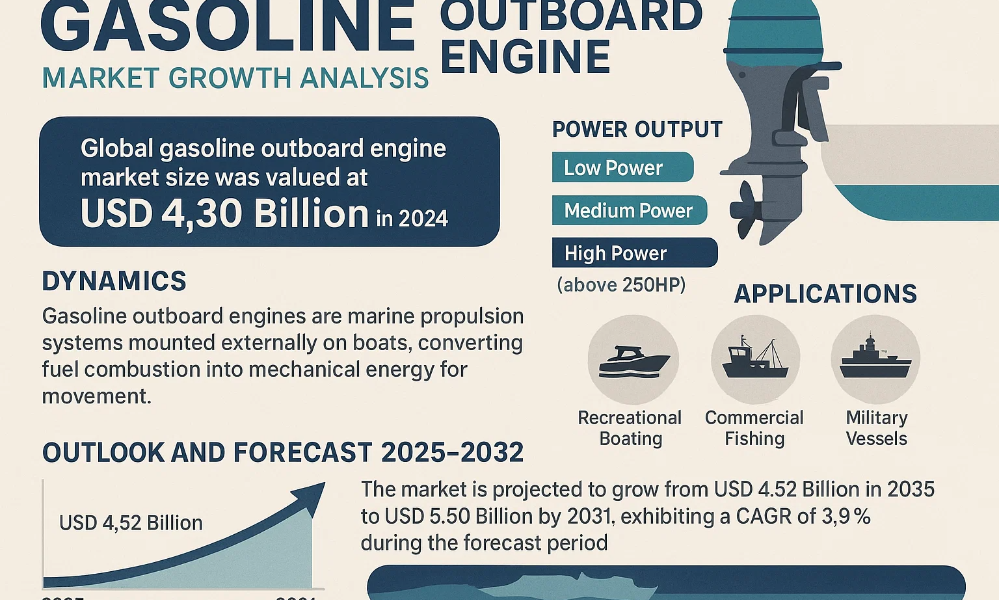
Global gasoline outboard engine market size was valued at USD 4.30 billion in 2024. The market is projected to grow from USD 4.52 billion in 2025 to USD 5.60 billion by 2031, exhibiting a CAGR of 3.9% during the forecast period.
Gasoline outboard engines are marine propulsion systems mounted externally on boats, converting fuel combustion into mechanical energy for movement. These engines are categorized by power output into low power (below 30HP), medium power (30-250HP), and high power (above 250HP) segments. They find applications across recreational boating, commercial fishing, and military vessels.
The market growth is driven by increasing marine recreational activities and expanding commercial fisheries, particularly in coastal economies. However, environmental regulations promoting electric alternatives pose challenges. Key players like Yamaha Motor Co., Ltd. and Mercury Marine, Inc. are investing in cleaner combustion technologies to meet emission standards while maintaining performance. The Asia-Pacific region dominates sales due to strong maritime traditions and growing middle-class participation in boating activities.
Grab Your Complimentary Sample Report- https://www.intelmarketresearch.com/download-free-sample/9971/gasoline-outboard-engine-market
MARKET DYNAMICS
MARKET DRIVERS
Growth in Recreational Boating Industry to Accelerate Market Demand
The global gasoline outboard engine market is experiencing steady growth, primarily driven by the expanding recreational boating industry. With marine tourism and leisure activities regaining momentum post-pandemic, demand for small and medium-sized pleasure boats equipped with gasoline outboards has increased significantly. In North America alone, recreational boating participation grew by approximately 15% between 2022-2024, creating substantial opportunities for engine manufacturers. Outboard motors remain the preferred propulsion system for recreational vessels below 25 feet due to their portability, ease of maintenance, and cost-effectiveness compared to inboard alternatives.
Expanding Commercial Fishing Sector to Sustain Market Growth
Commercial fishing operations continue to rely heavily on gasoline outboard engines for small to mid-sized fishing vessels, particularly in coastal and inland water bodies. The engines’ quick-start capabilities, maneuverability, and reliability make them indispensable for artisanal fisheries worldwide. As global seafood consumption continues rising – projected to reach 23kg per capita by 2030 – fishing fleets are expanding, directly benefiting outboard engine manufacturers. Emerging economies in Southeast Asia and Latin America are witnessing particularly strong growth in small-scale fisheries, further driving regional market expansion.
Technological Advancements in Engine Design to Boost Adoption Rates
Leading manufacturers are overcoming traditional limitations of gasoline outboards through innovative engineering solutions. Modern four-stroke engines now deliver fuel efficiency improvements of 20-25% compared to earlier models while reducing emissions by up to 90%. Variable valve timing, direct fuel injection systems, and advanced combustion technologies are enabling these performance gains. For instance, recent innovations include integrated digital throttles and Bluetooth connectivity for performance monitoring – features that appeal to both recreational and professional users seeking smarter marine propulsion solutions.
MARKET OPPORTUNITIES
Emerging Markets to Offer Significant Growth Potential
Developing economies in Southeast Asia, Latin America, and Africa present largely untapped opportunities for gasoline outboard engine manufacturers. Rising disposable incomes, growing tourism sectors, and expanding artisanal fishing industries are driving marine vessel ownership in these regions. Countries like Indonesia, Brazil, and Nigeria are witnessing accelerating demand, with the Southeast Asian market alone projected to grow at 5.2% CAGR through 2030. Localized product offerings tailored to regional needs – such as corrosion-resistant designs for tropical climates – could provide manufacturers with competitive advantages.
Aftermarket Services to Create Additional Revenue Streams
The maintenance-intensive nature of gasoline outboard engines presents lucrative aftermarket opportunities. Parts replacement, servicing, and engine refurbishment represent a growing business segment that often generates higher margins than new engine sales. With average service intervals of 100-150 operating hours and recommended major overhauls every 1,000 hours, established service networks can develop recurring revenue models. Manufacturers investing in digital service platforms and mobile maintenance solutions stand to benefit most from this trend.
Product Specialization to Address Niche Market Needs
Differentiation through specialized engine configurations allows manufacturers to command premium pricing. Examples include ultra-shallow water versions for marsh applications, high-torque models for heavy workboats, and specialized icebreaking outboards. The growing popularity of adventure fishing has also created demand for ruggedized engines capable of extended operation in challenging conditions. By identifying and servicing these niche segments, companies can build brand loyalty while avoiding direct competition in commoditized engine categories.
Segment Analysis:
By Power Output
Low Power (Below 50 HP)
Medium Power (50-150 HP)
High Power (Above 150 HP)
Medium Power engines (50-150 HP) are most used due to their balance of fuel efficiency and performance in both recreational and commercial applications.
By Application
Recreational Boating
Commercial Fishing
Marine Rescue
Military & Defense
Recreational Boating accounts for the largest share as leisure fishing and water sports continue to drive demand for gasoline outboard engines.
By Technology
2-Stroke
4-Stroke
Direct Injection
4-Stroke engines dominate due to stricter environmental regulations and better fuel efficiency compared to traditional 2-stroke variants.\
By End User
Individual Consumers
Boat Manufacturers
Commercial Fleets
Government Agencies
Boat Manufacturers represent the largest segment, as they integrate outboard engines into new vessel production.
List of Key Gasoline Outboard Engine Manufacturers
Yamaha Motor Co., Ltd. (Japan)
Mercury Marine, Inc. (U.S.)
Honda Motor Co., Ltd. (Japan)
Suzuki Marine (Japan)
Torqeedo GmbH (Germany)
Zhejiang Canglong Power Machinery Co., Ltd. (China)
Zhejiang Anqidi Power Machinery Co., Ltd. (China)
Powertec Group (Australia)
Mudd Hog Mud Motors, LLC (U.S.)
Yongkang Longxiao Industry and Trade Co., Ltd. (China)
GASOLINE OUTBOARD ENGINE MARKET TRENDS
Shift Toward Fuel-Efficient and Eco-Friendly Engines Drives Market Evolution
The global gasoline outboard engine market is undergoing a significant transformation due to increasing environmental regulations and consumer demand for sustainable marine solutions. Stringent emission regulations, such as the EPA Tier 3 standards in North America and the EU’s Stage V norms, are compelling manufacturers to develop cleaner, more efficient engines. Innovations like direct fuel injection (DFI) and advanced catalytic converters have reduced CO2 and NOx emissions by up to 30% compared to conventional two-stroke engines. Additionally, lightweight engine designs and improved combustion efficiency are enhancing fuel economy, making modern gasoline outboard engines more attractive to both recreational and commercial users.
Other Trends
Integration of Smart Technologies
The marine industry is rapidly adopting smart technologies to enhance engine performance and user experience. Advanced engine control units (ECUs) with real-time monitoring capabilities, Bluetooth connectivity, and predictive maintenance features are becoming standard in high-end models. These technologies not only improve fuel efficiency but also reduce downtime through proactive diagnostics. Furthermore, GPS-enabled engine management systems are gaining traction, allowing boat operators to optimize routes and fuel consumption based on weather and water conditions.
Growing Recreational Boating Industry Fuels Market Expansion
The surge in recreational boating activities is a key driver for the gasoline outboard engine market. In North America alone, recreational boat sales increased by approximately 9% in the last fiscal year, with pontoon boats and fishing vessels accounting for a significant share. This growth is attributed to rising disposable incomes and the popularity of outdoor leisure activities post-pandemic. Manufacturers are capitalizing on this trend by introducing compact, high-performance engines tailored for smaller watercraft. The Asia-Pacific region is also witnessing robust demand, fueled by expanding marina infrastructure and government initiatives to promote water sports tourism.
Grab Your Complimentary Sample Report- https://www.intelmarketresearch.com/download-free-sample/9971/gasoline-outboard-engine-market
Recent Developments in the Gasoline Outboard Engine Market:
Launch of advanced fuel-efficient models – Leading manufacturers such as Yamaha, Mercury Marine, and Suzuki have introduced gasoline outboard engines with improved fuel injection systems and lightweight designs to enhance performance while reducing fuel consumption.
Integration of digital and smart control systems – Companies are equipping outboard engines with digital throttle and shift (DTS) systems, electronic fuel injection (EFI), and GPS-based navigation support for better user control and seamless boating experience.
Shift toward higher horsepower engines – Demand for high-performance outboards, especially above 300 HP, is rising in recreational boating and commercial marine applications. Recent product launches focus on reliability, speed, and torque optimization.
Sustainability and emission compliance – Manufacturers are focusing on engines that comply with stricter emission norms such as EPA, CARB, and EU Stage V. Efforts are ongoing to reduce noise, vibration, and exhaust emissions in gasoline outboards.
Strategic partnerships and acquisitions – Key players are forming collaborations with boat manufacturers to deliver integrated propulsion systems. For example, Mercury Marine and Yamaha have partnered with various boat builders to expand their OEM supply agreements.
Growth in recreational boating demand – Rising popularity of water sports, fishing, and leisure boating in North America, Europe, and Asia-Pacific has led to increased production and sales of advanced gasoline outboard engines.
About Intel Market Research
Intel Market Research delivers actionable insights in technology and infrastructure markets. Our data-driven analysis leverages:
Real-time infrastructure monitoring
Techno-economic feasibility studies
Competitive intelligence across 100+ countries
Trusted by Fortune 500 firms, we empower strategic decisions with precision.
International: +1(332) 2424 294 | Asia: +91 9169164321
Website: https://www.intelmarketresearch.com
Follow us on LinkedIn:https://www.linkedin.com/company/intel-market-research




