
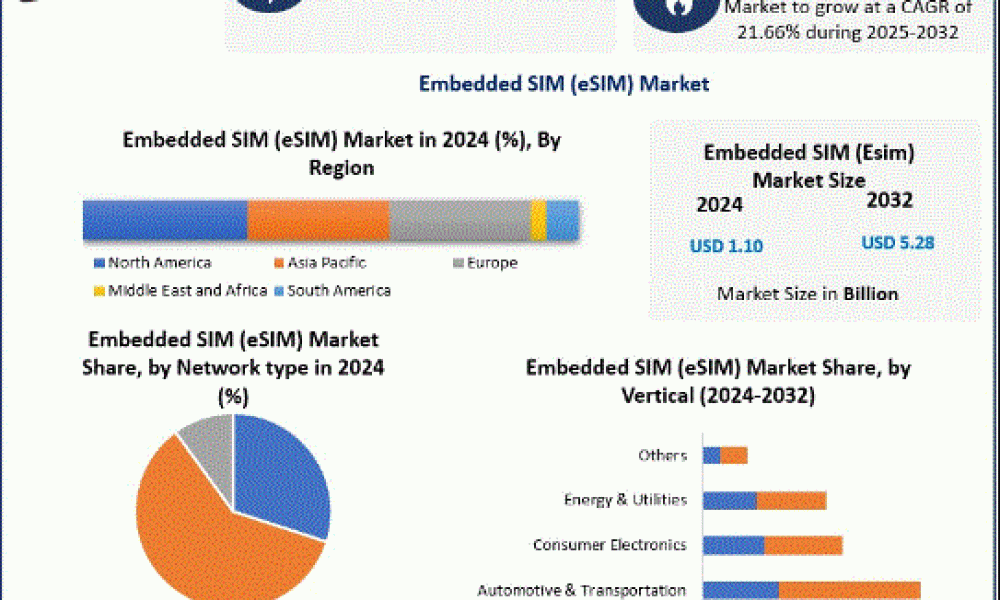
As per a recent study released by Maximize Market Research, titled, “Embedded SIM Market,” The Embedded SIM Market, valued at USD 1.10 billion in 2024, is expected to undergo rapid expansion, growing at a compound annual growth rate (CAGR) of about 21.66% between 2025 and 2032, with projections estimating it will reach nearly USD 5.28 billion by 2032.
Embedded SIM Market Overview:
The fundamental shift from physical SIM cards to programmable, integrated solutions is being propelled by rising demand for seamless connectivity in devices such as smartphones, tablets, wearables, and ever‐increasing Internet of Things (IoT) deployments. eSIM technology is attractive for its capability to remotely provision mobile network profiles, remove reliance on physical SIM swapping, and enhance user experience in global roaming and multi‐carrier operations.
This market evolution is supported by growing use of connected devices across various verticals—automotive, consumer electronics, healthcare, industrial, and logistics, among others. Device manufacturers and mobile network operators (MNOs) alike are responding by embedding eSIM support into new handset models, tablets, wearables, and automotive platforms, and investing heavily in connectivity services, software platforms, and hardware that support this shift.
Download a Free Sample Report Today : https://www.maximizemarketresearch.com/request-sample/3132/
Embedded SIM Market Dynamics
One of the primary drivers of growth in the eSIM market is the dramatic rise in connected devices spurred by IoT expansion. From smart home sensors and wearables to industrial machinery and connected vehicles, the number of devices requiring continuous, reliable, secure connectivity is surging. eSIMs offer a solution well suited for this proliferation because they support remote provisioning, multiple profiles, lower physical space requirements, and improved resilience to tampering—all of which make them ideal for small or permanently installed devices in remote or challenging environments.
On the flip side, the market faces several headwinds. Interoperability and standardization remain areas of concern. Different regions, device manufacturers, and network operators may adopt proprietary or semi‐proprietary implementations, which can result in fragmentation, increased costs, and delays in rolling out eSIM broadly. Additionally, the cost associated with designing devices to support eSIM, integrating secure elements, ensuring compliance with multiple regulatory jurisdictions, and scaling remote provisioning infrastructure can be considerable.
Embedded SIM Market Outlook and Future Trends :
Looking ahead, one of the key trends likely to shape the eSIM market is deeper integration with automotive and transportation sectors. Connected cars, telediagnostic services, over‐the‐air updates, remote monitoring, and infotainment systems all stand to benefit from embedded SIM solutions. As vehicles become more software‐defined and connected, the demand for robust, secure, and flexible network connectivity will push automotive OEMs and suppliers toward eSIM adoption.
Another anticipated trend is the maturation of global regulatory frameworks and industry standards around eSIM and remote SIM provisioning. As cross‐border connectivity becomes more common (e.g. for global IoT deployments), as well as the use of multiple carrier profiles in a single device, there will be more pressure on the industry (device makers, operators, standard bodies) to harmonize protocols, security features, and regulatory compliance.
Embedded SIM Market Regional Insights:
In terms of geographical trends, North America currently dominates the eSIM market and is expected to retain its leading position through the forecast period, driven by early adoption, strong presence of major device manufacturers, supportive network operators, and progressive regulatory environments. Asia-Pacific is another region of significant growth potential: rapidly increasing smartphone penetration, fast growth in IoT deployments, rising demand in automotive and consumer electronics, and supportive policies are likely to lead to substantial expansion. Europe will also contribute strongly, benefiting from regulatory pushes toward connectivity innovation, green technologies, and tighter standards in telecom.
Embedded SIM Market Segmentation
by Component
Connectivity services
Hardware
Software/Platforms
by Network Type
5G
4G/LTE
NB-IoT/LTE-M
by Vertical
Automotive
Consumer Electronics
Energy & Utilities Manufacturing
Retail Transportation & Logistics
Others
by Application
Smartphones
Connected Cars
Laptops
M2M
Tablets
Wearables
Others
Some of the current players in the Embedded SIM Market are:
1. Gemalto (Thales Digital Identity & Security) (Amsterdam, Netherlands)
2. Giesecke+Devrient (Munich, Germany)
3. IDEMIA (Courbevoie, France)
4. Sierra Wireless (Richmond, British Columbia, Canada)
5. STMicroelectronics (Geneva, Switzerland)
6. Sierra Wireless (Richmond, British Columbia, Canada)
7. Cisco Systems (San Jose, California, USA)
8. KORE Wireless (Alpharetta, Georgia, USA)
9. AT&T (Dallas, Texas, USA)
10. T-Mobile (Bellevue, Washington, USA)
About Maximize Market Research:
Maximize Market Research is one of the fastest-growing market research and business consulting firms serving clients globally. Our revenue impact and focused growth-driven research initiatives make us a proud partner of majority of the Fortune 500 companies. We have a diversified portfolio and serve a variety of industries such as IT & telecom, chemical, food & beverage, aerospace & defense, healthcare and others.
Contact Maximize Market Research:
MAXIMIZE MARKET RESEARCH PVT. LTD.
⮝ 3rd Floor, Navale IT park Phase 2,
Pune Banglore Highway, Narhe
Pune, Maharashtra 411041, India.
✆ +91 9607365656
🖂 [email protected]




