
Definition
Battery operated grass trimmers are cordless landscaping tools designed to provide precise trimming of grass, weeds, and vegetation in residential and commercial spaces. These devices rely on rechargeable lithium-ion battery systems, typically ranging from 18V, 20V, or 40V, allowing for cord-free operation and reducing dependency on gas-powered equipment.
Modern battery trimmers offer adjustable cutting widths, telescopic shafts, and quick-charge capabilities, delivering convenience, reduced noise, zero emissions, and lower maintenance costs compared to traditional gas trimmers. The growing adoption of environmentally friendly landscaping solutions, combined with urbanization and rising disposable income, has accelerated market growth.
The tools serve both residential gardeners and professional landscaping businesses, with commercial-grade models focusing on extended runtime, heavy-duty cutting heads, and durability for frequent use. Industry leaders continue to innovate by improving battery life, reducing charging times, and enhancing ergonomic designs to meet evolving consumer and professional requirements.
Recent Developments in the Battery-Operated Grass Trimmer Market
The battery-operated grass trimmer market is undergoing a swift evolution, primarily driven by consumer demand for more efficient, eco-friendly, and user-friendly outdoor power equipment. A major development is the continuous advancement in lithium-ion battery technology, which has resulted in longer run times, shorter charging periods, and increased power output, effectively closing the performance gap with traditional gas-powered models. Manufacturers are also focusing on ergonomic and lightweight designs to enhance user comfort and reduce fatigue. The market is also seeing the integration of smart technologies, such as Bluetooth connectivity and app-based monitoring, allowing users to track battery life, performance, and maintenance needs, thereby providing a more connected and seamless gardening experience.
Major Distribution for Battery-Operated Grass Trimmer
The distribution of battery-operated grass trimmers is a multi-channel strategy aimed at reaching a diverse customer base, including residential users, professional landscapers, and DIY enthusiasts. Big-box home improvement stores and large retail chains like The Home Depot and Lowe’s are a primary distribution channel, offering a wide variety of brands and price points. Specialized lawn and garden equipment dealers also play a crucial role, providing expert advice, service, and a curated selection of higher-end, professional-grade models. A significant and rapidly growing channel is e-commerce, with major online retailers like Amazon and brand-specific websites offering convenience, product reviews, and direct-to-consumer sales. This blend of brick-and-mortar retail, specialized dealers, and online platforms ensures a broad and accessible market presence for battery-operated grass trimmers.
Market Size
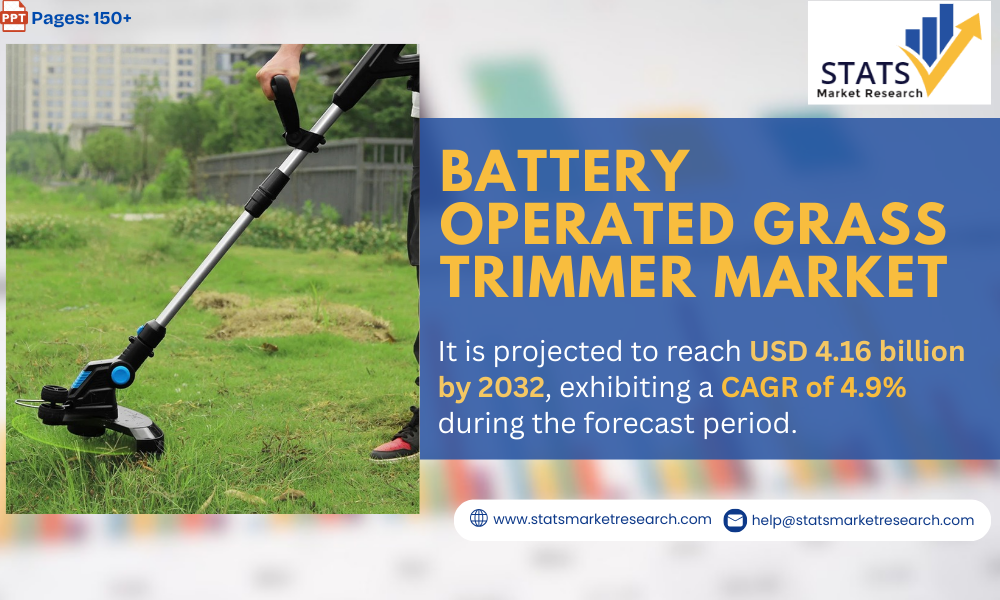
Global battery operated grass trimmer market was valued at USD 2.99 billion in 2024 and is projected to grow from USD 3.15 billion in 2025 to USD 4.16 billion by 2032, reflecting a CAGR of 4.9%.
Download FREE Sample of this Report @ https://www.statsmarketresearch.com/download-free-sample/8061066/global-battery-operated-grass-trimmer-forecast-market
Key market factors include:
- North America dominance: The region currently holds the largest share, driven by high consumer awareness, adoption of eco-friendly equipment, and strong DIY landscaping trends.
- Asia-Pacific growth: Rapid urbanization, increasing disposable income, and government subsidies for electric equipment are propelling the market at the fastest rate.
- Commercial adoption: Landscaping companies, parks, and golf courses are transitioning from gas-powered tools to battery-operated solutions, representing nearly 40% of total equipment sales.
Additional trends influencing market size include the rise of DIY home landscaping projects, improved battery technology, and government regulations limiting emissions from gas-powered tools in over 100 cities worldwide.
Market Dynamics (Drivers, Restraints, Opportunities, and Challenges)
Drivers
Environmental Concerns and Emission Regulations
- Increased awareness of greenhouse gas emissions from gasoline-powered trimmers.
- Regulatory bans in over 100 cities restrict gas-powered equipment use due to noise and air pollution.
- Battery trimmers provide zero emissions, quieter operation, and comparable performance.
Technological Advancements in Battery Systems
- Lithium-ion batteries now offer runtime parity with gas-powered tools, with some 40V models delivering up to 60 minutes of continuous use.
- Fast-charging reduces downtime to under 30 minutes, while brushless motors improve efficiency by 20–30%.
DIY Landscaping Trend
- Homeowners increasingly undertake landscaping tasks themselves.
- Battery trimmers are lightweight, low-maintenance, and easy to operate, leading over 65% of residential users to prefer them.
- Multi-tool battery platforms allow one battery to power multiple garden tools, enhancing convenience.
Restraints
High Initial Costs
- Entry-level battery trimmers are 30–50% more expensive than gas models.
- Spare batteries and chargers increase system costs.
- Battery replacement every 3–5 years adds to total ownership cost, deterring price-sensitive consumers.
Limited Runtime and Power Constraints
- Commercial landscapers often need multiple battery swaps for extended work sessions.
- High-capacity batteries are heavier, creating ergonomic challenges.
- Dense vegetation may still require gas-powered models for optimal performance.
Opportunities
Emerging Markets Expansion
- Asia-Pacific urbanization and rising incomes create new consumer segments for premium and entry-level battery trimmers.
- Government subsidies and electrification initiatives support adoption.
- Manufacturers can tailor competitively priced models to local needs.
Commercial Segment Growth
- Professional landscaping businesses are transitioning to battery-powered tools as performance improves.
- Innovations like swappable battery stations and heavy-duty cutting heads address professional needs.
- Noise reduction offers additional benefits for residential and sensitive environments like hospitals and schools.
Challenges
Battery Recycling Infrastructure
- Less than 15% of lithium-ion batteries from power tools are properly recycled.
- Lack of standardized chemistries and collection systems complicates recycling.
- Without proper recycling, environmental benefits may be offset by hazardous waste issues.
Supply Chain Vulnerabilities
- Lithium-ion battery demand exceeds supply by 20%, creating production bottlenecks.
- Geopolitical tensions affect rare earth mineral supply.
- Manufacturers adopt dual-source strategies and alternative chemistries to maintain production stability.
Get the Complete Report & TOC @ https://www.statsmarketresearch.com/global-battery-operated-grass-trimmer-forecast-market-8061066
Regional Analysis
- North America: Largest market; strong adoption of eco-friendly landscaping tools and DIY trend.
- Europe: Emission regulations drive adoption; premium and professional-grade battery trimmers dominate.
- Asia-Pacific: Fastest growth; urbanization, disposable income, and government incentives fuel adoption.
- Latin America: Moderate growth; emerging middle class and landscaping services drive market potential.
- Middle East & Africa: Growing infrastructure and landscaping projects provide niche opportunities.
Competitor Analysis (in brief)
The battery-operated grass trimmer market is highly competitive, with established global players and emerging challengers:
- TTI (Ryobi, Milwaukee): Estimated 18% global market share; strong battery platform and pricing strategies.
- Stanley Black & Decker (DEWALT) and Bosch: Account for ~27% of revenue; cross-selling within existing ecosystems; 40V brushless models for professionals.
- Husqvarna & STIHL: Focus on premium segments; $120 million combined R&D investment in 2023 for lithium-ion technology.
- Emerging challengers (Litheli, GreenWorks): Direct-to-consumer, lightweight 18V-20V systems; strong retail partnerships with Home Depot and Lowe’s.
Global Battery Operated Grass Trimmer: Market Segmentation Analysis
This report provides a deep insight into the global Battery Operated Grass Trimmer market, covering all its essential aspects. This ranges from a macro overview of the market to micro details of the market size, competitive landscape, development trend, niche market, key market drivers and challenges, SWOT analysis, value chain analysis, etc.
The analysis helps the reader to shape the competition within the industries and strategies for the competitive environment to enhance the potential profit. Furthermore, it provides a simple framework for evaluating and assessing the position of the business organization. The report structure also focuses on the competitive landscape of the Global Battery Operated Grass Trimmer market. This report introduces in detail the market share, market performance, product situation, operation situation, etc., of the main players, which helps the readers in the industry to identify the main competitors and deeply understand the competition pattern of the market.
In a word, this report is a must-read for industry players, investors, researchers, consultants, business strategists, and all those who have any kind of stake or are planning to foray into the Battery Operated Grass Trimmer market in any manner.
Market Segmentation (by Application)
- Household: Residential gardens, personal use
- Commercial: Landscaping services, parks, golf courses
Market Segmentation (by Type)
- 18V
- 20V
- 40V
- Others: Including higher voltage models
Key Company
- TTI (Hong Kong)
- Stanley Black & Decker (U.S.)
- Bosch (Germany)
- Makita (Japan)
- HiKOKI (Japan)
- CHERVON (China)
- Husqvarna (Sweden)
- WORX (U.S.)
- Stiga Group (Italy)
- Litheli (China)
- STIHL (Germany)
- Hyundai Power Products (South Korea)
Geographic Segmentation
- North America
- Europe
- Asia-Pacific
- Latin America
- Middle East & Africa
FAQ Section
Q1. What is the current market size of Battery Operated Grass Trimmer?
The global market was valued at USD 2.99 billion in 2024 and is projected to reach USD 4.16 billion by 2032, growing at a CAGR of 4.9%.
Q2. Which are the key companies operating in the Battery Operated Grass Trimmer market?
- TTI (Hong Kong)
- Stanley Black & Decker (U.S.)
- Bosch (Germany)
- Husqvarna (Sweden)
- STIHL (Germany)
Q3. What are the key growth drivers in the Battery Operated Grass Trimmer market?
- Environmental awareness and emissions regulations
- Advancements in lithium-ion battery technology
- Growth of DIY landscaping and home gardening trends
Q4. Which regions dominate the Battery Operated Grass Trimmer market?
- North America leads the market.
- Asia-Pacific is the fastest-growing region.
- Europe is significant due to professional landscaping adoption and regulatory standards.
Q5. What are the emerging trends in the Battery Operated Grass Trimmer market?
- Smart, brushless motor designs for increased efficiency
- Commercial-grade swappable battery systems
- Lightweight, ergonomic models for residential users
About Us
☎️ International: +1 (332) 2424 294
📄 Website: www.statsmarketresearch.com
Join us on LinkedIn:- https://www.linkedin.com/company/statsmarketresearch




