
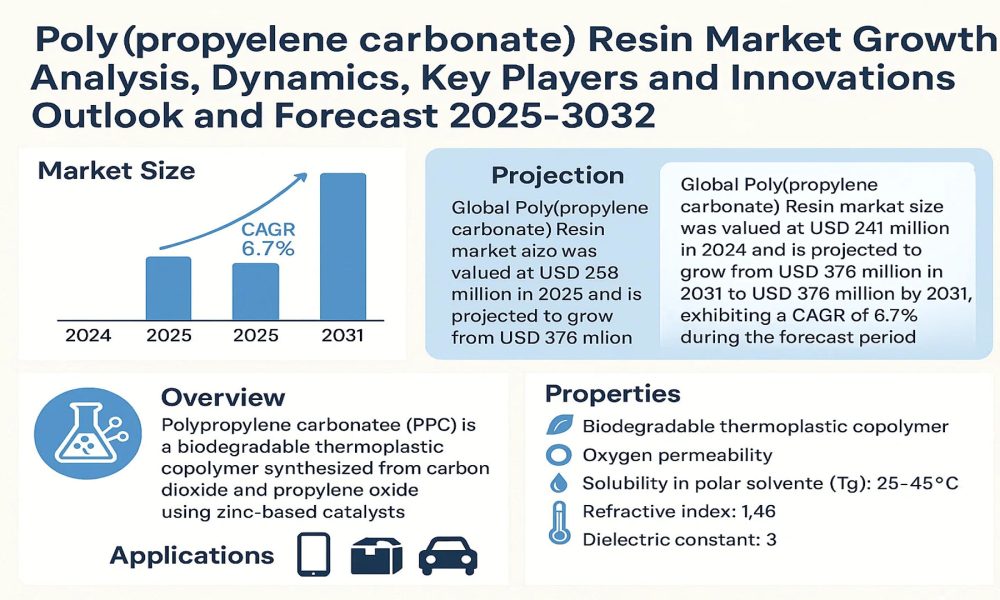
Global Poly(propylene carbonate) Resin market size was valued at USD 241 million in 2024 and is projected to grow from USD 258 million in 2025 to USD 376 million by 2031, exhibiting a CAGR of 6.7% during the forecast period.
Polypropylene carbonate (PPC) is a biodegradable thermoplastic copolymer synthesized from carbon dioxide and propylene oxide using zinc-based catalysts. This amorphous polymer exhibits unique properties including oxygen permeability, solubility in polar solvents, and a glass transition temperature (Tg) between 25-45°C. With a refractive index of 1.46 and dielectric constant of 3, PPC finds applications across multiple industries requiring sustainable material solutions.
The market growth is driven by increasing environmental regulations promoting biodegradable plastics and expanding applications in packaging, electronics, and medical sectors. While injection molding grade PPC dominates current demand, the food contact grade segment is gaining traction due to stricter food safety standards. Key players like BASF, SK Energy, and Empower Materials are investing in production capacity expansions to meet rising demand, particularly in Asia-Pacific where China accounts for over 35% of global consumption.
Get Your Free Sample Report Today- https://www.intelmarketresearch.com/download-free-sample/10010/poly-resin-market
MARKET DYNAMICS
MARKET DRIVERS
Growing Demand for Eco-Friendly Plastics Accelerates PPC Adoption
The global push toward sustainable materials is significantly driving the poly(propylene carbonate) resin market. With increasing environmental regulations banning single-use plastics in over 60 countries, manufacturers are actively seeking biodegradable alternatives. PPC’s unique carbon dioxide-based composition makes it an attractive solution, as it reduces dependency on fossil fuels while offering comparable mechanical properties to conventional plastics. Recent data shows the biodegradable plastics market growing at over 12% annually, with PPC positioned as a key material in packaging and consumer goods applications.
Advancements in Polymer Technology Enhance Commercial Viability
Technological breakthroughs in polymerization processes have substantially improved PPC’s thermal stability and mechanical strength – critical factors that previously limited its industrial adoption. Modern catalyst systems now achieve conversion rates exceeding 90%, while optimized manufacturing processes have reduced production costs by nearly 30% since 2020. These improvements have enabled PPC to compete with traditional engineering plastics in applications ranging from automotive components to electronic housings, creating new revenue streams for market players.
Government Support for Carbon Utilization Technologies Expands Market Potential
International climate initiatives are creating favorable conditions for PPC development. Carbon capture and utilization programs in regions like North America and Europe provide substantial subsidies for technologies that convert CO2 into valuable products. The U.S. Inflation Reduction Act alone has allocated $10 billion for carbon utilization projects through 2032. These policy frameworks lower investment risks for PPC manufacturers while accelerating the technology’s path to commercial scale, particularly in markets with stringent carbon emission targets.
MARKET OPPORTUNITIES
Expansion in Medical Device Packaging Offers High-Growth Potential
The healthcare sector presents promising opportunities as hospitals seek sustainable alternatives to PVC-based medical packaging. PPC’s excellent gas barrier properties and sterilization compatibility make it ideal for packaging sensitive medical devices and pharmaceuticals. With the global medical packaging market projected to exceed $50 billion by 2027, even modest penetration could generate significant demand. Recent partnerships between PPC producers and medical device manufacturers indicate growing recognition of these applications.
Circular Economy Initiatives Create New Value Propositions
Corporate sustainability commitments are driving demand for closed-loop material solutions. Major brands have pledged to incorporate 30-50% recycled or renewable content in packaging by 2030, creating opportunities for PPC as both a virgin material and as a component in advanced recycling systems. The material’s chemical recyclability through depolymerization processes offers distinct advantages in circular economy models, particularly in regions implementing extended producer responsibility regulations.
Emerging Applications in 3D Printing Expand Market Horizons
The rapid growth of additive manufacturing presents novel opportunities for specialized PPC formulations. Recent developments in fused deposition modeling (FDM) filaments demonstrate PPC’s potential as a sustainable alternative to ABS in prototyping and functional part production. The material’s low warpage characteristics and post-processing versatility make it particularly suitable for complex geometries, opening doors in aerospace, automotive, and consumer product design applications.
Poly(propylene carbonate) Resin Market Segment Analysis:
By Type
- Injection Molding Grade
- Food Contact Grade
Injection Molding Grade leads the market due to its wide application in manufacturing biodegradable plastic products with high durability.
By Application
- Biodegradable Plastics
- Electronics
- Packaging
- Medical Devices
Biodegradable Plastics remains the dominant application segment, driven by increasing regulatory support and consumer preference for sustainable materials.
By Region
- North America
- Europe
- Asia-Pacific
- Rest of the World
Asia-Pacific holds the largest market share, fueled by strong industrial growth, government initiatives, and increasing environmental awareness.
List of Key Poly(propylene carbonate) Resin Companies
- Tianguan Group (China)
- Jiangsu Zhongke Jinlong-cas Chemical (China)
- SK Energy (South Korea)
- BASF SE (Germany)
- Empower Materials (U.S.)
- Novomer (U.S.)
- Cardia Bioplastics (Australia)
- Inner Mongolia Mengxi High-Tech (China)
This competitive landscape continues to evolve as companies increasingly prioritize circular economy principles. Recent capacity expansions by Chinese manufacturers reflect the region’s growing dominance in raw material production, while Western companies are focusing on value-added specialty grades to maintain profitability. The market’s projected 6.7% CAGR through 2031 will likely spur further R&D investments and strategic partnerships across the value chain.
POLY(PROPYLENE CARBONATE) RESIN MARKET TRENDS
Sustainability and Innovation Driving Growth in the PPC Resin Market
The global poly(propylene carbonate) (PPC) resin market is experiencing significant growth, driven by increasing awareness of sustainable materials and the shift toward biodegradable plastics. With environmental regulations tightening worldwide, industries are actively seeking alternatives to conventional petroleum-based plastics. PPC resin, synthesized from carbon dioxide and propylene oxide, presents a carbon-negative production process, making it a compelling solution. The market was valued at $241 million in 2024 and is projected to reach $376 million by 2031, growing at a CAGR of 6.7%. Innovations in catalytic polymerization, such as the use of zinc glutarate, have improved resin quality and scalability, further propelling industry adoption.
Other Trends
Expansion in Biodegradable Packaging
The demand for biodegradable packaging solutions is accelerating the adoption of PPC resins in food packaging, agricultural films, and disposable products. PPC’s ability to degrade under natural conditions without leaving harmful residues aligns with global sustainability initiatives. Recent developments in food-contact-grade PPC resins have widened applications in single-use cutlery, containers, and beverage packaging. With packaging contributing to nearly 40% of plastic waste globally, PPC-based solutions are emerging as a viable alternative, supported by government bans on conventional plastics in regions like Europe and North America.
Growing Industrial Applications Beyond Plastics
PPC resins are finding new applications beyond traditional plastics, including adhesives, coatings, and electronics. Their high gas permeability and dielectric properties make them suitable for protective films in lithium-ion batteries and flexible electronics. The electronics segment is expected to witness a growth rate exceeding 8% annually, driven by advancements in wearable technology and energy storage solutions. Additionally, PPC’s compatibility with other polymers enables hybrid material development, enhancing mechanical performance while retaining biodegradability a key factor for industries balancing functionality and environmental responsibility.
Recent Developments in the Poly(propylene carbonate) (PPC) Resin Market:
- Rising Demand for Biodegradable Polymers
With increasing restrictions on single-use plastics, PPC resin has gained attention as an eco-friendly alternative. Manufacturers are enhancing production capacity to meet the growing demand for biodegradable plastics in packaging, agriculture, and consumer goods. - Strategic Collaborations & Joint Ventures
Leading companies have entered partnerships to expand the application scope of PPC resins. For example, collaborations between resin producers and packaging companies are enabling the development of compostable films and bags with better strength and heat resistance. - Technological Advancements in Polymerization
Recent R&D efforts focus on improving the catalytic process for PPC production. This innovation enhances molecular weight control, mechanical strength, and thermal stability, making PPC suitable for industrial applications like adhesives, foams, and coatings. - Integration with Carbon Capture Utilization (CCU) Technology
PPC production directly utilizes carbon dioxide, aligning with carbon reduction strategies. Many chemical companies are investing in CO₂-based polymers to meet sustainability goals and reduce greenhouse gas emissions. This has boosted the visibility of PPC resins as part of the circular economy. - Regulatory Support and Green Certifications
Government policies in regions such as Europe, China, and North America are supporting bio-based materials through subsidies, tax incentives, and plastic bans. Several PPC resin products have recently received certifications for industrial compostability, improving their acceptance in global markets. - Expansion in 3D Printing and Electronics
Beyond packaging, PPC resins are being tested in additive manufacturing and electronic components due to their biodegradability, flexibility, and dielectric properties. This diversification is opening new revenue streams for resin producers.
Get Your Free Sample Report Today- https://www.intelmarketresearch.com/download-free-sample/10010/poly-resin-market
About Intel Market Research
Intel Market Research delivers actionable insights in technology and infrastructure markets. Our data-driven analysis leverages:
- Real-time infrastructure monitoring
- Techno-economic feasibility studies
Competitive intelligence across 100+ countries
Trusted by Fortune 500 firms, we empower strategic decisions with precision.
International: +1(332) 2424 294 | Asia: +91 9169164321
Website: https://www.intelmarketresearch.com
Follow us on LinkedIn: https://www.linkedin.com/company/intel-market-research
Market Research Reports | Market Trends | SWOT Analysis | Industrial Survey – Intelmarketresearch
Intel market research provides market research reports and company research reports across worldwide industries. We also offers customized market research solutions




