Definition
The Global Transparent Anti-Reflective Film Market consists of specialized optical films designed to reduce surface reflections and maximize light transmission across various display and optical devices. These films employ multilayer interference technology, typically composed of alternating layers of high and low refractive index materials, achieving reflection rates as low as 0.5% across the visible light spectrum.
Key Features and Applications:
- Minimized glare and enhanced optical clarity
- Improved touch sensitivity for interactive displays
- Durable, ultra-thin coatings (<100nm) with optional anti-fingerprint or self-cleaning properties
Primary End-Use Applications Include:
- Consumer electronics: Smartphones, tablets, laptops
- Automotive electronics: Digital dashboards, heads-up displays (HUDs)
- Industrial displays and optical instruments
- Architectural and solar applications
The films are crucial for applications where high optical performance is mandatory, such as premium mobile devices, automotive infotainment systems, and advanced displays used in aerospace or medical devices. Key innovations involve hybrid coatings combining anti-reflective and anti-fingerprint functionalities and flexible films for curved or foldable display technologies.
Market Size
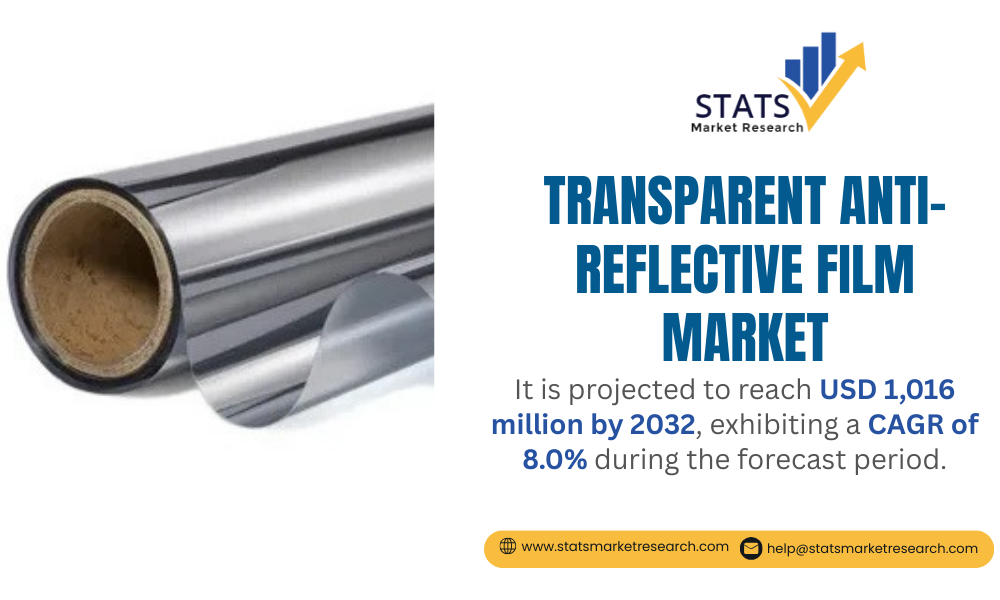
Global Transparent Anti-Reflective Film Market was valued at USD 625 million in 2024 and is projected to reach USD 1,016 million by 2032, growing at a CAGR of 8.0% during the forecast period.
Download FREE Sample of this Report @ https://www.statsmarketresearch.com/download-free-sample/8060215/global-transparent-antireflective-film-forecast-market
Market Insights and Historical Trends
- Consumer Electronics Dominance: Smartphone display shipments are expected to exceed 1.5 billion units annually by 2025, with anti-reflective films incorporated in over 70% of flagship models.
- Automotive Growth: Digital dashboards and HUDs are now standard in over 60% of new vehicles, with each vehicle using 4-6 anti-reflective film applications.
- Flexible and Foldable Displays: Advancements in flexible film technology allow application on curved screens and foldable devices, driving new market growth.
- Technological Innovation: Ultra-thin films with enhanced durability and self-cleaning capabilities are becoming industry standard, especially in premium electronics and automotive sectors.
The market’s projected expansion reflects the ongoing integration of AR/VR, foldable displays, and automotive infotainment growth, alongside steady adoption in industrial and architectural applications.
Market Dynamics (Drivers, Restraints, Opportunities, and Challenges)
Drivers
- Growing Demand for High-Quality Displays:
- Anti-reflective films enhance visual clarity and touch sensitivity, critical for smartphones, tablets, and premium laptops.
- Over 70% of high-end smartphones now incorporate these films.
- The films support glare reduction, enabling better viewing experiences under bright ambient light.
- Automotive Sector Growth:
- Rising adoption of digital dashboards, HUDs, and touchscreens in vehicles.
- Films reduce driver eye strain and maintain visibility under varying light conditions.
- Adoption projected to grow 12% annually through 2030, driven by increased integration of anti-fingerprint properties.
- Flexible and Wearable Electronics:
- Advancements in flexible film production enable curved and foldable displays, opening opportunities in wearables, automotive, and consumer electronics.
- Partnerships between leading manufacturers and smartphone brands are accelerating specialty film adoption.
Restraints
- High Production Costs:
- Multi-layer optical film production requires specialized coating equipment and cleanroom facilities, with setup costs often exceeding $50 million.
- This restricts market entry for smaller manufacturers and limits affordability in cost-sensitive segments.
- Material Compatibility Issues:
- Films must maintain optical properties across glass, plastic, or hybrid substrates.
- Thermal expansion differences can cause delamination, particularly in automotive applications.
- Performance Trade-offs:
- Achieving ideal anti-reflective performance can compromise scratch resistance or hydrophobic properties, forcing manufacturers to balance optical and mechanical characteristics.
Challenges
- Competition from Alternative Technologies:
- Emerging nano-texturing techniques offer similar anti-reflective properties without extra film layers.
- Though currently less than 15% of the market, these alternatives threaten material-based film adoption.
- Supply Chain Vulnerabilities:
- Specialty chemicals for film production are prone to long lead times (over six months during peak demand).
- Disruptions can affect consistent product delivery, particularly for high-volume electronics manufacturers.
- Environmental Regulations:
- Stricter chemical regulations require costly reformulations and may increase production expenses by 5-7%.
Opportunities
- Renewable Energy Applications:
- Solar panels can achieve 8-12% improved photovoltaic efficiency with anti-reflective films.
- Durable outdoor-grade films resistant to UV exposure are under development, aligning with the 10% annual growth in global solar capacity.
- Self-Cleaning and Anti-Microbial Films:
- Films with photocatalytic self-cleaning reduce maintenance for architectural glass and public displays.
- Early adopters in digital signage report 30% reduction in cleaning frequency.
- Post-pandemic healthcare and transportation sectors are exploring anti-microbial coatings.
- Foldable and Flexible Display Growth:
- Rising demand for flexible consumer electronics offers opportunities for bendable, durable films.
- Partnerships with major smartphone manufacturers are driving next-generation specialty film adoption.
Get the Complete Report & TOC @ https://www.statsmarketresearch.com/global-transparent-antireflective-film-forecast-market-8060215
Regional Analysis
- North America: Strong adoption in consumer electronics and automotive HUDs.
- Europe: Focused on premium automotive dashboards and industrial displays.
- Asia-Pacific: Dominant market due to electronics manufacturing hubs, automotive growth, and regional production capacity expansion.
- Japan & South Korea: High adoption in display panel and electronics manufacturing, with local players leading innovation.
- Rest of the World: Emerging markets showing gradual adoption due to growing electronics penetration and infrastructure development.
Competitor Analysis (in brief)
- 3M Company (U.S.): Diversified portfolio with strong multi-layer optical film capabilities; expanded production in Asia to meet growing demand.
- Mitsubishi Chemical Corporation (Japan): Ultra-thin coatings with 99% light transmittance, advanced nanotechnology integration.
- Toppan Printing Co., Ltd. (Japan): Strategic partnerships with South Korean display manufacturers; strong supply chain efficiency.
- Daicel Corporation (Japan): Automotive-grade films designed for extreme temperatures.
- Dexerials Corporation (Japan): Specialized flexible films for foldable displays.
- NOF Corporation (Japan): Focused on augmented reality and specialized optical films.
- Regional players like Diamond Coatings Inc. (U.S.) and Shincron (Asia) compete via customized solutions and rapid prototyping.
The market emphasizes innovation, sustainability, and application-specific differentiation as key competitive factors.
Global Transparent Anti-Reflective Film Market: Market Segmentation Analysis
This report provides a deep insight into the global Transparent Anti-Reflective Film Market, covering all its essential aspects. This ranges from a macro overview of the market to micro details of the market size, competitive landscape, development trend, niche market, key market drivers and challenges, SWOT analysis, value chain analysis, etc.
The analysis helps the reader to shape the competition within the industries and strategies for the competitive environment to enhance the potential profit. Furthermore, it provides a simple framework for evaluating and assessing the position of the business organization. The report structure also focuses on the competitive landscape of the Global Transparent Anti-Reflective Film Market. This report introduces in detail the market share, market performance, product situation, operation situation, etc., of the main players, which helps the readers in the industry to identify the main competitors and deeply understand the competition pattern of the market.
In a word, this report is a must-read for industry players, investors, researchers, consultants, business strategists, and anyone planning to enter the transparent anti-reflective film market.
Market Segmentation (by Application)
- Consumer Electronics
- Smartphones, Tablets, Laptops, Others
- Automotive Electronics
- Industrial Displays
- Optical Instruments
Market Segmentation (by Type)
- Low Reflection (LR) Film
- Subtypes: Single-layer, Multi-layer, Hybrid
- Antiglare (AG) Film
Key Company
- 3M Company (U.S.)
- Mitsubishi Chemical Corporation (Japan)
- Toppan Printing Co., Ltd. (Japan)
- Daicel Corporation (Japan)
- Diamond Coatings Inc. (U.S.)
- Pro Display (UK)
- NOF CORPORATION (Japan)
- GEOMATEC Co., Ltd. (Japan)
- Shincron Co., Ltd. (Japan)
- Dexerials Corporation (Japan)
- E3Displays (Taiwan)
- Reiko Co., Ltd. (Japan)
Geographic Segmentation
- North America
- Europe
- Asia-Pacific
- Japan
- South Korea
- Rest of the World
FAQ Section
- What is the current market size of the Transparent Anti-Reflective Film Market?
- The market was valued at USD 625 million in 2024 and is projected to reach USD 1,016 million by 2032, growing at a CAGR of 8.0%.
- Which are the key companies operating in the Transparent Anti-Reflective Film Market?
- 3M, Mitsubishi Chemical Corporation, Toppan Printing, Daicel Corporation, NOF CORPORATION, Dexerials, Diamond Coatings Inc., Pro Display, Shincron, GEOMATEC Co., Ltd., E3Displays, and Reiko Co., Ltd.
- What are the key growth drivers in the Transparent Anti-Reflective Film Market?
- Rising consumer electronics adoption, automotive digital dashboards and HUDs, and innovations in flexible and self-cleaning films drive growth.
- Which regions dominate the Transparent Anti-Reflective Film Market?
- Asia-Pacific, North America, and Europe dominate due to electronics manufacturing hubs, automotive adoption, and display technology growth.
- What are the emerging trends in the Transparent Anti-Reflective Film Market?
- Emerging trends include self-cleaning and anti-microbial films, flexible/foldable display applications, hybrid anti-reflective coatings, and solar panel efficiency enhancement.
About Us
☎️ International: +1 (332) 2424 294
📄 Website: www.statsmarketresearch.com
Join us on LinkedIn:- https://www.linkedin.com/company/statsmarketresearch




