
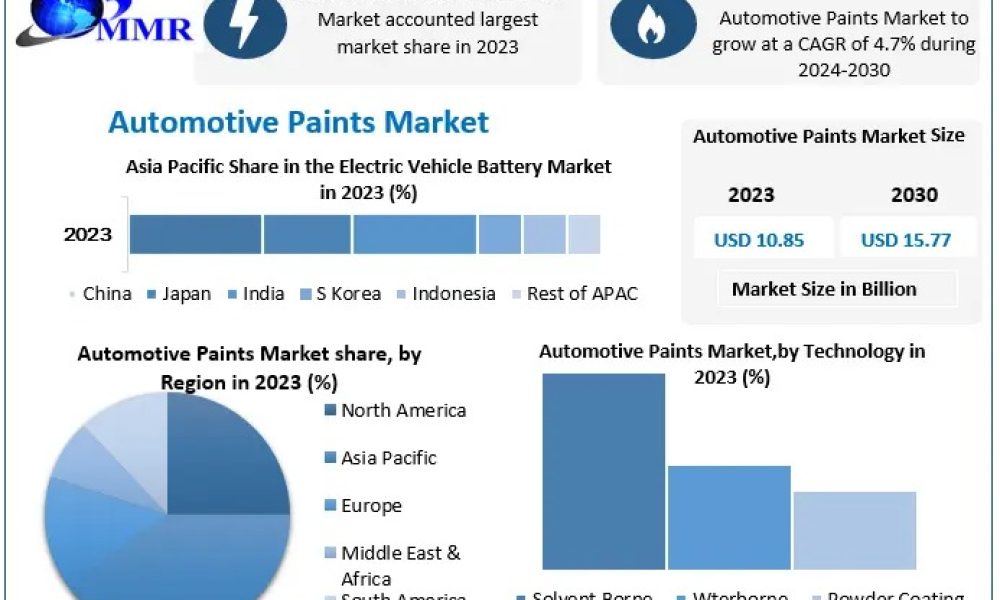
Automotive Paints Market is experiencing sustained growth, driven by ongoing vehicle production, rapidly evolving consumer preferences, technological advancements, and tightening environmental regulations. Valued at approximately USD 10.85 billion in 2023, the market is projected to reach nearly USD 15.77 billion by 2030, growing at a compound annual rate of around 4.7 percent through the forecast period.
Automotive Paints Market Overview
Automotive paint is essential for both protection and aesthetics, with specialized formulations enhancing vehicle durability, surface longevity, and visual appeal. The market is undergoing a transformation marked by a surge in eco-friendly and water-based paints, self-healing coatings, and anti-scratch technologies. Sustainability has come to the forefront, driving manufacturers and automakers to reduce emissions and energy consumption across their painting processes.
Key Highlights
- Market size in 2023: USD 10.85 billion
- Forecast size for 2030: USD 15.77 billion
- Expected CAGR: Approximately 4.7 percent
- Dominant region: Asia Pacific, due to high vehicle production and rapid economic development
- Leading segment: Clear coat for superior protection, durability, and aesthetics
Market Drivers and Opportunities
Industry Expansion
Growth of the automotive industry directly boosts demand for paints and coatings. Global car sales continue to rise, supported by urbanization, improved living standards, and expanding transportation infrastructure. This surge in vehicle production fuels parallel increases in the requirement for specialized coatings.
Technological Innovation
Major auto manufacturers are advancing self-healing, high-performance, and anti-scratch solutions. These technologies extend the life of automotive finishes and allow for better consumer satisfaction and reduced maintenance costs. Waterborne and powder coatings reduce volatile organic compound (VOC) emissions, aligning with environmental mandates.
Customization and Personalization
Consumers increasingly seek customization options, including unique colors, textures, and finishes. This trend drives automakers to diversify paint offerings and integrate advanced color-matching technologies, digital design, and smart coating features that adapt to evolving consumer tastes.
Electric Vehicle Demand
Rising demand for electric vehicles presents significant opportunity. EVs require specialty coatings for lightweight composites and unique substrates. Manufacturers are designing paints to reduce aerodynamic drag and enhance battery efficiency, driving new research and product development.
Market Restraints
The push for sustainable practices has increased the stringency of environmental regulations worldwide, compelling manufacturers to invest in low-VOC, water-based, and eco-friendly solutions. Transitioning to greener paints often increases production costs and may require upgrades to existing paint infrastructure. The move toward electric vehicles, which generally utilize less paint, may also temper growth.
Segment Analysis
By Coating Type
- Clear coat dominates due to its key protective benefits, preserving color integrity and surface quality.
- Base coat and primer remain crucial for adhesion, corrosion resistance, and base color application.
- Electrocoat gains popularity for its efficiency and uniform protection in large-scale manufacturing.
By Resin Type
Polyurethane coatings are rising in dominance, offering superior abrasion resistance and anti-scratch performance. Polyurethane’s weather, UV, and chemical resistance cater to high-end, luxury vehicles and regions with harsh climates.
By Technology
Waterborne coatings lead in market share, preferred for environmental safety, chemical resistance, and lower temperature processing. Powder coatings and solvent-borne technologies remain relevant in specific applications due to their film thickness control and finish characteristics.
Regional Insights
Asia Pacific is the largest and fastest-growing region for automotive paints, bolstered by its expansive automotive manufacturing sector in countries such as China and India. The rising middle-class population and preference for personalized vehicles support demand for diverse paint colors and finishes. Regional governments promote automotive industry growth through supportive policies and incentives.
North America and Europe also contribute significantly to market growth, focusing on sustainability initiatives, premium vehicle production, and technological innovation in paint and coating solutions. Producers in these regions respond to consumer trends for durability, customization, and eco-friendliness.
Competitive Landscape and Key Players
Companies compete based on technology, product excellence, portfolio diversity, and global reach. Strategic partnerships, mergers, and acquisitions frequently occur as firms expand their reach and respond to changing demand. Leading players include Nippon Paint Group, Sherwin-Williams, PPG, AkzoNobel, Axalta, BASF, Kansai Paint, Asian Paints, and Jotun.
Trends Shaping the Market
Innovation in coatings—such as self-healing, digital color matching, and bi-functional protection—enhances manufacturer and consumer experience. The focus on sustainability drives the adoption of waterborne and zero-VOC solutions. Rapid advances in smart coatings and surface protection technologies support new vehicle designs and longer-lasting finishes.
Future Perspective
The global automotive paints market remains integral to the transformation of automotive aesthetics and protection. As environmental and technological priorities continue to shift, manufacturers and automakers will benefit by adopting sustainable, high-performance solutions and responding to consumer demand for personalization and innovation.




