
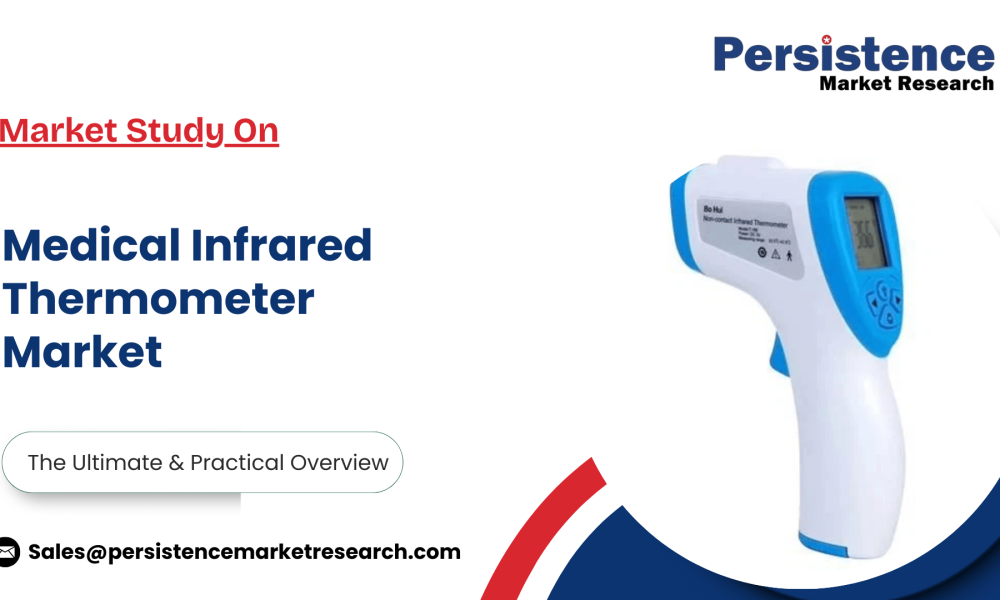
The medical infrared thermometer market has witnessed significant growth over the past decade, driven primarily by the demand for non-contact temperature measurement tools in healthcare and related sectors. As the need for rapid, accurate, and hygienic temperature monitoring rises, especially in the wake of global health challenges such as the COVID-19 pandemic, the medical infrared thermometer market is positioned for robust expansion. According to Persistence Market Research, this market is projected to reach a value of US$ 1,386.1 million by 2032, growing at a CAGR of 6.6% from 2025 onwards. This article explores the detailed dynamics, market segmentation, key players, regional insights, drivers, restraints, and opportunities shaping the future of this vital industry.
Overview of the Market
Medical infrared thermometers are devices designed to measure body temperature without direct contact, using infrared sensors to detect thermal radiation from the forehead or other measurement points. The growing emphasis on infection prevention and the adoption of contactless screening techniques in healthcare facilities have propelled the demand for these devices. Additionally, advancements in technology such as IoT integration and artificial intelligence have enhanced the precision and usability of medical infrared thermometers, making them indispensable for both professional and home healthcare settings.
The market’s growth is supported by surging applications in pediatrics, hospitals, and home healthcare, with leading product types like forehead thermometers capturing the majority share. North America currently leads the market owing to its well-established healthcare infrastructure and innovation in medical device technology, while Asia Pacific is emerging rapidly due to increased research and development investments and growing healthcare awareness.
Market Statistics and Key Growth Drivers
As per Persistence Market Research, the global medical infrared thermometer market is expected to grow from an estimated US$ 886.1 million in 2025 to US$ 1,386.1 million by 2032. This impressive growth is underpinned by factors such as the need for quick and reliable temperature measurement tools, especially amid rising infectious disease prevalence, and growing consumer awareness around health monitoring. The COVID-19 pandemic significantly accelerated demand as hospitals and public spaces adopted thermal screening to curb virus transmission.
Forehead thermometers, due to their ease of use and accuracy, are projected to hold 59% of the market share in 2025. North America dominates the regional market with 33% share, backed by strong innovation ecosystems, smart thermometer integration, and high healthcare spending. Asia Pacific’s rapid adoption, particularly in India, stems from expanding healthcare infrastructure and government initiatives to bolster public health surveillance.
Get a Sample Copy of Research Report (Use Corporate Mail id for Quick Response): https://www.persistencemarketresearch.com/samples/35102
Key Highlights from the Report:
• Widespread adoption of contactless temperature screening in healthcare is driving market growth.
• Demand for home healthcare devices is boosting consumer purchases of medical-grade infrared thermometers.
• Smart features and Bluetooth connectivity facilitate temperature data tracking and healthcare app integration.
• Workplace safety protocols are increasing demand in professional and industrial settings.
• Medical applications account for 64% of the market share due to their effectiveness in infection control.
• North America and Asia Pacific lead the market, driven by technological advances and healthcare investments.
Market Segmentation:
The medical infrared thermometer market is segmented primarily by product type and end-user applications. Based on product types, the market includes forehead thermometers, ear thermometers, and handheld infrared thermometers. Forehead thermometers dominate due to their non-invasive nature and rapid measurement capabilities, making them particularly suitable for hospitals, clinics, and home use. Ear thermometers and other handheld devices also have niche applications in pediatrics and professional healthcare environments.
By end-user, the market is divided into medical, industrial, and consumer applications. The medical segment commands the largest share, driven by hospitals, clinics, and outpatient centers requiring efficient infection control solutions. Industrial applications are gaining momentum for surface temperature monitoring in manufacturing and food safety. Consumer demand for personal health monitoring, especially in homecare and telemedicine, is growing due to rising health awareness and technological advances such as AI and Bluetooth-enabled thermometers.
Regional Insights:
North America holds a dominant position in the medical infrared thermometer market, accounting for around 33% of the global share in 2025. This leadership is largely due to strong healthcare infrastructure, rapid adoption of innovative medical devices, and the presence of leading manufacturers like Fluke Corporation and FLIR Systems. The integration of smart features into medical thermometers further supports North America’s robust growth trajectory.
Asia Pacific is expected to emerge as the fastest-growing regional market, projected to hold 29% of the market share in 2025. Countries like India are experiencing rapid healthcare development and increased R&D investments, fostering demand for reliable temperature measurement solutions. Companies such as Omron Healthcare and Braun are tailoring their products to meet regional needs, helping drive market expansion in this part of the world.
Market Drivers:
The medical infrared thermometer market is primarily driven by the increasing need for non-contact temperature measurement methods, spurred by infection control concerns and heightened awareness due to the COVID-19 pandemic. Pediatric healthcare evolution, emphasizing contactless and pain-free methods for children, has significantly contributed to this trend. The American Academy of Pediatrics’ recommendation for non-contact temperature measurements underscores this shift.
Technological advancements also fuel growth, with the incorporation of AI and IoT enabling real-time data collection and predictive health insights. Products like Omron’s AI-powered infrared thermometers illustrate how innovations enhance diagnostic accuracy and early detection capabilities, thus increasing adoption in both clinical and home settings.
Market Restraints
Despite positive growth trends, the market faces challenges related to accuracy and device limitations. Infrared thermometers struggle with crowd scanning due to lack of precise mass screening capabilities, impacting their use in public settings. Consumer-grade devices often fall short of clinical accuracy standards, leading to reduced trust and lower adoption in professional environments.
Regulatory pressures, particularly new FDA guidelines, have increased production costs by about 25%, which poses challenges for smaller manufacturers. Post-pandemic saturation has also led to price competition and inventory surpluses, forcing many players to focus on premium, medical-grade products to maintain profitability.
Market Opportunities
Government regulations promoting public health infrastructure offer substantial growth opportunities. WHO’s recommendations on rapid temperature screening and public health monitoring have spurred investments in advanced thermal scanning systems in airports, transit hubs, and public buildings. For example, Delta Airlines’ US$ 100 million investment in thermal scanning at major airports highlights this trend.
Hospitals and healthcare facilities are increasingly adopting infrared thermometers for fast, non-invasive fever detection, essential in managing infectious diseases. Hospital pharmacies, expected to account for 47% of market share in 2025, are significant buyers due to ease of access, brand recognition, and strategic partnerships with manufacturers.
Reasons to Buy the Report:
Comprehensive analysis of market trends and competitive landscape.
Detailed segmentation insights by product type and end-user applications.
Regional market intelligence highlighting growth opportunities.
In-depth coverage of technological advancements and their impact.
Strategic recommendations to capitalize on emerging market dynamics.
Company Insights and Recent Developments:
The medical infrared thermometer market is highly competitive, with key players focusing on innovation and geographic expansion. Leading companies include:
• Welch Allyn – A Hill-Rom Inc. Company
• Exergen Corporation
• Geratherm Medical AG
• Thermomedics, Inc.
• Microlife Corporation
• PAUL HARTMANN AG
• BPL Medical Technologies
• Contec Medical Systems Co. Ltd.
• Cardinal Health (Medtronic)
• OMRON Corporation
• Braun GmbH
• Thermo Fisher Scientific Inc.
• OMEGA Engineering Inc.
• HORIBA, Ltd.
• PCE Deutschland GmbH
Recent industry developments highlight the pace of innovation:
• In July 2024, Exergen Corporation obtained Testing and Measuring accreditation from the Government of India, enabling wider supply of its Temporal Artery Thermometers to Indian healthcare institutions.
• In January 2024, Withings launched BeamO, a multifunctional device combining ECG, oximeter, stethoscope, and thermometer, enhancing home-based health monitoring.
Frequently Asked Questions (FAQs):
• How big is the medical infrared thermometer market?
• Who are the key players in the global medical infrared thermometer market?
• What is the projected growth rate of the medical infrared thermometer market?
• What is the market forecast for medical infrared thermometers for 2032?
• Which region is estimated to dominate the medical infrared thermometer industry through the forecast period?
In conclusion, the medical infrared thermometer market is on a strong growth path fueled by technological advancements, evolving healthcare needs, and increased public health surveillance efforts. With innovations in sensor technology and smart connectivity becoming mainstream, the industry is poised to address critical challenges in infection control and temperature monitoring. Stakeholders including manufacturers, healthcare providers, and investors can leverage detailed market insights and strategic developments to capture emerging opportunities in this dynamic field.
Read Related Reports:




