
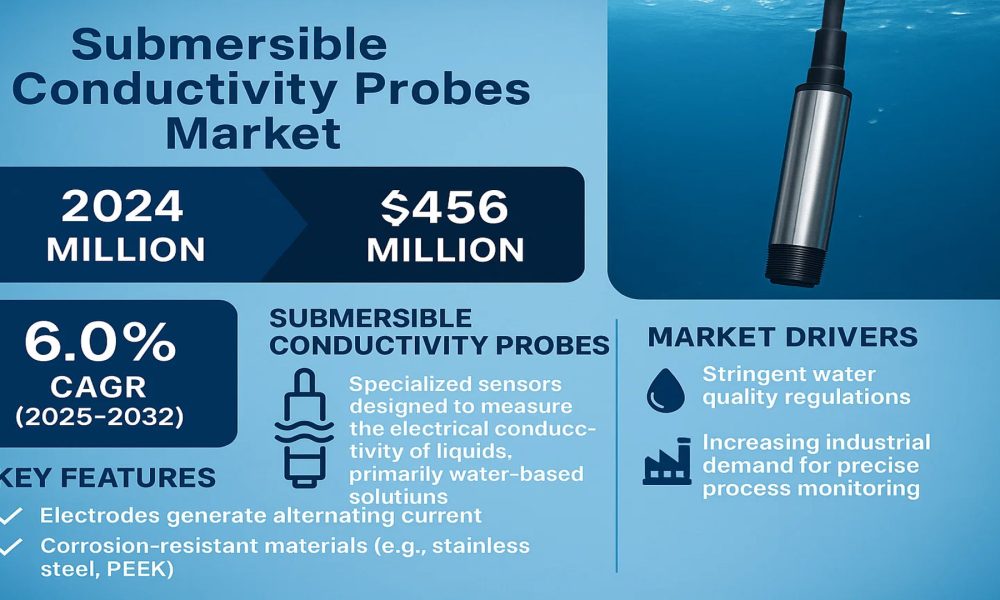
Submersible Conductivity Probes Market size was valued at US$ 287 million in 2024 and is projected to reach US$ 456 million by 2032, at a CAGR of 6.0% during the forecast period 2025-2032.
Submersible conductivity probes are specialized sensors designed to measure the electrical conductivity of liquids, primarily water-based solutions. These devices feature electrodes that generate an alternating current to assess ionic concentration, with measurements directly correlating to dissolved solids content. The probes consist of corrosion-resistant materials like stainless steel or PEEK, connected via shielded cables to monitoring equipment for real-time data acquisition.
Market growth is driven by stringent water quality regulations and increasing industrial demand for precise process monitoring. The wastewater treatment sector accounts for over 35% of probe deployments, followed by chemical processing (22%) and food & beverage industries (18%). Recent advancements include smart probes with IoT connectivity and self-cleaning electrodes, addressing challenges like biofouling in continuous monitoring applications. Key players like Emerson, HORIBA, and Hanna Instruments are expanding their portfolios with modular designs capable of measuring multiple parameters including temperature and pH alongside conductivity.
Claim Your Free Sample Report-https://semiconductorinsight.com/download-sample-report/?product_id=107180
MARKET DRIVERS
Growing Water Quality Monitoring Requirements to Fuel Submersible Conductivity Probe Demand
The global emphasis on water quality management is accelerating the adoption of submersible conductivity probes across multiple industries. With increasing industrial pollution and stricter environmental regulations, real-time water quality monitoring has become essential. The wastewater treatment sector alone contributes over 35% of the total demand for these probes, as they provide crucial conductivity measurements indicating dissolved solids concentration. Municipal water treatment plants are rapidly modernizing their infrastructure, with conductivity monitoring systems becoming standard for process control and regulatory compliance.
Industrial Automation Trends to Drive Market Expansion
Industry 4.0 initiatives are transforming process industries through automation, creating significant demand for smart monitoring solutions like submersible conductivity probes. Pharmaceutical manufacturing, which requires precise water quality control throughout production cycles, has seen a 28% increase in conductivity probe adoption over the past three years. These digital sensors integrate seamlessly with SCADA and DCS systems, enabling automated process adjustments that improve efficiency and product consistency. The food and beverage industry particularly benefits from hygienic probe designs that maintain product quality while meeting sanitation standards.
Technological Advancements in Sensor Design to Accelerate Adoption
Manufacturers are innovating probe designs to overcome traditional limitations, with newer models offering 25% longer lifespans and 15% better accuracy compared to previous generations. Features like titanium housings, PTFE cables, and modular designs now dominate premium product lines. Recent developments in multi-parameter sensors combining conductivity with pH, ORP, and temperature measurements are reducing installation complexity while providing comprehensive water quality data. Such innovations make the probes more valuable for critical applications like semiconductor manufacturing where ultrapure water monitoring is essential.
Recent Developments in the Submersible Conductivity Probes Market:
- Integration with IoT and Cloud Platforms: Manufacturers are increasingly embedding smart sensors with IoT compatibility, enabling real-time conductivity data monitoring in water treatment and environmental applications.
- Advancement in Sensor Accuracy: New probes are being developed with higher precision and stability to provide reliable data even in extreme conditions like wastewater plants, aquaculture, and marine research.
- Miniaturization and Portability: Compact and lightweight probe designs are gaining traction, making them easier to deploy for field research and on-site monitoring.
- Material Innovation: Use of corrosion-resistant and biofouling-resistant materials, such as titanium and advanced polymers, has improved the durability and longevity of submersible conductivity probes.
- Rising Adoption in Aquaculture and Hydrology: With growing concerns over water quality management, these probes are being widely deployed in aquaculture farms, rivers, and groundwater monitoring projects.
- Strategic Collaborations: Leading sensor manufacturers are partnering with environmental monitoring companies and water treatment solution providers to enhance integrated monitoring systems.
MARKET OPPORTUNITIES
Emerging Economies to Offer Significant Growth Potential
Developing nations present substantial opportunities as they invest in water infrastructure and industrial modernization. Countries implementing smart city initiatives are incorporating advanced water monitoring systems, with projected growth rates exceeding 15% annually in these regions. The Asia Pacific market alone is expected to account for 45% of new installations by 2030, driven by rapid industrialization and environmental awareness.
Additional Opportunities
Expansion of Aquaculture Industry
The growing aquaculture sector requires precise water quality monitoring, creating demand for durable marine-grade conductivity probes. Saltwater applications now represent one of the fastest-growing segments.
Development of IoT-Enabled Solutions
Wireless conductivity probes with cloud connectivity enable remote monitoring across distributed facilities. This innovation is proving particularly valuable for environmental monitoring networks and decentralized water systems.
Claim Your Free Sample Report-https://semiconductorinsight.com/download-sample-report/?product_id=107180
List of Key Submersible Conductivity Probe Manufacturers
- Emerson Electric Co. (U.S.)
- HORIBA, Ltd. (Japan)
- Hanna Instruments, Inc. (U.S.)
- AMETEK, Inc. (U.S.)
- Van London-Phoenix Company (U.S.)
- AquaMetrix (U.S.)
- Turtle Tough (Australia)
- Seametrics (U.S.)
- pHionics Inc. (U.S.)
- Greenspan Technology Pty Ltd (Australia)
- Observator Instruments (Netherlands)
- PMC-Sierra (Canada)
Segment Analysis:
By Type
Stainless Steel Probes Lead the Market Due to Superior Corrosion Resistance and Durability
The market is segmented based on type into:
- Stainless Steel
- Subtypes: 316L, 304, Titanium-coated, and others
- PEEK (Polyether ether ketone)
- Others
- Subtypes: PVDF, PTFE, and specialty composites
By Application
Chemical Industry Segment Dominates with High Utilization in Process Monitoring and Control
The market is segmented based on application into:
- Chemical Industry
- Bio-pharmacy
- Food & Beverage
- Paper Industry
- Metallurgical Industry
- Others
By Measurement Range
Wide-Range Probes Gain Traction for Multi-Purpose Industrial Applications
The market is segmented based on measurement range into:
- Low Range (0-200 µS/cm)
- Medium Range (200-20,000 µS/cm)
- High Range (Above 20,000 µS/cm)
By End User
Industrial Sector Accounts for Major Adoption Due to Strict Process Control Requirements
The market is segmented based on end user into:
- Industrial Manufacturing
- Water Treatment Plants
- Research Laboratories
- Environmental Monitoring Agencies
- Others
Other Topic-IoT Cold Chain Temperature Monitoring Devices Market
CONTACT US:
City vista, 203A, Fountain Road, Ashoka Nagar, Kharadi, Pune, Maharashtra 411014
[+91 8087992013]




