
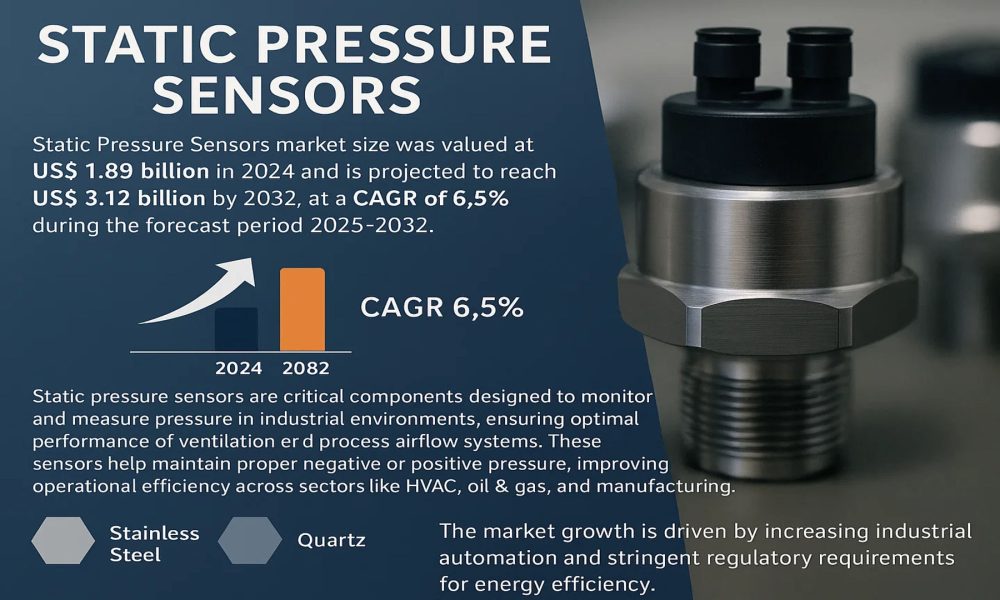
Static Pressure Sensors Market size was valued at US$ 1.89 billion in 2024 and is projected to reach US$ 3.12 billion by 2032, at a CAGR of 6.5% during the forecast period 2025-2032.
Static pressure sensors are critical components designed to monitor and measure pressure in industrial environments, ensuring optimal performance of ventilation and process airflow systems. These sensors help maintain proper negative or positive pressure, improving operational efficiency across sectors like HVAC, oil & gas, and manufacturing. Key variants include stainless steel, quartz, and other specialized materials, each offering distinct advantages for different applications.
The market growth is driven by increasing industrial automation and stringent regulatory requirements for energy efficiency. While traditional wired sensors dominate, emerging wireless and MEMS-based technologies are gaining traction due to advantages like reduced maintenance costs and enhanced precision. Major players like Honeywell, Siemens, and Schneider Electric are investing in smart sensor technologies, including AI-enabled self-calibration features, to strengthen their market position.
Claim Your Free Sample Report-https://semiconductorinsight.com/download-sample-report/?product_id=107182
MARKET DYNAMICS
MARKET DRIVERS
Industrial Automation and Smart Manufacturing to Accelerate Static Pressure Sensor Adoption
The rapid advancement of Industry 4.0 and industrial automation is significantly driving demand for static pressure sensors across manufacturing sectors. These sensors play a critical role in maintaining optimal pressure conditions in automated production lines, HVAC systems, and process control applications. The global industrial automation market is growing at a compound annual growth rate of nearly 8%, creating substantial opportunities for pressure sensing technologies. Modern static pressure sensors with digital outputs and IoT connectivity enable real-time monitoring and predictive maintenance, reducing downtime by up to 30% in industrial facilities.
Stringent Environmental Regulations Fuel Demand for Emission Control Systems
Increasing environmental regulations worldwide are compelling industries to implement advanced emission control systems that rely on precise pressure monitoring. Static pressure sensors are essential components in flue gas desulfurization units, catalytic converters, and scrubber systems across power plants and manufacturing facilities. Recent updates to clean air standards in major economies have driven a 15-20% annual increase in demand for high-accuracy pressure sensors capable of withstanding harsh industrial environments. The oil & gas sector alone accounts for approximately 25% of industrial pressure sensor deployments for emission monitoring applications.
Moreover, the integration of artificial intelligence with pressure monitoring systems enables predictive analysis of equipment failure and optimized energy consumption.
➤ For instance, advanced static pressure sensors can detect minute pressure fluctuations that signal impending pump failures up to 72 hours before they occur, significantly reducing maintenance costs.
Furthermore, the growing adoption of wireless sensor networks in industrial settings eliminates costly wiring installations while providing reliable pressure data across distributed systems.
Recent Developments in the Static Pressure Sensors Market:
- Integration with Smart HVAC Systems: Companies are increasingly embedding static pressure sensors into HVAC systems to enable real-time monitoring and improve energy efficiency in smart buildings.
- Automotive Industry Adoption: Rising use of static pressure sensors in electric vehicles (EVs) and advanced driver-assistance systems (ADAS) for optimizing air intake, cabin comfort, and battery cooling.
- Miniaturization and MEMS Technology: Manufacturers are focusing on compact MEMS-based static pressure sensors with higher sensitivity, lower power consumption, and better durability for industrial and consumer applications.
- IoT-Enabled Solutions: Development of wireless and IoT-compatible static pressure sensors for remote monitoring in industrial automation, cleanrooms, and environmental monitoring.
- Aerospace and Defense Applications: Growing demand in aircraft systems for monitoring air flow, cabin pressure, and engine performance, leading to specialized high-accuracy static pressure sensors.
- Sustainability Focus: Companies are launching eco-friendly, energy-efficient sensors to meet environmental standards and support green building initiatives.
MARKET OPPORTUNITIES
Emerging IIoT Applications Create New Demand for Smart Pressure Sensors
The Industrial Internet of Things (IIoT) revolution is creating substantial opportunities for next-generation static pressure sensors with embedded intelligence. Smart sensors featuring self-diagnostic capabilities, wireless connectivity, and edge computing functionality are experiencing 35% annual growth in adoption rates. These advanced units can process pressure data locally and communicate only actionable insights, reducing network bandwidth requirements by up to 70%. Major industrial equipment manufacturers are increasingly embedding these intelligent sensors directly into pumps, compressors, and turbines during production.
Renewable Energy Sector Presents Untapped Potential for Specialized Sensors
The rapid expansion of renewable energy infrastructure creates new application areas for specialized pressure sensors. Wind turbine hydraulic systems require precise pressure monitoring to optimize blade pitch control, while concentrated solar power plants need robust sensors capable of withstanding both high temperatures and thermal cycling. The hydrogen energy sector particularly demands pressure sensors with enhanced safety features for storage and transportation applications. These emerging renewable energy markets are projected to account for over 15% of total industrial pressure sensor demand within the next five years.
Claim Your Free Sample Report-https://semiconductorinsight.com/download-sample-report/?product_id=107182
List of Key Static Pressure Sensors Companies Profiled
- Siemens AG (Germany)
- Honeywell International Inc. (U.S.)
- TE Connectivity (Switzerland)
- PCB Piezotronics (U.S.)
- Schneider Electric (France)
- Kistler Group (Switzerland)
- Setra Systems (U.S.)
- Alpha Instruments (U.S.)
- Fuji Electric (Japan)
- Johnson Controls (Ireland)
- Baker Hughes (U.S.)
- Munters (Sweden)
- SAUTER (Germany)
- Phason Controls (Canada)
- TROX GmbH (Germany)
Segment Analysis:
By Type
Stainless Steel Segment Leads Due to Durability and High-Pressure Tolerance in Harsh Environments
The market is segmented based on type into:
- Stainless Steel
- Subtypes: 316L, 304, and others
- Quartz
- Silicon
- Subtypes: MEMS-based, piezoresistive, and others
- Ceramic
- Others
By Application
Oil & Gas Segment Dominates with High Demand for Pressure Monitoring in Drilling and Refining
The market is segmented based on application into:
- Oil & Gas
- Architecture (HVAC systems)
- Coal Industry
- Pharmaceutical Manufacturing
- Others
By Technology
MEMS-based Sensors Gain Traction Due to Miniaturization and Smart Industrial Applications
The market is segmented based on technology into:
- Piezoresistive
- Capacitive
- Optical
- MEMS-based
- Others
Other Topic-LCP FPCB Modules Market
CONTACT US:
City vista, 203A, Fountain Road, Ashoka Nagar, Kharadi, Pune, Maharashtra 411014
[+91 8087992013]




