
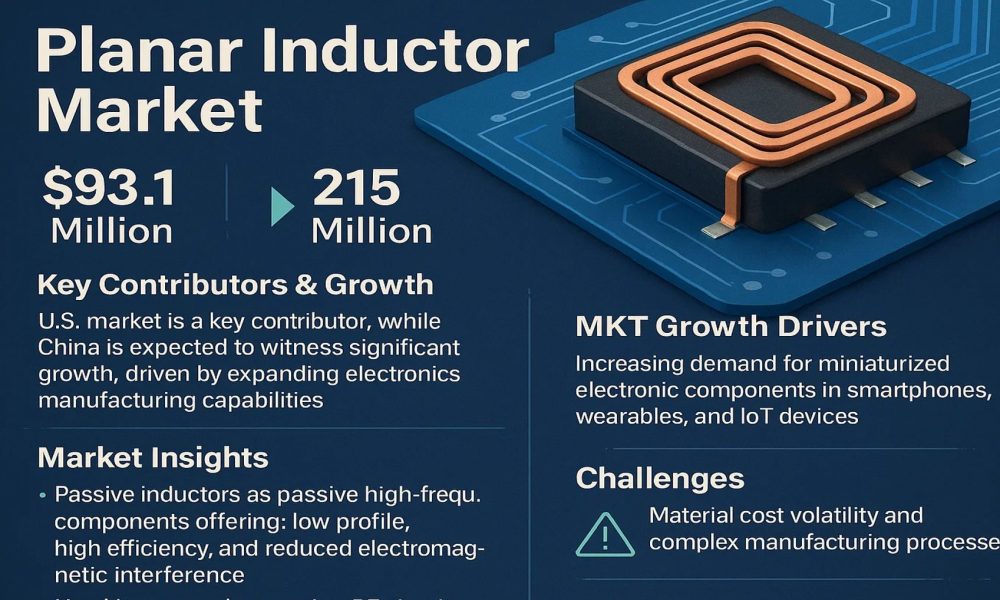
Planar Inductor Market was valued at 93.1 million in 2024 and is projected to reach US$ 215 million by 2032, at a CAGR of 13.0% during the forecast period. The U.S. market is a key contributor, while China is expected to witness significant growth, driven by expanding electronics manufacturing capabilities.
Planar inductors are passive electronic components designed for high-frequency applications, offering advantages such as low profile, high efficiency, and reduced electromagnetic interference. These inductors are widely used in power electronics, RF circuits, and filtering applications across industries like aerospace, consumer electronics, automotive, and medical devices. The inductance range of 1-4 µH represents a dominant segment, catering to compact electronic designs.
Market growth is fueled by increasing demand for miniaturized electronic components in smartphones, wearables, and IoT devices. However, challenges such as material cost volatility and complex manufacturing processes could restrain expansion. Key players like Vishay Intertechnology, Standex Electronics, and Pulse Electronics (Yageo) are investing in R&D to enhance performance and reduce footprint, further driving adoption in next-generation electronics.
Download Your Free Copy of the Sample Report-https://semiconductorinsight.com/download-sample-report/?product_id=107168
MARKET DRIVERS
Expanding Consumer Electronics Sector Fuels Planar Inductor Demand
The global consumer electronics market, valued at over $1 trillion annually, continues to drive substantial demand for planar inductors due to their compact size and high efficiency. As smartphones, tablets, and wearable devices become increasingly sophisticated, manufacturers require smaller yet more powerful components. Planar inductors offer superior performance in power management circuits, RF applications, and signal processing compared to traditional wire-wound alternatives. Recent product launches featuring advanced wireless charging capabilities and 5G connectivity have further accelerated adoption rates. For instance, flagship smartphones released in 2024 incorporate 30% more planar inductor components than previous generations to support enhanced battery management systems.
Automotive Electrification Creates New Growth Opportunities
The automotive industry’s rapid shift toward electrification presents a significant growth vector for planar inductor manufacturers. Modern electric vehicles typically contain 3-5 times more inductor components than conventional internal combustion vehicles, primarily for DC-DC converters, onboard chargers, and battery management systems. With global EV sales projected to exceed 40 million units annually by 2030, tier-1 suppliers are increasingly adopting planar technology for its space-saving benefits and thermal performance. Major automotive OEMs have begun specifying planar inductors in their latest platform designs, particularly for 48V mild hybrid systems where component footprint reduction is critical.
Renewable Energy Infrastructure Development Boosts Market Growth
Global investments in renewable energy infrastructure, particularly solar and wind power systems, have created robust demand for efficient power conversion components. Planar inductors play a crucial role in grid-tied inverters, microinverters, and energy storage systems where high power density and reliability are paramount. The renewable energy sector’s compound annual growth rate of nearly 9% directly correlates with increased planar inductor adoption. Manufacturers have responded by developing specialized product lines with enhanced current handling capabilities and improved thermal characteristics for harsh operating environments.
Recent Developments:
- Rising Demand in Electronics: With the growth of compact electronics and wearable devices, planar inductors are increasingly being adopted for their small size, high efficiency, and thermal performance.
- Automotive Applications: Planar inductors are seeing higher integration in electric vehicles (EVs) and hybrid vehicles for DC-DC converters and power management modules.
- Advanced Materials: Manufacturers are investing in advanced magnetic materials and low-loss substrates to improve efficiency and reduce heat generation.
- Technological Partnerships: Several key players are forming collaborations to develop next-generation planar inductors suitable for 5G networks, IoT devices, and high-frequency applications.
- Regional Expansion: Asia-Pacific, particularly China, Japan, and South Korea, is witnessing rapid growth due to strong electronics manufacturing sectors and increasing EV production.
- Product Innovation: Companies are introducing miniaturized planar inductors with higher current handling capability and better electromagnetic interference (EMI) suppression for compact devices.
MARKET OPPORTUNITIES
Emerging AI and Edge Computing Applications Create New Demand Vertical
The rapid growth of artificial intelligence applications and edge computing infrastructure represents a significant growth opportunity for planar inductor manufacturers. AI accelerators and high-performance computing systems require precise power delivery networks with minimal electromagnetic interference, where planar inductors excel. Recent deployments of AI-enabled devices in industrial, automotive, and consumer sectors have driven demand for specialized power components that can operate reliably in compact, thermally constrained environments. The edge computing market’s projected 20% CAGR through 2030 suggests sustained growth potential for associated component suppliers.
Advanced Packaging Technologies Enable Innovative Product Designs
Breakthroughs in semiconductor packaging technologies, including system-in-package and chiplet architectures, are creating opportunities for closer integration of planar inductors with active components. Some manufacturers are developing embedded inductor solutions that eliminate discrete components entirely, offering substantial space savings in advanced electronic assemblies. These innovations are particularly valuable for medical implants, miniature IoT devices, and aerospace applications where every cubic millimeter counts. Collaborative development projects between inductor suppliers and semiconductor companies have increased significantly in recent years to capitalize on these emerging integration opportunities.
Download Your Free Copy of the Sample Report-https://semiconductorinsight.com/download-sample-report/?product_id=107168
List of Key Planar Inductor Manufacturers Profiled
- Standex Electronics (U.S.)
- Vishay Intertechnology (U.S.)
- Payton Planar Magnetics (Israel)
- Elytone Electronics Co., Ltd. (Taiwan)
- Pulse Electronics (Yageo) (U.S.)
- Champs Technologies (U.S.)
- Custom Planar Magnetics (U.K.)
- AGW Electronics (Germany)
- GCI Technologies (Japan)
- Mentech Technology USA (U.S.)
- Novsense Electronics (China)
Segment Analysis:
By Type
Inductance Range 1-4 μH Segment Leads Due to High Demand in Compact Electronics and Power Management Systems
The market is segmented based on type into:
- Inductance range 1-4 μH
- Inductance range 5-10 μH
- Other inductance ranges
By Application
Consumer Electronics Segment Dominates the Market Due to Widespread Use in Smartphones and Wearable Devices
The market is segmented based on application into:
- Consumer electronics
- Automotive
- Medical devices
- Energy systems
- Others
By Core Material
Ferrite Core Segment Offers Maximum Efficiency in High-Frequency Applications
The market is segmented based on core material into:
- Ferrite core
- Laminated core
- Ceramic core
- Powdered iron core
By Mounting Type
Surface Mount Technology (SMT) Segment Gains Traction Due to Space Efficiency in Modern Electronics
The market is segmented based on mounting type into:
- Surface mount technology (SMT)
- Through-hole technology
- Other mounting types
Other Topic-Semiconductor Slip Rings Market
CONTACT US:
City vista, 203A, Fountain Road, Ashoka Nagar, Kharadi, Pune, Maharashtra 411014
[+91 8087992013]




