
Definition
Automotive Temperature Sensors are vital components within vehicles, tasked with monitoring and regulating thermal conditions to ensure optimal performance, safety, and efficiency. These sensors track temperatures across various systems, including engines, exhaust systems, battery modules, and cabin climate control systems. The primary technologies used in automotive temperature sensors are thermistors, thermocouples, Resistance Temperature Detectors (RTDs), and infrared sensors.
Among these, thermistors dominate the market, capturing over 96% of the global share due to their high accuracy, cost-effectiveness, and reliability in critical applications. Thermistors, particularly Negative Temperature Coefficient (NTC) variants, exhibit fast response times and can accurately detect temperature variations as small as ±0.5°C, making them indispensable in modern vehicle thermal management.
The automotive temperature sensor market is influenced by several key factors: the rise of electric vehicles (EVs), stricter emissions regulations, increasing vehicle production, and advancements in driver assistance and smart vehicle technologies. Temperature sensors are now integrated at multiple points within vehicles, ranging from 3–5 points in early 2000s models to 15–20 points in modern vehicles, highlighting their growing importance.
Market Size
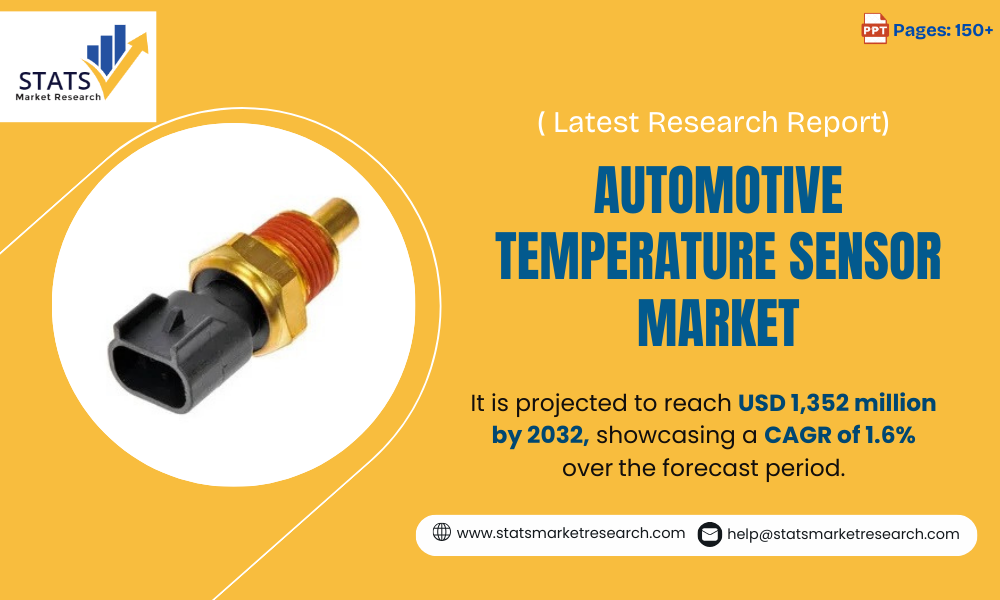
Global automotive temperature sensor market was valued at USD 1,211 million in 2024. The market is projected to grow steadily from USD 1,263 million in 2025 to USD 1,352 million by 2032, reflecting a CAGR of 1.6% during the forecast period.
This steady growth is driven by multiple trends:
- Increasing global vehicle production, particularly in emerging economies, has created higher demand for sensors.
- The rise of EVs requires more sophisticated thermal management, with EV battery packs alone needing 8–12 sensors per module to prevent overheating or thermal runaway.
- Regulatory pressures such as Euro 6d in Europe and China VI standards mandate real-time temperature monitoring to reduce emissions, compelling automakers to integrate additional sensors per vehicle.
Regional Highlights:
- Europe leads the market with a 26% share, reflecting high automotive manufacturing output and stringent emissions standards.
- North America follows closely, with increasing adoption of EVs and advanced driver-assistance systems (ADAS) driving demand.
- China is an emerging hub due to rapid vehicle electrification and government-backed EV incentives.
Historical trends indicate a shift from conventional internal combustion engine (ICE) vehicles to hybrids and EVs, further reinforcing the importance of thermal management systems and sensor adoption.
Download FREE Sample of this Report @ https://www.statsmarketresearch.com/download-free-sample/8057092/global-automotive-temperature-sensor-forecast-market
Recent Developments
The automotive temperature sensor market is undergoing significant transformation, driven primarily by the rapid shift towards electric and hybrid vehicles. These modern vehicles rely on a multitude of temperature sensors, particularly for complex battery management systems, which are crucial for ensuring safety, performance, and longevity. Manufacturers are also developing more advanced sensor technologies, such as Micro-Electro-Mechanical Systems (MEMS) and infrared sensors, which offer improved accuracy, smaller size, and enhanced capabilities like wireless communication. Additionally, the integration of temperature sensors with IoT and AI systems is enabling new features like predictive maintenance and more efficient vehicle performance.
Major Distribution
The distribution of automotive temperature sensors is primarily divided into two main channels: Original Equipment Manufacturer (OEM) and aftermarket. The OEM channel accounts for the vast majority of the market, where sensor manufacturers supply their products directly to vehicle assembly plants for installation during production. The aftermarket channel, while smaller, is growing and involves the sale of sensors for vehicle repair and replacement. This segment is supported by a network of distributors, wholesalers, and retail auto parts stores that cater to repair shops and individual consumers.
Market Dynamics (Drivers, Restraints, Opportunities, and Challenges)
Drivers
- Stringent Emission Regulations Accelerate Adoption of Precision Sensors
Global emissions standards are becoming increasingly rigorous. Regions like Europe and China enforce Euro 6d and China VI standards, respectively, requiring real-time monitoring of exhaust temperatures and engine thermal management. Modern vehicles integrate multiple sensors, ensuring compliance while maintaining efficiency. - EV Thermal Management Systems Create New Demand
The electric vehicle revolution has significantly boosted demand for high-precision temperature sensors:
- Battery packs alone require multiple sensors to avoid thermal runaway.
- EV motor and power electronics temperature monitoring is critical for performance, safety, and longevity.
- NTC thermistors in EVs offer 30% faster response times, enhancing battery management systems’ efficiency.
The global EV battery market, expected to reach $95 billion by 2027, will drive significant sensor deployment in both vehicles and charging infrastructure.
- Advanced Driver Assistance Systems (ADAS)
Thermal cameras in ADAS for night vision and pedestrian detection open additional market applications, particularly for high-temperature IR sensors. Sensor manufacturers are increasingly integrating solutions catering to these advanced systems.
Restraints
- Standardization Gaps Limit Innovation Adoption
A lack of unified protocols for sensor data communication creates integration challenges in vehicles with mixed-technology architectures.
- CAN FD networks are becoming prevalent, yet 63% of manufacturers report compatibility issues with legacy LIN-based systems, increasing development costs by 15–20%.
- Regional differences in EMC standards, such as ECE R10 in Europe versus GB/T in China, often require redesigns, delaying market entry by 9–12 months.
- Pricing Pressures
Volatile raw material prices, particularly platinum, nickel oxide, and specialty ceramics, affect manufacturing economics, especially for Tier 2 suppliers with thin margins.
Opportunities
- Smart Factory Integration and Predictive Maintenance
Industry 4.0 is driving demand for IIoT-enabled sensors capable of predictive maintenance.
- Embedded AI algorithms can predict component failures 500–800 hours in advance.
- These sensors command 35–40% price premiums, presenting lucrative opportunities.
- Digital Twin Technology and Fleet Analytics
Collaborations between sensor manufacturers and cloud platforms enable real-time thermal analytics across vehicle fleets, improving maintenance efficiency by 28% in pilot programs, representing a $720 million revenue opportunity through 2030.
Challenges
- Material Cost Volatility
Nickel prices alone have shown 22% volatility since mid-2023, impacting thermistor production costs. - Supply Chain Fragmentation
Geopolitical tensions have delayed 78% of shipments of critical components, extending lead times for semiconductor-grade ceramics from 8 weeks to 22 weeks since 2021. - Validation Bottlenecks
Automotive-grade sensors require 18–24 months of qualification testing, causing mismatches with OEM accelerated product cycles. AEC-Q200 qualification failures have cost suppliers $2.3 million per SKU on average.
Regional Analysis
- Europe: Leads global market (26% share), driven by strict emission standards and advanced automotive technology adoption.
- North America: Growth fueled by EV adoption, technological innovation, and government incentives.
- China: Emergent market, with rapidly growing EV production and government-backed policies.
- Asia-Pacific: Expansion supported by increased passenger vehicle production and emerging EV infrastructure.
- Rest of the World: Slow but steady adoption driven by emerging EV markets and luxury vehicle penetration.
Europe remains the hub for high-end and premium sensor solutions, while China dominates the budget and mid-tier segments.
Competitor Analysis (in brief)
The automotive temperature sensor market is semi-consolidated, with top three players—Bosch, Sensata Technologies, and Denso—holding roughly 47% of global market share. Key strategies include:
- Bosch (Germany): Leading with miniaturized and IoT-enabled NTC thermistors, accuracy ±0.5°C, response times under 3 seconds.
- Denso (Japan): Strategic OEM partnerships, reporting 12% YoY growth in hybrid vehicle sensor shipments.
- Continental AG (Germany): Expanded production capacity by 15% in 2024 to meet European demand.
- TE Connectivity (Switzerland): Acquired thermocouple manufacturer to broaden product portfolio.
- Chinese players like Wuhan Huagong Xingaoli Electron focus on cost-competitive solutions but face international quality compliance challenges.
Emerging trends include a focus on EV-specific sensors, ADAS integration, and high-temperature solutions for power electronics.
Get the Complete Report & TOC @ https://www.statsmarketresearch.com/global-automotive-temperature-sensor-forecast-market-8057092
Global Automotive Temperature Sensor: Market Segmentation Analysis
This report provides a deep insight into the global automotive temperature sensor market, covering all its essential aspects. This ranges from a macro overview of the market to micro details of the market size, competitive landscape, development trend, niche market, key market drivers and challenges, SWOT analysis, value chain analysis, etc. The analysis helps the reader to shape the competition within the industries and strategies for the competitive environment to enhance the potential profit. Furthermore, it provides a simple framework for evaluating and assessing the position of the business organization. The report structure also focuses on the competitive landscape of the Global Automotive Temperature Sensor. This report introduces in detail the market share, market performance, product situation, operation situation, etc., of the main players, which helps the readers in the industry to identify the main competitors and deeply understand the competition pattern of the market.
In a word, this report is a must-read for industry players, investors, researchers, consultants, business strategists, and all those who have any kind of stake or are planning to foray into the automotive temperature sensor market in any manner.
Market Segmentation (by Application)
- Engine Temperature Monitoring
- Cabin Climate Control
- Battery Temperature Management
- Transmission System Monitoring
- Others
Market Segmentation (by Type)
- Thermistor Temperature Sensor
- Negative Temperature Coefficient (NTC)
- Positive Temperature Coefficient (PTC)
- Thermocouple Temperature Sensor
- Resistance Temperature Detector (RTD)
- Infrared Temperature Sensor
- Others
Key Company
- Bosch (Germany)
- Sensata Technologies (U.S.)
- Denso Corporation (Japan)
- BorgWarner Inc. (U.S.)
- Continental AG (Germany)
- TE Connectivity (Switzerland)
- Hella GmbH & Co. KGaA (Germany)
- Valeo SA (France)
- Panasonic Corporation (Japan)
- TDK Corporation (Japan)
- Qufu Temb Auto Parts Manufacturing (China)
- Inzi Controls Co (South Korea)
- Wuhan Huagong Xingaoli Electron (China)
- Nippon Thermostat Co (Japan)
Geographic Segmentation
- Europe
- North America
- China
- Asia-Pacific
- Rest of the World
FAQ
- What is the current market size of the Automotive Temperature Sensor Market?
The global market was valued at USD 1,211 million in 2024 and is projected to reach USD 1,352 million by 2032 with a CAGR of 1.6%. - Which are the key companies operating in the Automotive Temperature Sensor Market?
Key players include Bosch, Sensata Technologies, Denso, BorgWarner, Continental AG, TE Connectivity, Hella, Valeo, Panasonic, TDK, Qufu Temb, Inzi Controls, Wuhan Huagong Xingaoli Electron, and Nippon Thermostat Co. - What are the key growth drivers in the Automotive Temperature Sensor Market?
Growth drivers include stringent emission regulations, EV thermal management requirements, and ADAS integration. - Which regions dominate the Automotive Temperature Sensor Market?
Europe leads with 26% share, followed by North America and China, with the Asia-Pacific region emerging rapidly. - What are the emerging trends in the Automotive Temperature Sensor Market?
Trends include smart sensors for predictive maintenance, IoT-enabled devices, MEMS-based solutions, and advanced sensors for EV batteries and ADAS applications.
About Us
☎️ International: +1 (332) 2424 294
📄 Website: www.statsmarketresearch.com
Join us on LinkedIn:- https://www.linkedin.com/company/statsmarketresearch




