
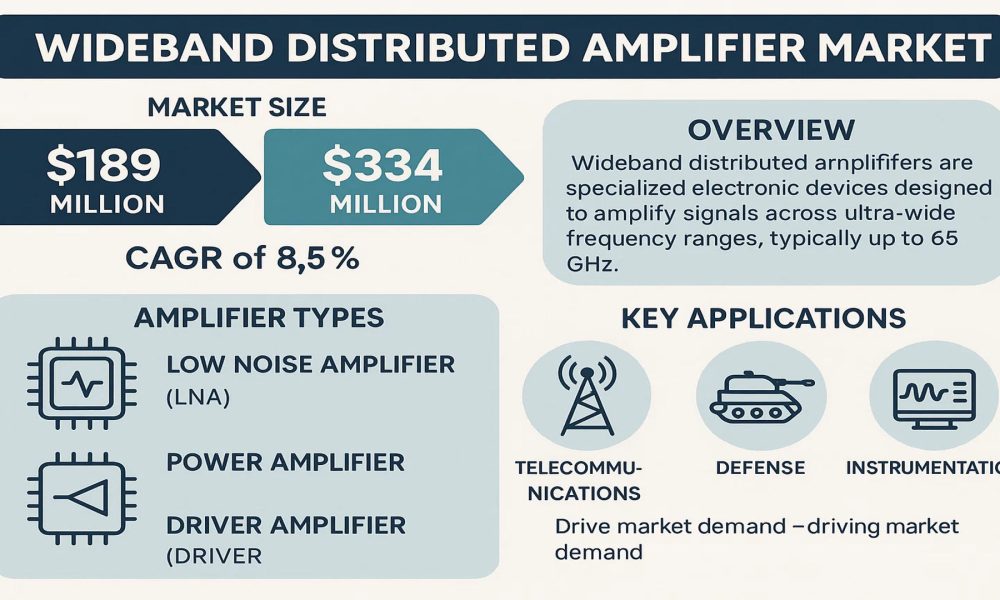
Wideband Distributed Amplifier Market size was valued at US$ 189 million in 2024 and is projected to reach US$ 334 million by 2032, at a CAGR of 8.5% during the forecast period 2025-2032.
Wideband distributed amplifiers are specialized electronic devices designed to amplify signals across ultra-wide frequency ranges, typically from DC to 65 GHz. These amplifiers utilize distributed architectures to maintain consistent gain and linearity across broad bandwidths, making them critical components in high-frequency applications. The technology finds applications across three primary amplifier types: low noise amplifiers (LNAs), power amplifiers, and driver amplifiers, each serving distinct functions in signal processing chains.
Market growth is being driven by increasing demand from key sectors including telecommunications (particularly 5G infrastructure), defense systems requiring wideband capabilities, and advanced instrumentation applications. While North America currently leads in market share (with the U.S. accounting for approximately 38% of 2024 revenues), the Asia-Pacific region is projected to show the highest growth rate due to expanding 5G deployments. Major industry players like Analog Devices, Qorvo, and Mini-Circuits continue to innovate with new product releases, such as Qorvo’s QPA2211 wideband power amplifier launched in Q1 2024 for defense applications.
Request Your Free Sample Report-https://semiconductorinsight.com/download-sample-report/?product_id=107347
MARKET DYNAMICS
MARKET DRIVERS
Rising Demand for High-Frequency Communication Systems to Accelerate Market Growth
The wideband distributed amplifier market is witnessing substantial growth due to the increasing adoption of high-frequency communication systems across defense, telecommunications, and instrumentation sectors. With wireless technologies advancing rapidly, the need for amplifiers capable of handling frequencies from DC to 65 GHz has surged. Major telecommunications providers are investing heavily in 5G infrastructure, which relies on wideband amplifiers for signal integrity and low noise performance. The global rollout of 5G networks, projected to cover over 50% of the population by 2026, is a key factor propelling this demand. Additionally, modern radar systems and electronic warfare applications require ultra-wideband performance, further driving innovation in amplifier technologies.
Expansion of Test & Measurement Applications to Fuel Adoption
Growth in test and measurement applications continues to create robust demand for wideband distributed amplifiers. The instrumentation sector relies on these amplifiers for precise signal amplification in oscilloscopes, spectrum analyzers, and network analyzers. With increasing complexity in semiconductor designs and RF components, testing equipment must handle wider bandwidths while maintaining signal fidelity. Recent advancements in gallium nitride (GaN) and silicon germanium (SiGe) technologies have enabled amplifiers to deliver higher power efficiency and thermal stability, making them indispensable in laboratory and industrial testing environments. The semiconductor testing market, valued at over $6 billion, is expected to grow steadily, directly benefiting the wideband amplifier segment.
Military Modernization Programs to Drive Defense Sector Demand
Defense applications represent one of the strongest growth avenues for wideband distributed amplifiers. Modern electronic warfare systems, satellite communications, and radar technologies require amplifiers capable of operating across wide frequency ranges without distortion. Governments worldwide are increasing defense budgets, with several countries allocating substantial funds for electronic warfare enhancements. For instance, recent military procurement initiatives emphasize multi-band, software-defined radios that utilize wideband amplifiers for secure, jam-resistant communications. Such programs are expected to contribute significantly to market expansion as defense contractors prioritize RF component performance and reliability.
Recent Market Developments:
- Advancements in 5G and 6G Communication Systems: Increasing adoption of wideband distributed amplifiers to support high-frequency, high-speed data transmission is driving new product innovations.
- Integration in Aerospace & Defense Applications: Key players are introducing amplifiers with improved linearity and bandwidth for radar, electronic warfare, and satellite communications.
- Silicon Germanium (SiGe) and GaN-based Designs: Manufacturers are focusing on next-gen semiconductor materials to enhance power efficiency, frequency range, and thermal performance.
- Strategic Collaborations and Acquisitions: Companies are entering partnerships with telecom operators and defense contractors to expand their application scope.
- Miniaturization & Low-Power Solutions: Growing demand for compact and power-efficient wideband distributed amplifiers in portable devices and IoT applications.
MARKET OPPORTUNITIES
Emerging mmWave Applications to Create New Revenue Streams
The growing adoption of millimeter-wave (mmWave) technologies presents lucrative opportunities for wideband amplifier manufacturers. Applications in 5G backhaul, automotive radar, and satellite communications are driving demand for amplifiers capable of operating at frequencies above 30 GHz. The global mmWave technology market, projected to grow significantly by 2030, will require distributed amplifiers with ultra-low noise figures and high linearity. Companies investing in advanced packaging techniques and heterojunction technologies are well-positioned to capitalize on this emerging sector.
Integration with AI-Driven RF Systems to Enable Smart Amplification
The integration of artificial intelligence with RF systems offers promising opportunities for performance optimization. AI algorithms can dynamically adjust amplifier parameters to compensate for signal distortions and environmental variations. This intelligent amplification approach is particularly valuable in software-defined radios and cognitive electronic warfare systems. Leading manufacturers are exploring machine learning techniques to enhance amplifier efficiency, creating differentiation in a competitive market.
Request Your Free Sample Report-https://semiconductorinsight.com/download-sample-report/?product_id=107347
List of Key Wideband Distributed Amplifier Manufacturers
- Analog Devices, Inc. (U.S.)
- Qorvo, Inc. (U.S.)
- Mini-Circuits (U.S.)
- Castle Microwave Ltd. (UK)
- Macom Technology Solutions (U.S.)
- BDTIC (China)
- Infineon Technologies (Germany)
- NXP Semiconductors (Netherlands)
- Skyworks Solutions (U.S.)
- Teledyne Technologies (U.S.)
The competitive intensity continues to rise as companies pursue strategic collaborations. A notable example includes Qorvo’s multi-year supply agreement with a major 5G infrastructure provider, ensuring steady demand for its wideband amplifier solutions through 2028. Furthermore, Analog Devices maintains technological leadership through its heterojunction bipolar transistor (HBT) based amplifiers that enable superior linearity across microwave frequencies.
Second-tier manufacturers are responding by focusing on niche applications – Castle Microwave specializes in military-grade ruggedized amplifiers, while Mini-Circuits dominates the test and measurement segment through its broad catalog of low-cost, high-performance components. This increasing specialization suggests the market is evolving beyond pure performance competition toward application-specific solution differentiation.
Segment Analysis:
By Type
Low Noise Amplifier Segment Holds Significant Market Share Owing to High Demand in Precision Communication Systems
The market is segmented based on type into:
- Low Noise Amplifier
- Power Amplifier
- Driver Amplifier
By Application
Telecommunication Emerges as the Leading Application Segment Due to Expanding 5G Infrastructure
The market is segmented based on application into:
- Instrumentation
- Defense
- Telecommunication
- Others
By Frequency Range
0-20 GHz Segment Gains Traction for Its Wide Applicability Across Various Industries
The market is segmented based on frequency range into:
- 0-20 GHz
- 20-40 GHz
- 40-65 GHz
By Distribution Channel
Direct Sales Account for Majority Share as Manufacturers Prefer B2B Engagement With Large Clients
The market is segmented based on distribution channel into:
- Direct Sales
- Distributors
- Online Retailers
Other Topic-Smartcard Reader Module Market
CONTACT US:
City vista, 203A, Fountain Road, Ashoka Nagar, Kharadi, Pune, Maharashtra 411014
[+91 8087992013]




