Definition
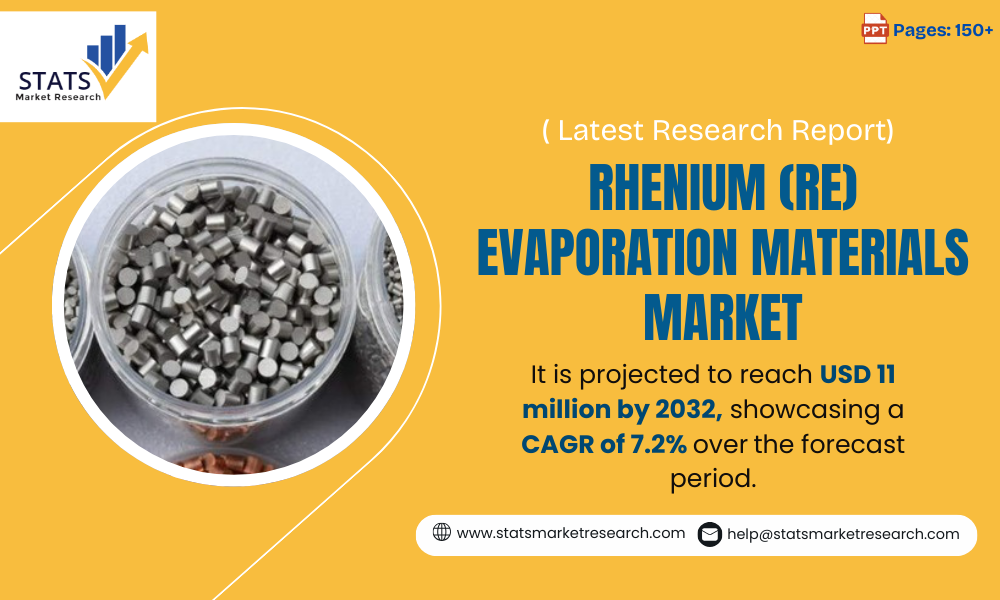
Rhenium (Re) evaporation materials are specialized high-performance materials primarily used in thin-film deposition processes, especially in industries requiring extreme resistance to heat, wear, and corrosion. These materials are available in forms such as powders, granules, rods, and pellets that are suitable for physical vapor deposition (PVD) methods.
Rhenium is one of the rarest elements on Earth, with an exceptionally high melting point (3,186°C)—the second highest of all elements after tungsten. This property, combined with its remarkable resistance to thermal shock, creep, and chemical corrosion, makes it indispensable for highly demanding applications.
Key usage areas include:
- Aerospace: As part of superalloys used in jet engine turbine blades and exhaust components.
- Semiconductors & Electronics: For thin-film coatings in 3D NAND, DRAM, and advanced logic chips.
- Optical Applications: Specialized coatings for camera lenses, defense optics, and foldable display technologies.
- Research & Nuclear Technology: Used in next-generation reactors and scientific experiments requiring radiation and heat resistance.
Due to its unique physical and chemical characteristics, rhenium evaporation materials are a critical enabler of performance, reliability, and efficiency in advanced manufacturing sectors.
Recent Developments
The Rhenium (Re) evaporation materials market is experiencing significant growth, primarily driven by the expanding demand from the semiconductor and aerospace sectors. Recent developments include the refinement of recycling processes, which now account for a substantial portion of the total supply. This helps mitigate the challenges of raw material scarcity and high cost. Manufacturers are also innovating in the production of high-purity materials, with controlled particle sizes to optimize the uniformity of thin-film coatings. The shrinking geometries in semiconductor manufacturing, particularly for advanced nodes below 5nm, have increased the demand for Rhenium due to its excellent thermal stability and conductivity. Furthermore, new applications are emerging in next-generation nuclear reactors, which are specifying rhenium coatings for critical components due to its radiation resistance and thermal properties.
Major Distribution Channels
The distribution of Rhenium (Re) evaporation materials is highly specialized and primarily operates through a B2B model. The major distribution channels include direct sales from manufacturers, specialized electronic component distributors, and online marketplaces. Major material producers and suppliers often have direct sales teams to handle large contracts with original equipment manufacturers (OEMs) in the aerospace, defense, and semiconductor industries. Authorized distributors, such as Stanford Advanced Materials and Kurt J. Lesker Company, play a crucial role by providing a wide array of Rhenium products in various forms (pellets, granules, powder) to smaller-scale businesses, research institutions, and engineers for prototyping and R&D. The rise of e-commerce has also made it easier for customers to access detailed product specifications and purchase these high-value, low-volume materials online, creating a more accessible global market.
Market Size
Global Rhenium (Re) Evaporation Materials Market was valued at USD 6.9 million in 2024 and is projected to reach USD 11 million by 2032, growing at a CAGR of 7.2% during the forecast period (2025–2032).
Key Highlights:
- Annual Supply: Global production of rhenium remains constrained at approximately 50 metric tons annually, with Chile accounting for over 50% of primary output.
- Recycling Impact: Advances in recycling now contribute nearly 30–35% of global supply, mitigating some supply risks.
- Aerospace Demand: More than 60% of demand is linked to aerospace turbine blades and coatings, where high-performance rhenium superalloys are essential.
- Semiconductors: With the semiconductor industry growing at 8% CAGR, rhenium thin-film materials are witnessing strong adoption, especially in Asia-Pacific fabrication hubs.
The combination of scarcity, high performance, and growing demand is driving steady market expansion despite volatility in pricing and supply constraints.
Download FREE Sample of this Report @ https://www.statsmarketresearch.com/download-free-sample/8058769/global-rhenium-evaporation-materials-forecast-market
Market Dynamics (Drivers, Restraints, Opportunities, and Challenges)
Market Drivers
- Expanding Aerospace Industry
- Rhenium is critical for superalloys in turbine blades that operate at >1,500°C.
- Aircraft engine manufacturers are increasingly specifying rhenium-based coatings to improve fuel efficiency and durability.
- With commercial aircraft production expected to rise by 25% over the next 5 years, rhenium demand in aerospace will surge.
- Advancements in Semiconductor Manufacturing
- Rhenium enables precise thin-film deposition for chips below 5nm nodes.
- It plays a role in 3D NAND and DRAM innovations where high thermal stability is critical.
- APAC fabs, especially in Taiwan, South Korea, and China, are leading adopters.
- High-Performance Optical and Defense Applications
- Smartphone makers use rhenium-based coatings for scratch-resistant lenses.
- Defense optics increasingly adopt rhenium for durability under harsh conditions.
Market Restraints
- Supply Chain Volatility
- Over 80% of supply comes from only three countries, exposing buyers to geopolitical and mining risks.
- Historical price swings reached 300% fluctuations, affecting planning.
- Environmental Regulations
- Mining and refining face stricter emission standards, adding 15–20% extra costs.
- Long project timelines (2–3 years) delay new supply development.
Market Opportunities
- Recycling Advancements
- Modern processes recover >90% of rhenium from spent catalysts and scrap.
- Recycled rhenium costs 20–30% less than primary sources.
- Recycling already accounts for ~35% of supply, growing at 12% CAGR.
- Emerging Nuclear Applications
- Rhenium’s radiation resistance makes it ideal for molten salt reactors and gas-cooled reactors.
- Over 50 next-gen nuclear projects globally may boost demand significantly.
Market Challenges
- Technical Complexity
- Producing 99.99% pure rhenium requires advanced metallurgy, with <10 facilities globally capable of this.
- High yield losses (~30%) add to costs.
- Substitution Pressure
- Tungsten-rhenium alloys and advanced ceramics offer cost-effective alternatives in some sectors.
- Skill Gaps
- Fewer than 100 experts worldwide specialize in rhenium metallurgy, limiting production capacity expansion.
Regional Analysis
- North America
- Strong demand from aerospace (GE, Pratt & Whitney, Boeing) and defense applications.
- Home to leading suppliers like Stanford Advanced Materials and Kurt J. Lesker Company.
- Europe
- Focused on aerospace and advanced optical coatings.
- Companies like Testbourne Ltd and Advanced Engineering Materials Limited serve niche markets.
- Asia-Pacific (APAC)
- Fastest-growing region due to semiconductor manufacturing hubs in China, South Korea, and Taiwan.
- Rising aerospace production in China boosts additional demand.
- Latin America (Chile)
- Key supplier of primary rhenium (over 50% global share).
- Middle East & Africa
- Currently limited demand but emerging interest in nuclear projects could expand future consumption.
Competitor Analysis (in brief)
The market is moderately concentrated, with a handful of specialized suppliers dominating due to technical expertise and secure supply partnerships.
- Stanford Advanced Materials (U.S.) – Leading global supplier with vertically integrated sourcing and production.
- Kurt J. Lesker Company (U.S.) – Strong R&D in deposition and rhenium alloys.
- ALB Materials Inc (U.S.) – Niche player in research and optical applications.
- Testbourne Ltd (UK) and Advanced Engineering Materials Limited (UK) – Regional specialists serving aerospace and optical sectors.
- Heeger Materials (China) – Fast-growing APAC supplier targeting semiconductors.
Get the Complete Report & TOC @ https://www.statsmarketresearch.com/global-rhenium-evaporation-materials-forecast-market-8058769
Global Rhenium (Re) Evaporation Materials Market Segmentation Analysis
This report provides a deep insight into the global Rhenium (Re) Evaporation Materials market, covering all its essential aspects. This ranges from a macro overview of the market to micro details of the market size, competitive landscape, development trend, niche market, key market drivers and challenges, SWOT analysis, value chain analysis, etc.
The analysis helps the reader to shape the competition within the industries and strategies for the competitive environment to enhance the potential profit. Furthermore, it provides a simple framework for evaluating and assessing the position of the business organization. The report structure also focuses on the competitive landscape of the Global Rhenium (Re) Evaporation Materials Market. This report introduces in detail the market share, market performance, product situation, operation situation, etc., of the main players, which helps the readers in the industry to identify the main competitors and deeply understand the competition pattern of the market.
In a word, this report is a must-read for industry players, investors, researchers, consultants, business strategists, and all those who have any kind of stake or are planning to foray into the Rhenium (Re) Evaporation Materials Market in any manner.
Market Segmentation (by Application)
- Deposition processes
- Optics
- High-temperature coatings
- Research & development
- Others
Market Segmentation (by Type)
- Powder
- Granular
- Others (including rods and pellets)
Key Company
- Stanford Advanced Materials (U.S.)
- Kurt J. Lesker Company (U.S.)
- ALB Materials Inc (U.S.)
- Heeger Materials (China)
- Testbourne Ltd (UK)
- Advanced Engineering Materials Limited (UK)
- ACI Alloys, Inc. (U.S.)
- Edgetech Industries LLC (U.S.)
- Reade Advanced Materials (U.S.)
Geographic Segmentation
- North America
- Europe
- Asia-Pacific (APAC)
- Latin America
- Middle East & Africa
FAQs
Q1. What is the current market size of the Rhenium (Re) Evaporation Materials Market?
The market was valued at USD 6.9 million in 2024 and is projected to reach USD 11 million by 2032 at a CAGR of 7.2%.
Q2. Which are the key companies operating in the Rhenium (Re) Evaporation Materials Market?
Major players include Stanford Advanced Materials, Kurt J. Lesker Company, ALB Materials Inc, Testbourne Ltd, Heeger Materials, and Advanced Engineering Materials Limited.
Q3. What are the key growth drivers in the Rhenium (Re) Evaporation Materials Market?
Growth is fueled by aerospace demand, semiconductor advancements, and recycling innovations.
Q4. Which regions dominate the Rhenium (Re) Evaporation Materials Market?
North America and Asia-Pacific are the leading markets, driven by aerospace and semiconductor demand respectively.
Q5. What are the emerging trends in the Rhenium (Re) Evaporation Materials Market?
Key trends include rhenium recycling growth, nuclear technology adoption, and integration into next-gen semiconductors and optical coatings.
About Us
☎️ International: +1 (332) 2424 294
📄 Website: www.statsmarketresearch.com
Join us on LinkedIn:- https://www.linkedin.com/company/statsmarketresearch




