
Definition
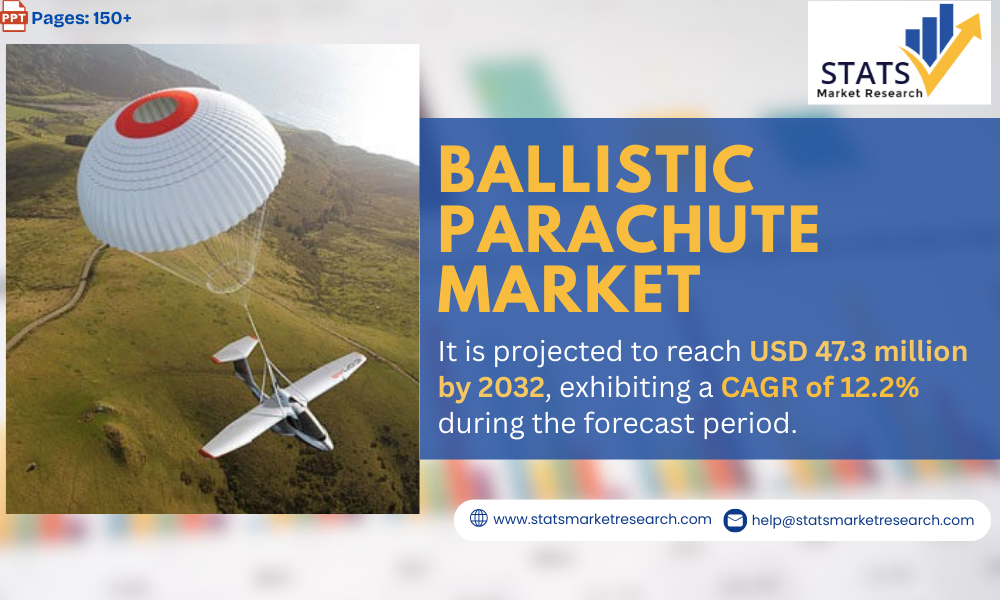
A ballistic parachute is an emergency safety system designed to provide rapid descent control for aircraft, including drones and light aircraft, during critical system failures. Unlike conventional parachutes that require manual deployment, ballistic parachutes use pyrotechnic charges to trigger immediate deployment, ensuring rapid stabilization and controlled descent.
Key features of ballistic parachutes include:
- Rapid Deployment: Pyrotechnic activation allows near-instantaneous parachute deployment in emergencies.
- Safety for Manned and Unmanned Aircraft: Applicable to UAVs, light-sport aircraft (LSA), helicopters, and experimental aircraft.
- Advanced Materials: New composite and lightweight fabrics enhance strength while minimizing added weight.
- Integration Capabilities: Modern systems integrate with flight control systems, AI algorithms, and urban air mobility (UAM) platforms.
Ballistic parachutes are essential for aviation safety compliance, risk reduction, and insurance benefits, providing a fail-safe option for operators and pilots.
Recent Developments
The ballistic parachute market is being shaped by several key technological advancements, particularly in the unmanned aerial vehicle (UAV) and light-sport aircraft sectors. A significant trend is the development of more compact, lightweight, and automated systems that can be integrated seamlessly into a wider range of platforms. This includes the use of advanced materials like high-strength, lightweight fabrics and improved deployment mechanisms. The integration of artificial intelligence and machine learning is also a major development, allowing systems to autonomously analyze real-time flight data and environmental conditions to determine the optimal moment for deployment, thereby increasing reliability and safety. Additionally, there is a growing demand for specialized and customized systems to meet the unique safety and regulatory requirements of different industries, such as commercial drone delivery services and urban air mobility.
Major Distribution Channels
The distribution of ballistic parachutes is a specialized process, primarily handled through a combination of direct manufacturer sales, authorized distributors, and B2B partnerships. For large-scale clients, such as aerospace and defense companies, government agencies, and major aircraft manufacturers, manufacturers often use direct sales channels to manage contracts and provide dedicated technical support. Authorized electronic component and aviation equipment distributors, like those serving the general aviation and hobbyist markets, are crucial for reaching a broader customer base, including individual pilots, small aircraft owners, and drone enthusiasts. The proliferation of e-commerce has also made it a vital channel, offering a convenient platform for customers to research and purchase systems, including specialized kits and components. Lastly, licensing agreements and B2B partnerships with drone and aircraft manufacturers are a primary distribution model, ensuring that ballistic parachute systems are pre-installed or offered as a standard safety feature in new products.
Market Size
Global ballistic parachute market was valued at USD 21.5 million in 2024 and is projected to grow to USD 47.3 million by 2032, achieving a CAGR of 12.2%.
Market Insights:
- North America dominates the market with a 20% share, driven by stringent aviation safety regulations.
- Product Segmentation: The 10-20FT parachute segment is the most widely adopted, accounting for over 30% of total market revenue.
- Industry Growth: The surge in UAV deployment, both in commercial and military sectors, underpins consistent market expansion.
- Historical Trends: The growing focus on aviation safety, coupled with insurance incentives for equipped aircraft, is a major contributor to market growth.
Key technological developments include lightweight composite systems, AI-powered deployment algorithms, and improved pyrotechnic reliability, achieving deployment success rates of over 99.9% in recent tests.
Download FREE Sample of this Report @ https://www.statsmarketresearch.com/download-free-sample/8057702/global-ballistic-parachute-forecast-market
Market Dynamics
Drivers
- Growing UAV Adoption in Commercial and Military Sectors:
Commercial drones are seeing a 35% annual adoption increase, with applications in logistics, agriculture, and infrastructure inspection. Military UAV spending exceeded $12 billion globally in 2023-2024, fueling demand for reliable safety systems. - Stringent Aviation Safety Regulations:
New mandates require emergency recovery systems for aircraft under 1,320 pounds. Compliance-driven installations contribute nearly 40% of market revenue in North America and Europe. Insurance providers also offer 15-25% premium reductions for certified systems, incentivizing adoption. - Technological Advancements:
Next-generation systems leverage AI for autonomous deployment and employ lighter, more durable materials for weight efficiency. The integration of ballistic parachutes with collision avoidance systems and flight control software provides additional operational benefits.
Restraints
- High System Costs and Weight Penalties:
- Light aircraft systems weigh 25-40 pounds, reducing payload capacity.
- Costs range from $3,000 for UAVs to over $15,000 for manned aircraft.
- Maintenance and recertification add 20-30% to total ownership costs.
- Operational Trade-Offs:
Operators in cost-sensitive markets face adoption challenges due to high upfront and ongoing costs, particularly in commercial drone applications.
Challenges
- Technical Limitations in Urban and High-Speed Environments:
- Dense urban areas pose landing safety issues.
- Deployment at speeds above 120 knots has a success rate of only 85%, limiting applications in commercial aviation and urban air mobility (UAM).
- Regulatory Fragmentation:
Different regional certification standards necessitate multiple product variants, increasing R&D expenditure by 15-20%. - Skill Gaps:
A 25% shortage of certified installation and maintenance technicians constrains growth.
Opportunities
- Urban Air Mobility (UAM):
Projected demand for 50,000 VTOL aircraft by 2030 creates a $1.2 billion potential market for advanced ballistic parachute solutions. - Technological Convergence:
Integration with collision avoidance, autonomous flight controls, and AI-driven deployment enhances value and opens premium market segments. - Space Tourism:
Modified ballistic parachute systems are being explored for crew capsule recovery, providing new revenue streams and innovation opportunities.
Regional Analysis
- North America: Market leader; strong adoption due to safety regulations and insurance incentives.
- Europe: Growth fueled by ultralight aircraft regulations; focus on durable, high-reliability systems.
- Asia-Pacific: Emerging UAV and drone markets; moderate adoption in commercial and industrial applications.
- Latin America & Middle East/Africa: Niche opportunities in recreational aviation and emerging UAM initiatives.
Competitor Analysis
The market is fragmented but competitive, with leading manufacturers focusing on innovation and strategic partnerships.
- Ballistic Recovery Systems, Inc. (BRS) – U.S.: Market pioneer with proven safety track record; extensive R&D investments.
- GALAXY GRS s.r.o. – Czech Republic: Advanced deployment systems for ultralight aircraft; growing European presence.
- Stratos 07, s.r.o. – Slovakia: Ruggedized designs for harsh environments; focus on light aircraft.
- ParaZero Drone Safety Systems Ltd. – Israel: AI-integrated parachutes for UAVs; competitive technological moat.
- Drone Rescue Systems GmbH – Germany: UAV-focused safety solutions with proprietary AI algorithms.
Market consolidation is expected as larger aerospace providers seek to integrate ballistic parachutes into broader safety systems.
Get the Complete Report & TOC @ https://www.statsmarketresearch.com/global-ballistic-parachute-forecast-market-8057702
Global Ballistic Parachute: Market Segmentation Analysis
This report provides a deep insight into the global Ballistic Parachute market, covering all its essential aspects. This ranges from a macro overview of the market to micro details of the market size, competitive landscape, development trend, niche market, key market drivers and challenges, SWOT analysis, value chain analysis, etc.
The analysis helps the reader to shape the competition within the industries and strategies for the competitive environment to enhance the potential profit. Furthermore, it provides a simple framework for evaluating and assessing the position of the business organization. The report structure also focuses on the competitive landscape of the Global Ballistic Parachute market. This report introduces in detail the market share, market performance, product situation, operation situation, etc., of the main players, which helps the readers in the industry to identify the main competitors and deeply understand the competition pattern of the market.
In a word, this report is a must-read for industry players, investors, researchers, consultants, business strategists, and all those who have any kind of stake or are planning to foray into the Ballistic Parachute market in any manner.
Market Segmentation (by Application)
- Light-sport Aircraft (LSA) & Ultralight Aircraft
- Unmanned Aerial Vehicle (UAV)
- Helicopters
- Experimental Aircraft
- Others
Market Segmentation (by Type)
- Less than 10FT
- 10-20FT
- Military-grade Parachutes
- Custom and Specialty Parachutes
- Others
Key Company
- Ballistic Recovery Systems, Inc. (U.S.)
- GALAXY GRS s.r.o. (Czech Republic)
- Stratos 07, s.r.o. (Slovakia)
- Indemnis, Inc. (U.S.)
- Opale Parachutes (France)
- Mars Parachutes (Netherlands)
- Drone Rescue Systems GmbH (Germany)
- ParaZero Drone Safety Systems Ltd. (Israel)
- Fruity Chutes (U.S.)
Geographic Segmentation
- North America
- Europe
- Asia Pacific
- Latin America
- Middle East & Africa
FAQ Section
Q1: What is the current market size of the Ballistic Parachute market?
The market was valued at USD 21.5 million in 2024 and is projected to reach USD 47.3 million by 2032, at a CAGR of 12.2%.
Q2: Which are the key companies operating in the Ballistic Parachute market?
Key players include: Ballistic Recovery Systems, GALAXY GRS, Stratos 07, ParaZero Drone Safety Systems, and Drone Rescue Systems GmbH.
Q3: What are the key growth drivers in the Ballistic Parachute market?
- Rising UAV adoption in commercial and military sectors
- Stringent aviation safety regulations
- Technological advancements in lightweight materials and AI deployment systems
Q4: Which regions dominate the Ballistic Parachute market?
North America leads the market due to strict safety standards, followed by Europe and Asia-Pacific as emerging regions.
Q5: What are the emerging trends in the Ballistic Parachute market?
- Urban Air Mobility (UAM) adoption for VTOL aircraft
- AI-integrated deployment systems for UAVs
- Integration with collision avoidance and autonomous flight control systems
- Growth in space tourism for capsule recovery systems
About Us
☎️ International: +1 (332) 2424 294
📄 Website: www.statsmarketresearch.com
Join us on LinkedIn:- https://www.linkedin.com/company/statsmarketresearch




