
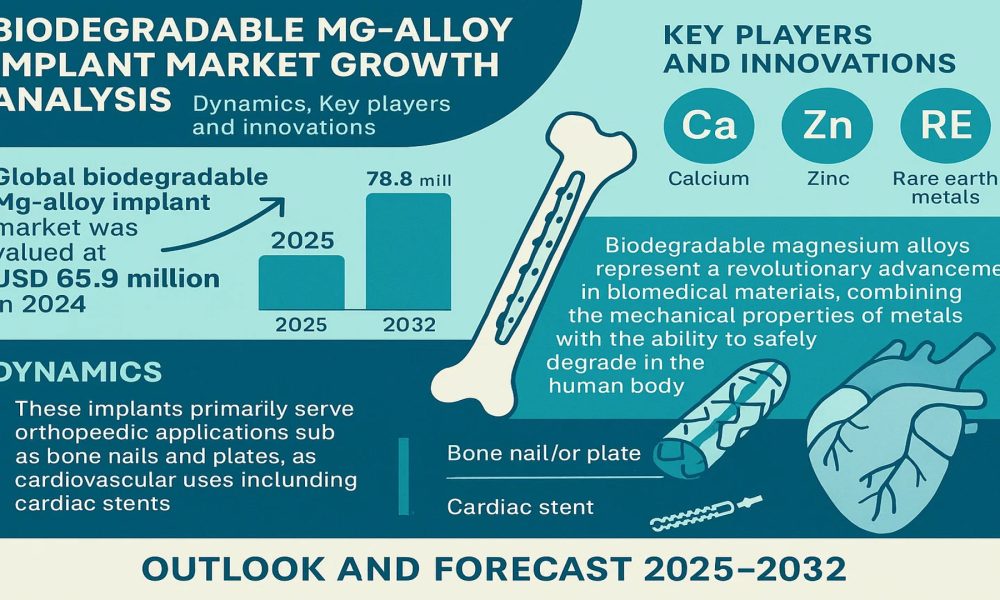
Global biodegradable Mg-alloy implant market was valued at USD 62.9 million in 2024. The market is projected to grow from USD 65.2 million in 2025 to USD 78.8 million by 2032, exhibiting a CAGR of 3.4% during the forecast period.
Biodegradable magnesium alloys represent a revolutionary advancement in biomedical materials, combining the mechanical properties of metals with the ability to safely degrade in the human body. These implants serve primarily in orthopedic applications such as bone nails and plates, as well as cardiovascular uses including cardiac stents. Their composition typically includes magnesium combined with alloying elements like calcium, zinc, and rare earth metals to optimize degradation rates and mechanical performance.
Get the Complete Report & TOC at https://www.intelmarketresearch.com/download-free-sample/8389/biodegradable-mg-alloy-implant-market
The market growth is driven by increasing demand for temporary implants that eliminate secondary removal surgeries, reducing healthcare costs and patient trauma. While adoption remains concentrated in fracture treatment applications, emerging research into magnesium alloy stents presents significant growth potential. Regulatory approvals continue expanding, with recent CE marks and FDA clearances accelerating market penetration in developed regions. However, challenges persist in controlling degradation rates and managing hydrogen gas byproducts during corrosion – key focus areas for ongoing material science research.
MARKET DRIVERS
Rising Demand for Advanced Orthopedic Solutions to Fuel Market Growth
The increasing prevalence of bone-related disorders is significantly driving the adoption of biodegradable Mg-alloy implants worldwide. With approximately 178 million fractures occurring annually and an aging population contributing to higher incidence rates of osteoporosis and arthritis, the demand for innovative orthopedic solutions is surging. Magnesium alloys offer distinct advantages over traditional materials like titanium and stainless steel, particularly their ability to degrade naturally in the body while providing necessary support during bone healing. This eliminates the need for secondary surgeries, reducing both patient risk and healthcare system burdens. The orthopedic implant market’s consistent growth, projected at over 6.5% annually, creates a favorable environment for magnesium alloy adoption.
Technological Advancements in Material Science Accelerate Commercialization
Recent breakthroughs in alloy composition and surface modification techniques are enhancing the performance of biodegradable magnesium implants. Research institutions and manufacturers have developed advanced Mg-Zn-Ca and Mg-RE (rare earth) alloys that demonstrate improved corrosion resistance while maintaining optimal mechanical properties. These innovations address the historical challenge of premature degradation that previously limited clinical applications. Several next-generation implants now achieve controlled degradation rates matching bone healing timelines (typically 12-24 months), with corrosion rates reduced by 40-60% compared to earlier formulations. Such improvements are receiving increased regulatory approvals, with multiple Mg-alloy implants gaining CE marks and FDA clearances in recent years.
Growing Emphasis on Biocompatible Materials in Cardiovascular Applications
The cardiovascular sector presents substantial growth potential for Mg-alloy implants, particularly in stent applications. Traditional metallic stents often require lifelong antiplatelet therapy and may cause chronic inflammation. In contrast, biodegradable Mg-alloy stents provide temporary scaffolding that disappears after artery remodeling, reducing long-term complications. With coronary artery disease affecting over 18 million adults in the U.S. alone and global PCI procedures exceeding 4 million annually, the addressable market continues expanding. Clinical trials demonstrate Mg-alloy stents achieve comparable efficacy to conventional options while eliminating the risk of late stent thrombosis, making them increasingly attractive to interventional cardiologists.
MARKET OPPORTUNITIES
Expansion into Pediatric Orthopedics Presents Significant Growth Potential
The pediatric orthopedic segment offers compelling opportunities for biodegradable Mg-alloy implants, particularly in fracture fixation and deformity correction applications. Traditional metallic implants often require removal surgeries in growing children, subjecting young patients to additional procedures and trauma. Mg-alloy devices that safely degrade could prevent these secondary operations while providing necessary stabilization during critical growth periods. With pediatric orthopedic procedures numbering over 2 million annually in developed markets alone, this specialized application could become a key growth driver. Early clinical studies in adolescent populations show promise, with one trial reporting 92% satisfactory outcomes and no implant-related complications over 24-month follow-up periods.
Strategic Partnerships Between Academia and Industry Accelerate Innovation
Collaborations between research institutions and medical device companies are creating new avenues for product development and market expansion. Leading universities specializing in biomaterials science are partnering with manufacturers to commercialize next-generation Mg-alloy formulations. These partnerships combine academic expertise in material innovation with industry capabilities in clinical translation and commercialization. Recent examples include multi-year research agreements focused on developing Mg-alloys with enhanced antibacterial properties and improved mechanical strength, both critical for expanding clinical applications. Such collaborations not only advance technological capabilities but also facilitate faster regulatory pathways through comprehensive preclinical data packages.
MARKET CHALLENGES
Standardization Gaps in Material Specifications and Testing Methods
The emerging nature of biodegradable Mg-alloy implants has resulted in insufficient industry standards for material specifications, performance testing, and quality control. Unlike established implant materials with well-defined ASTM and ISO standards, Mg-alloys lack comprehensive standardized testing protocols for critical parameters like degradation rates and mechanical integrity under physiological conditions. This standardization gap creates inconsistencies in product development and makes cross-study comparisons difficult. Developing consensus standards requires extensive inter-laboratory validation and industry coordination, processes that typically take several years to establish. Until robust standards emerge, variability in product quality and performance may persist, potentially slowing market acceptance.
Other Challenges
Supply Chain Vulnerabilities for Specialty Alloy Components
The production of medical-grade Mg-alloys depends on specialized raw materials, including high-purity magnesium and precise alloying elements. Many of these materials have limited global suppliers, creating potential supply chain vulnerabilities. Rare earth elements used in some advanced formulations face particularly constrained supply scenarios, with over 85% of global production concentrated in China. These dependencies introduce risks of price volatility and supply disruptions, especially considering growing competition from other high-tech industries requiring similar materials. Developing reliable, diversified supply chains remains a persistent challenge for manufacturers seeking to scale production.
Reimbursement Uncertainties in Key Healthcare Markets
Adoption of Mg-alloy implants faces reimbursement challenges in many healthcare systems. Payers often categorize these devices as premium-priced innovations without clear clinical superiority evidence compared to conventional options. This leads to inconsistent coverage policies and additional administrative burdens for healthcare providers seeking reimbursement. In the U.S., while some Mg-alloy devices have received specific CPT codes, many fall under broader categories that don’t reflect their higher costs. Similar challenges exist in European single-payer systems where health technology assessment bodies require extensive cost-effectiveness data that remains limited for these novel implants.
| By Type |
| Bone Nail dominates the segment due to its widespread use in orthopedic applications and compatibility with degradable properties. |
| By Application |
| Fracture Treatment holds the largest share, driven by increasing orthopedic surgeries and demand for biodegradable implants. |
| By End User |
| Hospitals are the primary adopters due to large-scale surgical procedures requiring biodegradable implants. |
| By Region |
| North America leads due to advanced healthcare infrastructure and strong regulatory support for biodegradable materials. |
List of Key Biodegradable Mg-Alloy Implant Companies
- Biotronik SE & Co. KG (Germany)
- SINOMED (China)
- Magisterial Medical Inc. (U.S.)
- Dextera Surgical (U.S.)
- ZT Medical (China)
- SONIC INNOVATIONS (Canada)
- LANGBOW (China)
- MAGNAPHARM (Germany)
- UBM Medical (Germany)
Recent Developments
- Clinical Trial Advancements
- Increasing number of human clinical trials validating the safety and efficacy of magnesium-based biodegradable implants in orthopedic, cardiovascular, and dental applications.
- Early-stage success in pediatric orthopedic implants where bone regrowth eliminates need for secondary surgeries.
- Material Innovations
- Development of next-gen Mg-alloys with rare earth and zinc additions to improve corrosion resistance, mechanical strength, and biocompatibility.
- Surface modification techniques (plasma electrolytic oxidation, polymer coatings, nano-layering) reducing rapid degradation issues.
- Orthopedic Application Growth
- Commercialization of biodegradable Mg screws, pins, and plates for trauma and sports injury treatments.
- Increasing adoption in Europe and Asia-Pacific due to favorable regulatory pathways.
- Cardiovascular Implant Progress
- R&D in biodegradable Mg-alloy stents as alternatives to polymer-based bioresorbable stents.
- Collaborations with cardiovascular device makers to address restenosis and mechanical stability challenges.
- Regulatory Milestones
- CE mark approvals in the EU for Mg-based orthopedic screws; expanding regulatory submissions in U.S., Japan, and China.
- Growing acceptance under ISO and ASTM standards for biodegradable implant materials.
- Strategic Collaborations & Start-Up Growth
- Partnerships between medical device companies and universities to accelerate translation of lab-scale Mg-alloys to clinical-grade implants.
- Start-ups in Germany, China, and South Korea securing funding for commercial-scale biodegradable implant solutions.
- Focus on Personalized Medicine
- Integration of 3D printing and additive manufacturing with Mg-alloys to create patient-specific biodegradable implants.
- Hybrid implants combining bioceramic coatings with Mg-alloy cores for tailored resorption rates.
Get the Complete Report & TOC at https://www.intelmarketresearch.com/biodegradable-mg-alloy-implant-market-8389
CONTACT US:
276 5th Avenue, New York , NY 10001,United States
International: (+1) 646 781 7170
Email:[email protected]
Follow Us On linkedin :- https://www.linkedin.com/company/24-market-reports




