
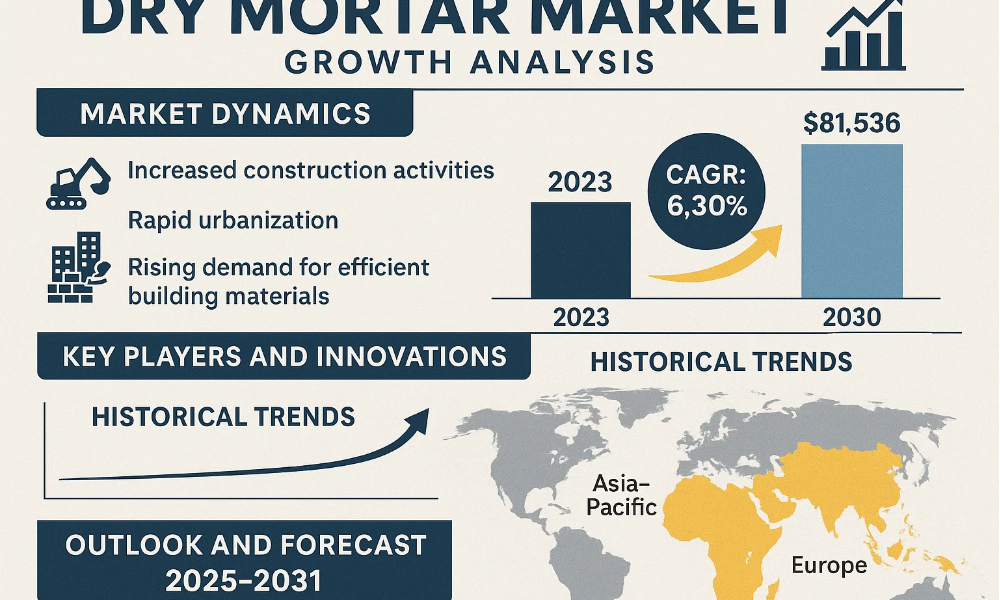
The global Dry Mortar market was valued at US$ 53,824 million in 2023 and is projected to grow at a CAGR of 6.30% during the forecast period, reaching US$ 81,536 million by 2030. This robust growth is driven by increased construction activities, rapid urbanization, and rising demand for efficient building materials. Historical trends reveal a steady rise in the adoption of dry mortar due to its versatility and superior performance compared to traditional materials. In terms of production, the market is segmented across various regions, with Asia-Pacific and Europe dominating the output.
Download Sample: Free Market Analysis Excerpt
Dry mortar refers to pre-mixed construction materials consisting of cement, sand, mineral binders, and other additives. These materials are combined in specific proportions at manufacturing facilities to create a ready-to-use mixture. Dry mortars are used for various applications, such as masonry, plastering, flooring, and tiling, eliminating the need for on-site mixing. Their ease of use, consistent quality, and reduced construction time make them a popular choice in the construction industry.
Key statistics:
- 2023 Revenue: $53,824 million
- 2030 Projected Revenue: $81,536 million
- CAGR (2024-2030): 6.30%
Drivers
- Rapid Urbanization: As urban centers expand globally, the demand for efficient and durable construction materials like dry mortar is increasing significantly.
- Technological Advancements: Innovations in dry mortar formulations, such as improved adhesion, water resistance, and thermal insulation, are driving market growth.
- Sustainability Trends: Dry mortars are eco-friendly, reducing on-site material wastage and contributing to sustainable construction practices.
- Rising Infrastructure Development: Government investments in infrastructure projects, including roads, bridges, and residential complexes, boost the demand for dry mortar.
Opportunities
- Emerging Markets: Rapid construction activities in regions like Southeast Asia, Africa, and the Middle East offer untapped growth potential.
- Customized Solutions: The growing demand for specialized dry mortars, such as self-leveling compounds and high-strength adhesives, opens new revenue streams.
Competitor Analysis
The global dry mortar market is moderately fragmented, with major players accounting for approximately 13.94% of total revenue in 2023. Key companies focus on product innovation, strategic partnerships, and geographic expansion to maintain competitive advantage.
Top Manufacturers:
- Sika: Leading provider of innovative construction solutions.
- Saint-Gobain Weber: Known for high-performance building materials.
- Ardex: Specialized in premium adhesives and mortars.
- Henkel: Diversified portfolio with strong market presence.
- Mapei: Renowned for quality and technological advancements in construction products.
Market Segmentation (by Application)
Construction Industry
The largest application segment, encompassing residential, commercial, and industrial construction. Dry mortar is extensively used for masonry, plastering, and flooring.
Home Decoration Industry
Increasing demand for aesthetic finishes and modern designs drives the use of tile adhesives, grouts, and wall renders in home decoration.
Others
Includes niche applications such as waterproofing and insulation in specialized construction projects.
Market Segmentation (by Type)
Bricklaying/Masonry Mortar
Used for bonding bricks and blocks, ensuring structural stability.
Floor Screed
Provides a smooth, level surface for flooring applications.
Tile Adhesives/Grouts
High demand in tiling projects due to their superior bonding and aesthetic properties.
Wall Renders and Plasters
Enhances wall durability and provides a finished appearance.
EIFS Products
Exterior Insulation and Finish Systems (EIFS) contribute to energy-efficient buildings.
Other
Includes specialty mortars for specific industrial applications.
Key Company
- Sika
- Saint-Gobain Weber
- Ardex
- Henkel
- Mapei
- BASF
- Cemex
- Knauf
- Bostik
- CBP
What is Dry Mortar?
Dry mortar represents a revolutionary advancement in construction materials – a factory-prepared blend of cement, sand, mineral additives and polymers that only requires water addition on-site. Engineered for specific applications like masonry, tiling and plastering, these pre-mixed formulations deliver consistent quality, reduced waste and labor savings compared to conventional site-mixed mortars. Major types include tile adhesives, waterproofing compounds, self-leveling underlayments and thermal insulation products.
Recent Developments in the Rotating Tracked Dumper Market (2024–2025)
Launch of hybrid and electric models to meet emission regulations.
Enhanced payload capacity and undercarriage stability for rough terrains.
Adoption of telematics and IoT for fleet monitoring and predictive maintenance.
Introduction of compact models for urban and tunneling projects.
Growing demand from the rental market driving durable, low-maintenance designs.
Safety upgrades including rollover protection and automatic load balancing.
Expansion of manufacturing facilities in Asia and Europe to serve global demand.
Report Scope & Offerings
This comprehensive analysis provides:
- Granular 2024-2030 market forecasts by product and region
- Competitive benchmarking of 15+ manufacturers
- SWOT and value chain analysis
- Emerging technology assessment
Access Full Report: Dry Mortar Market – Comprehensive Research
Download Sample: Free Market Analysis Excerpt
About Intel Market Research
Intel Market Research delivers actionable insights in technology and infrastructure markets. Our data-driven analysis leverages:
- Real-time infrastructure monitoring
- Techno-economic feasibility studies
Competitive intelligence across 100+ countries
Trusted by Fortune 500 firms, we empower strategic decisions with precision.
International: +1(332) 2424 294 | Asia: +91 9169164321
Website: https://www.intelmarketresearch.com
Follow us on LinkedIn: https://www.linkedin.com/company/intel-market-research




