
Controller Area Network (CAN) Transceiver ICs Market: Trends, Innovations & Business Strategies 2025-2032
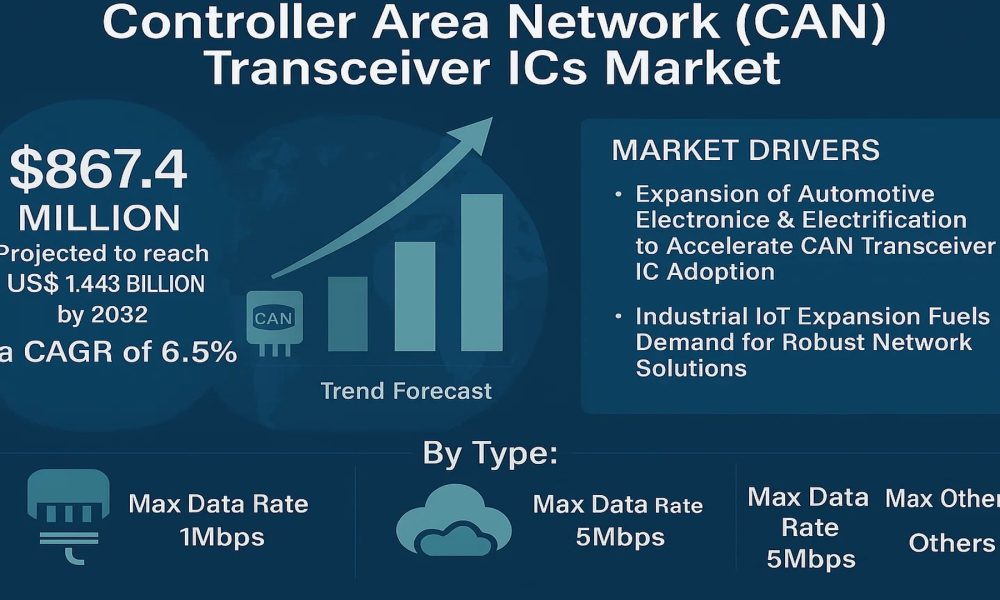
Global Controller Area Network (CAN) Transceiver ICs Market size was valued at US$ 867.4 million in 2024 and is projected to reach US$ 1.43 billion by 2032, at a CAGR of 6.5% during the forecast period 2025-2032
CAN Transceivers are critical components that detect and drive data between electronic control units (ECUs) and the CAN bus in automotive and industrial networks. These ICs convert single-ended logic signals from controllers into robust differential signals required for reliable communication across the CAN bus protocol. Key product variants include transceivers supporting data rates of 1Mbps, 5Mbps, and 8Mbps, catering to different performance requirements in vehicle networks and industrial automation systems.
The market growth is primarily driven by increasing automotive electronics content, with modern vehicles containing 70-100 ECUs on average. Furthermore, the transition towards electric and autonomous vehicles is accelerating demand, as these applications require enhanced network reliability. Industrial automation adoption is another key growth factor, with the Industry 4.0 movement driving 12.5% annual growth in industrial communication networks. Recent developments include NXP Semiconductor’s launch of the TJA146x family in 2023, featuring improved EMC performance for next-generation automotive networks. Other major players like Texas Instruments and Infineon Technologies are expanding their CAN FD (Flexible Data-rate) transceiver portfolios to address evolving market needs.
Get Full Report with trend analysis, growth forecasts, and Future strategies : https://semiconductorinsight.com/report/controller-area-network-can-transceiver-ics-market/
Segment Analysis:
By Type
Max Data Rate 5Mbps Segment Leads Owing to High Demand in Automotive and Industrial Applications
The market is segmented based on type into:
- Max Data Rate 1Mbps
- Max Data Rate 5Mbps
- Max Data Rate 8Mbps
- Others
By Application
Automotive Application Dominates Due to Pervasive CAN Integration in Vehicle Electronics
The market is segmented based on application into:
- Automotive
- Industrial Application
- Aerospace & Defense
- Building Automation
- Others
MARKET DYNAMICS
MARKET DRIVERS
Expansion of Automotive Electronics & Electrification to Accelerate CAN Transceiver IC Adoption
The automotive industry’s rapid shift toward electrification and advanced driver assistance systems (ADAS) is creating unprecedented demand for CAN transceiver ICs. Modern vehicles now contain nearly 150 electronic control units (ECUs) on average, requiring robust network communication solutions. The global electric vehicle market, projected to grow at over 25% CAGR through 2030, particularly drives demand as these vehicles typically require 2-3 times more CAN nodes than conventional vehicles. Semiconductor manufacturers are responding with innovative products – in Q1 2024, a leading vendor introduced a new family of CAN FD transceivers specifically designed for high-voltage automotive applications up to 48V systems.
Industrial IoT Expansion Fuels Demand for Robust Network Solutions
Industrial applications accounted for nearly 28% of CAN transceiver IC shipments in 2023, a percentage expected to grow as Industry 4.0 adoption accelerates. The industrial sector’s need for noise-immune, fault-tolerant communication in harsh environments makes CAN the protocol of choice for machine controls, robotics, and smart manufacturing systems. With the global industrial automation market expected to exceed $400 billion by 2027, manufacturers are developing industrial-grade transceivers supporting extended temperature ranges (-40°C to +125°C) and reinforced isolation barriers exceeding 5000V RMS. The emergence of CAN XL protocol support in next-generation transceivers will further drive this segment’s growth as factories demand higher bandwidth for real-time data exchange.
Regulatory Mandates for Vehicle Safety Systems Propel Market Growth
Government regulations worldwide mandating advanced safety features in vehicles are creating structural demand for CAN transceiver ICs. The European Union’s General Safety Regulation requires all new vehicles to include intelligent speed assistance and other ADAS features by 2024, while similar requirements take effect in North America and Asia. This regulatory push has led automotive OEMs to design more sophisticated network architectures, with premium vehicles now incorporating multiple CAN FD domains operating at 5Mbps. The ADAS segment alone is expected to require over 350 million CAN transceiver units annually by 2026, representing a 70% increase from 2023 shipment levels.
MARKET OPPORTUNITIES
Emerging Vehicle Architectures with Zonal Controllers Create New Application Spaces
The automotive industry’s transition to zonal architectures represents a significant opportunity for CAN transceiver IC suppliers. These architectures consolidate multiple ECUs into zonal controllers connected via high-speed backbones while using CAN FD for local device networks. Leading semiconductor companies are developing new transceiver families specifically for zonal applications, featuring ultra-low power modes and enhanced diagnostic capabilities. The zonal controller market is projected to exceed $8 billion by 2028, with each zonal node requiring 4-8 CAN transceivers for peripheral connectivity, creating substantial unit volume opportunities despite the broader network architecture shift towards Ethernet.
Industrial Automation’s Wireless Connectivity Demands Drive CAN-Hybrid Solutions
Industrial applications increasingly demand wireless connectivity while retaining deterministic CAN communication, creating opportunities for hybrid wired-wireless solutions. The global industrial wireless sensor network market growing at 15% annually reflects this trend. Several suppliers now offer CAN-to-wireless gateway ICs with time-sensitive networking (TSN) capabilities, allowing seamless integration of legacy CAN systems with modern industrial IoT architectures. This convergence enables retrofit applications in existing factories while maintaining the robustness of CAN for critical control functions. Analysts estimate the industrial communications gateway market will surpass $1.5 billion by 2026, with CAN variants capturing significant market share.
CONTROLLER AREA NETWORK (CAN) TRANSCEIVER ICS MARKET TRENDS
Automotive Electrification Driving CAN Transceiver IC Demand
The rapid shift towards vehicle electrification and autonomous driving technologies is significantly accelerating the adoption of CAN transceiver ICs. Modern vehicles now incorporate over 70-100 electronic control units (ECUs) connected via CAN networks, creating sustained demand for robust communication solutions. The transition to CAN FD (Flexible Data Rate) standards is particularly notable, offering data rates up to 5 Mbps compared to traditional CAN’s 1 Mbps, while maintaining backward compatibility. Furthermore, the emergence of CAN XL protocol, supporting speeds up to 10+ Mbps, is poised to address bandwidth requirements for next-generation automotive architectures featuring advanced driver assistance systems (ADAS) and vehicle-to-everything (V2X) communications.
Other Trends
Industrial IoT Expansion
Beyond automotive applications, growing Industrial IoT (IIoT) deployment is fueling demand for industrial-grade CAN transceivers. Manufacturing facilities increasingly adopt CANopen and DeviceNet protocols for machine-to-machine communication in harsh environments. The market sees particular growth in predictive maintenance systems, where CAN networks connect vibration sensors, thermal cameras, and other monitoring equipment. With industrial automation investments projected to grow annually by 7-9%, this sector represents a key growth vector for transceiver IC manufacturers offering extended temperature range (-40°C to +125°C) and EMI-resistant solutions.
Functional Safety & Cybersecurity Integration
Mounting functional safety requirements across industries are prompting transceiver IC innovations. The automotive sector’s ISO 26262 ASIL-D compliance mandates have driven development of fail-safe transceivers with advanced diagnostics covering bus short circuits, loss of ground, and over-temperature conditions. Simultaneously, cybersecurity concerns in connected vehicles and industrial systems are accelerating adoption of hardware-based security modules in next-gen CAN transceivers. These integrate message authentication and encryption acceleration, addressing vulnerabilities exposed by research showing over 60% of modern vehicles remain susceptible to CAN bus attacks if unprotected.
Recent Developments:
- Advancements in Automotive Applications
- Advancement: CAN transceiver ICs are increasingly being used in automotive electronics for advanced driver assistance systems (ADAS), infotainment systems, and electric vehicle (EV) integration.
- Impact: The growing demand for connected cars and EVs is driving the need for more reliable and faster CAN transceiver ICs, improving vehicle communication and overall system efficiency.
- Integration with Industrial Automation Systems
- Advancement: The use of CAN transceiver ICs is expanding in industrial automation for applications like robotics, factory automation, and smart factory systems.
- Impact: As industries move toward Industry 4.0, the need for robust, low-latency, and reliable communication between equipment is fueling the adoption of CAN transceivers in various automation systems.
- Miniaturization and Power Efficiency
- Advancement: Recent developments in miniaturization and low-power consumption of CAN transceiver ICs are making them ideal for space-constrained and energy-efficient applications, such as IoT devices, medical devices, and wearables.
- Impact: The focus on smaller form factors and better energy efficiency is pushing CAN transceivers into new market segments, especially in smart homes, healthcare monitoring, and wearable tech.
- Increased Focus on Security Features
- Advancement: CAN transceiver ICs are being enhanced with security features to protect against cyber threats, especially as more vehicles and industrial systems become connected.
- Impact: With the growing need for secure communication in sectors like automotive, IoT, and smart cities, these security-enhanced CAN transceivers are becoming a critical component in safeguarding data transmission.
- Support for High-Speed CAN FD (Flexible Data-rate)
- Advancement: The emergence of CAN FD (Flexible Data-rate) is enabling CAN transceivers to support higher data transfer speeds, making them suitable for high-bandwidth applications such as advanced vehicle systems and high-performance industrial equipment.
- Impact: The adoption of CAN FD is expanding the market for transceiver ICs, particularly in industries requiring higher communication speeds, such as automotive, aerospace, and robotics.
Learn more about Competitive Analysis, and Forecast of Controller Area Network (CAN) Transceiver ICs Market: https://semiconductorinsight.com/download-sample-report/?product_id=103418
COMPETITIVE LANDSCAPE
Key Industry Players
Strategic Innovations and Partnerships Drive Market Positioning
The Controller Area Network (CAN) Transceiver ICs market features a semi-consolidated competitive structure, with dominant multinational semiconductor firms competing alongside specialized mid-tier and emerging regional players. NXP Semiconductors leads the segment, holding approximately 28% revenue share in 2024, leveraging its pioneering CAN FD (Flexible Data-rate) technology and extensive automotive sector partnerships.
Texas Instruments and Infineon Technologies follow closely, collectively accounting for 35% market share. Their growth stems from robust industrial automation portfolios and proprietary EMC (electromagnetic compatibility) enhancements in transceiver designs. While the European market remains Infineon’s stronghold, Texas Instruments dominates North American supply chains through strategic distributor networks.
Recent developments highlight intensified competition: NXP’s Q2 2024 launch of the TJA1463 CAN SIC transceiver featuring 8Mbps throughput targets next-gen automotive architectures, while Infineon’s collaboration with Bosch on multi-voltage domain transceivers strengthens industrial IoT positioning. Meanwhile, Analog Devices and STMicroelectronics are gaining traction through cybersecurity-focused CAN transceivers with embedded authentication protocols.
The landscape shows increasing vertical integration, with onsemi and Microchip Technology expanding their CAN portfolios through acquisitions. Onsemi’s 2023 purchase of GT Advanced Technologies enhanced its silicon carbide capabilities for high-temperature automotive transceivers. Meanwhile, Asian players like Novosense Microelectronics and Guangzhou Zhiyuan Electronics compete aggressively on cost-efficiency, capturing 18% of the APAC market through localized support structures.
List of Key CAN Transceiver IC Companies Profiled
- NXP Semiconductors (Netherlands)
- Texas Instruments (U.S.)
- Infineon Technologies (Germany)
- onsemi (U.S.)
- Analog Devices (U.S.)
- Microchip Technology (U.S.)
- STMicroelectronics (Switzerland)
- MaxLinear (U.S.)
- Renesas Electronics (Japan)
- Silicon IoT (China)
- Chipanalog (China)
- Novosense Microelectronics (China)
- Elmos Semiconductor (Germany)
- Guangzhou Zhiyuan Electronics (China)
Browse Related Reports : Resonant Fiber Laser Market
CONTACT US:
City vista, 203A, Fountain Road, Ashoka Nagar, Kharadi, Pune, Maharashtra 411014
+91 8087992013
[email protected]




