
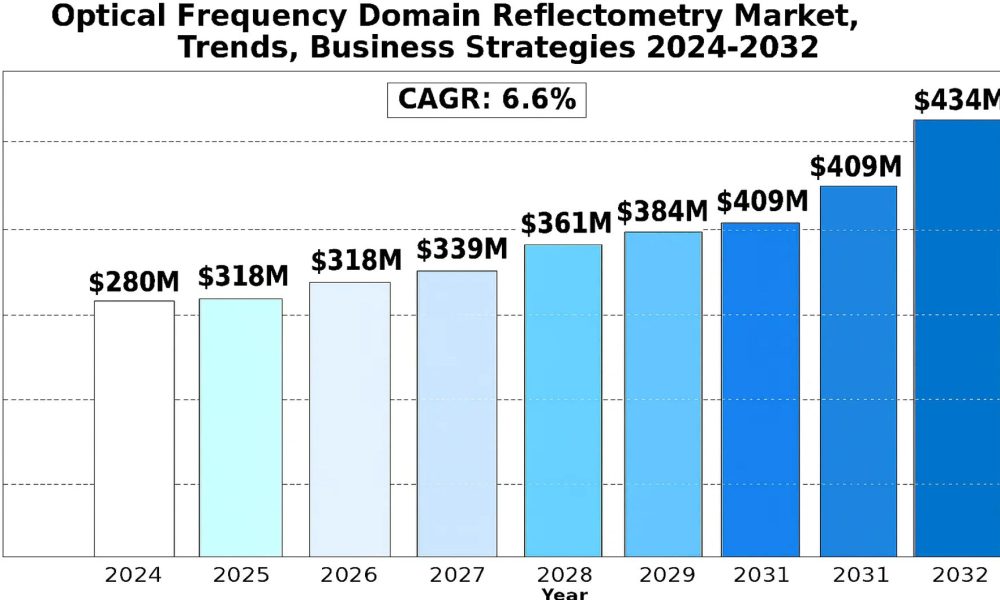
Optical Frequency Domain Reflectometry Market was valued at 280 million in 2024 and is projected to reach US$ 434 million by 2032, at a CAGR of 6.6% during the forecast period
Optical Frequency Domain Reflectometry Market was valued at 280 million in 2024 and is projected to reach US$ 434 million by 2032, at a CAGR of 6.6% during the forecast period.
Optical Frequency Domain Reflectometry (OFDR) is a high-precision fiber optic measurement technology used to analyze light reflection characteristics in optical fibers. Unlike traditional Optical Time Domain Reflectometry (OTDR), OFDR operates in the frequency domain using continuous wave laser sources, enabling superior resolution (as fine as 1 mm) and dynamic range (typically exceeding 90 dB). This technology plays a critical role in distributed sensing applications and optical component characterization.
The market growth is primarily driven by increasing demand for high-resolution fiber optic testing in telecommunications infrastructure, particularly with the global rollout of 5G networks requiring precise fiber characterization. Furthermore, adoption in distributed temperature and acoustic sensing applications across energy pipelines and aerospace structures is creating new opportunities. Key players including Luna Innovations and Anritsu Corporation are developing advanced OFDR systems with improved measurement speeds exceeding 100 Hz for real-time monitoring applications.
Download Sample Report https://semiconductorinsight.com/download-sample-report/?product_id=107454
MARKET DRIVERS
Expansion of 5G Networks Fueling OFDR Adoption in Telecom Infrastructure
The global rollout of 5G networks is creating unprecedented demand for high-precision fiber optic testing solutions. Optical Frequency Domain Reflectometry (OFDR) systems are becoming indispensable for maintaining ultra-low latency connections, with 5G base stations requiring installation density up to 10 times greater than 4G networks. Unlike traditional OTDR methods, OFDR’s superior resolution below 1 cm enables telecom operators to pinpoint microscopic fiber defects that could compromise 5G performance. Major carriers have invested over $200 billion worldwide in 5G infrastructure since 2020, directly contributing to double-digit growth in OFDR equipment sales.
Industrial IoT Adoption Driving Demand for Distributed Fiber Sensing
Manufacturing plants and energy facilities are increasingly deploying OFDR-based distributed temperature and strain sensing systems as part of Industrial IoT transformations. These systems provide real-time monitoring across kilometers of fiber with spatial resolution under 10 mm, detecting thermal anomalies in chemical reactors or structural stresses in pipelines. The global industrial sensors market surpassed $20 billion in 2023, with fiber optic variants growing at nearly 15% annually. OFDR technology accounts for approximately 25% of this segment due to its unparalleled measurement density and accuracy in harsh environments.
Recent Development:
1 Distributed Biosensing with OFDR
- A pioneering distributed optical fiber biosensor incorporates a tapered fiber (6 µm waist, 140 mm length) coated with human IgG. It uses OFDR to detect anti-human IgG via shifts in Rayleigh backscattering, achieving 2 ng/mL detection sensitivity over a 50 mm sensing range with ~680 µm spatial resolution
- This marks a significant leap—from traditional single-point detection to micron-level localization of biochemical substances.
2 Enhanced Temperature Sensing via Rayleigh Backscattering Enhanced Fiber
- A novel temperature sensing method uses Rayleigh Backscattering Enhanced Fibers (RBEF): strong random scattering points act as reference markers.
- With 12.5 µm spatial resolution, the method achieves 0.418 °C per meter temperature resolution and a positioning error of just 0.02 m
MARKET OPPORTUNITIES
Emerging Applications in Biomedical Sensing Creating New Revenue Streams
Medical researchers are adapting OFDR technology for minimally invasive diagnostic procedures, representing a $1.2 billion potential market by 2028. Recent breakthroughs include OFDR-based catheters capable of mapping cardiac tissue elasticity and endoscopes that detect early-stage tumors through microstrain measurements. The technology’s micron-level resolution enables detection of biological changes long before they become visible through imaging. Clinical trials have demonstrated 92% accuracy in identifying vulnerable atherosclerotic plaques using OFDR techniques.
Automation and AI Integration Enhancing OFDR Accessibility
Vendors are developing intelligent OFDR platforms with automated fault detection and machine learning-driven analytics. These systems reduce dependency on highly specialized operators by interpreting complex reflectometry data through standardized reports. Early adopters report 30% faster deployment times and 40% lower training requirements compared to conventional OFDR solutions. The integration of cloud platforms enables remote diagnostics, allowing single experts to support multiple field teams simultaneously.
List of Key Optical Frequency Domain Reflectometry Companies Profiled
- Luna Innovations (U.S.)
- FBGS Technologies (Belgium)
- Anritsu Corporation (Japan)
- APEX Technologies (China)
- Mega-Sense (Germany)
- Yokogawa Electric Corporation (Japan)
- VIAVI Solutions Inc. (U.S.)
- EXFO Inc. (Canada)
- Optromix Inc. (U.S.)
Segment Analysis:
By Type
Single-Mode Fiber Segment Dominates Due to High-Precision Applications in Telecommunication and Industrial Sensing
The market is segmented based on type into:
- Single-Mode Fiber
- Subtypes: Standard single-mode, Bend-insensitive single-mode, and others
- Multimode Fiber
- Subtypes: Step-index multimode, Graded-index multimode, and others
By Application
Temperature Sensing Leads the Market Owing to Extensive Use in Industrial Monitoring and Energy Infrastructure
The market is segmented based on application into:
- Temperature Sensing
- Acoustic Sensing
- Strain Measurement
- Optical Component Testing
- Others
By End User
Telecom Sector Accounts for Largest Share Due to Increasing 5G Network Rollouts Globally
The market is segmented based on end user into:
- Telecommunication
- Oil & Gas
- Aerospace & Defense
- Energy & Utilities
- Research & Development
Report Scope
This market research report provides a comprehensive analysis of the Global and regional Optical Frequency Domain Reflectometry (OFDR) markets, covering the forecast period 2025–2032. It offers detailed insights into market dynamics, technological advancements, competitive landscape, and key trends shaping the industry.
Download Sample Report https://semiconductorinsight.com/download-sample-report/?product_id=107454
Key focus areas of the report include:
- Market Size & Forecast: Historical data and future projections for revenue, unit shipments, and market value across major regions and segments. The Global OFDR market was valued at USD 280 million in 2024 and is projected to reach USD 434 million by 2032, growing at a CAGR of 6.6%.
- Segmentation Analysis: Detailed breakdown by product type (Single-Mode Fiber, Multimode Fiber), application (Temperature Sensing, Acoustic Sensing, Others), and end-user industry to identify high-growth segments.
- Regional Outlook: Insights into market performance across North America, Europe, Asia-Pacific, Latin America, and the Middle East & Africa, with specific focus on leading markets like the US, China, Japan, and Germany.
- Competitive Landscape: Profiles of leading market participants including Luna, FBGS, Anritsu, APEX Technologies, and Mega-Sense, covering their product portfolios, market shares, and strategic developments.
- Technology Trends & Innovation: Assessment of emerging OFDR technologies, integration with IoT platforms, and advancements in high-precision fiber optic measurement systems.




