
Definition
Dietary modified starch, also referred to as starch derivatives, represents an essential class of ingredients widely used in the global food industry. These starches are produced by altering native starch sources such as corn, cassava, potato, and wheat through physical, enzymatic, or chemical processes. The modification enhances their functionality, enabling improved heat stability, acid resistance, thickening capacity, and processing performance. With corn starch accounting for more than 55% of global modified starch production due to its low cost and abundant availability, dietary modified starch plays a crucial role in diverse food applications, ranging from instant noodles and frozen foods to meat products and dairy alternatives. Beyond food, it is also utilized in pharmaceuticals and industrial applications, though its dominant market share lies in the food and beverage industry. This makes dietary modified starch a key ingredient supporting the expanding demand for processed and convenience foods worldwide.
Recent Developments in the Dietary Modified Starch Market
The dietary modified starch market is experiencing significant growth and innovation, driven by changing consumer preferences and advancements in food science. A key recent development is the increasing focus on clean-label starches, which are modified using physical or enzymatic methods rather than chemical ones. This trend aligns with consumer demand for ingredients that are perceived as more natural and less processed. Manufacturers are also developing specialized modified starches with enhanced functionalities, such as those that provide superior freeze-thaw stability, fat replacement properties, or a better texture in specific food products like dairy, bakery, and meat alternatives. The market is also being shaped by the rising demand for convenience and processed foods, particularly in emerging economies, which is driving research and development into more efficient and versatile starch solutions.
Major Distribution Channels
The distribution of dietary modified starches is primarily handled through a B2B model, where the products move from manufacturers to food and beverage producers. A major distribution channel is direct sales to manufacturers, which is especially common for large-scale food companies that require customized starch solutions for their products. This channel allows for close collaboration between the supplier and the customer to ensure the starch meets specific functional requirements. Another critical channel is specialized ingredient distributors and wholesalers, who act as intermediaries, providing a wide range of modified starches to small and medium-sized food producers who may not have the capacity for direct procurement. The growing importance of online platforms and e-commerce is also emerging as a channel, particularly for smaller quantities or for R&D purposes, making it easier for new food startups and innovators to access these ingredients.
Market Size
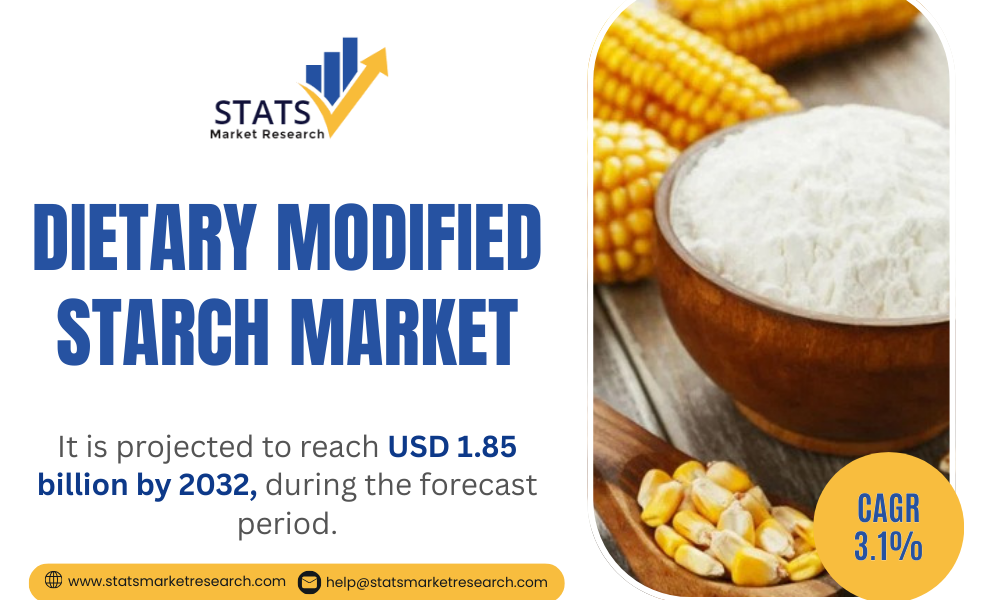
Global dietary modified starch market size was valued at USD 1.50 billion in 2024 and is projected to expand steadily, reaching USD 1.55 billion in 2025 and further rising to USD 1.85 billion by 2032. This growth reflects a CAGR of 3.1% during the forecast period (2025–2032).
The increasing consumption of processed and convenience foods continues to be the primary market driver, with instant noodles accounting for 22% of overall demand. Rising demand for gluten-free and clean-label food alternatives also plays a critical role in supporting market growth. The Asia-Pacific region, particularly China, contributes significantly to production and consumption, accounting for more than 35% of global output. Given the rising demand for plant-based, gluten-free, and health-oriented food products, the market is expected to continue expanding moderately, supported by innovation and sustainability initiatives by leading companies.
Download FREE Sample of this Report @ https://www.statsmarketresearch.com/download-free-sample/8057384/global-dietary-modified-starch-forecast-market
Market Dynamics (Drivers, Restraints, Opportunities, and Challenges)
Drivers
- Growing demand for processed and convenience foods: Rising urbanization and busy lifestyles have spurred global demand for convenience food products, with dietary modified starch serving as a vital component in instant noodles, sauces, frozen food, and bakery items.
- Shift toward clean-label and gluten-free trends: Over 65% of consumers globally demand recognizable and natural ingredients. This trend drives innovation in enzymatic and physical starch modifications to reduce reliance on chemical additives.
- Technological advancements in starch modification: New methods such as enzymatic and thermal modification enable starches to withstand high temperatures (up to 120°C) and perform better in diverse applications, enhancing product quality and processing efficiency.
Restraints
- Stringent regulations: Food safety authorities in North America and Europe enforce strict guidelines on chemically modified ingredients, which can delay new product launches by 12–18 months.
- Raw material price volatility: Corn, cassava, and potato prices fluctuate by up to 30% annually due to climate impacts and agricultural policies, raising concerns about cost management and long-term stability.
- Consumer misperception: Around 42% of European consumers view “modified” ingredients as artificial, posing challenges for acceptance despite proven safety and functionality.
Opportunities
- Emerging markets expansion: Asia-Pacific and Latin America, with rapid urbanization and rising middle-class populations, are expected to drive 45% of market growth through 2030.
- Plant-based and alternative foods: Modified starch is becoming increasingly vital in plant-based meats and dairy alternatives, offering premium pricing opportunities with 20–30% higher margins compared to conventional starches.
- Sustainability initiatives: Green modification processes, including water-saving and waste-recovery technologies, provide competitive advantages and align with global sustainability trends.
Challenges
- Balancing innovation with regulation: Companies must invest in compliant technologies while addressing consumer demand for natural solutions.
- Competition from hydrocolloids: Alternative texturizers such as xanthan gum and guar gum present competitive pressures.
- Supply chain disruptions: Global logistics challenges and agricultural uncertainties may affect production and pricing consistency.
Regional Analysis
- North America: The U.S. dominates the regional market, driven by high consumption of processed foods, gluten-free products, and advanced R&D investments by multinationals such as Cargill and ADM.
- Europe: Characterized by strict regulatory frameworks but strong demand for clean-label and organic food products. Major players like Tate & Lyle and Avebe focus on premium starches, particularly for bakery and dairy.
- Asia-Pacific: Accounts for the largest share, with China producing over 35% of global dietary modified starch. Instant noodles and plant-based diets are key growth contributors.
- Latin America: Brazil and Mexico show significant growth, driven by urbanization and rising processed food demand. Local production and partnerships with global companies are expanding.
- Middle East & Africa: Although smaller in scale, the region is witnessing rising demand for processed foods and bakery products, creating new opportunities for starch adoption.
Get the Complete Report & TOC @ https://www.statsmarketresearch.com/global-dietary-modified-starch-forecast-market-8057384
Competitor Analysis (in brief)
The market is moderately consolidated, with the top five players holding 34% of market share. Major players include:
- Cargill, Incorporated: Market leader with vertically integrated supply chains and a diverse product portfolio.
- ADM (Archer-Daniels-Midland Company): Strengthens its presence in Asia through partnerships and instant noodle segment growth.
- Ingredion Incorporated: Innovates in heat-resistant starches, with a strong focus on clean-label solutions.
- Roquette Frères: Specializes in pea-based starch derivatives, supporting plant-protein markets.
- Avebe: Focuses on premium potato-based starch solutions for Europe.
Mid-size players such as Emsland Group and Sanwa Starch compete via regional specialization and targeted product innovations, while Chinese producers like Guangxi Nongken Mingyang Biochemical increasingly expand their global presence.
Global Dietary Modified Starch Market: Segmentation Analysis
This report provides a deep insight into the global dietary modified starch market, covering all its essential aspects. This ranges from a macro overview of the market to micro details of the market size, competitive landscape, development trend, niche market, key market drivers and challenges, SWOT analysis, value chain analysis, etc.
The analysis helps the reader to shape the competition within the industries and strategies for the competitive environment to enhance the potential profit. Furthermore, it provides a simple framework for evaluating and assessing the position of the business organization. The report structure also focuses on the competitive landscape of the Global Dietary Modified Starch Market. This report introduces in detail the market share, market performance, product situation, operation situation, etc., of the main players, which helps the readers in the industry to identify the main competitors and deeply understand the competition pattern of the market.
In a word, this report is a must-read for industry players, investors, researchers, consultants, business strategists, and all those who have any kind of stake or are planning to foray into the Dietary Modified Starch Market in any manner.
Market Segmentation (by Application)
- Instant Noodles
- Meat Products
- Frozen Food
- Sauce Products
- Baked Products
- Beverage
- Dairy
- Others
Market Segmentation (by Type)
- Phosphate Starch
- Monostarch phosphate
- Distarch phosphate
- Others
- Acetate Starch
- Oxidized Starch
- Acetylated Distarch Phosphate
- Others
Key Company
- Cargill, Incorporated (U.S.)
- ADM (U.S.)
- Roquette Frères (France)
- Ingredion Incorporated (U.S.)
- Avebe (Netherlands)
- Tate & Lyle (U.K.)
- Emsland Group (Germany)
- Sanwa Starch Co., Ltd. (Japan)
- Hangzhou Prostar Starch Co., Ltd. (China)
- Guangxi Nongken Mingyang Biochemical (China)
Geographic Segmentation
- North America
- Europe
- Asia-Pacific
- Latin America
- Middle East & Africa
FAQs
What is the current market size of the dietary modified starch market?
The global dietary modified starch market was valued at USD 1.50 billion in 2024 and is projected to reach USD 1.85 billion by 2032 at a CAGR of 3.1%.
Which are the key companies operating in the dietary modified starch market?
Major companies include Cargill, ADM, Ingredion, Roquette Frères, Avebe, Tate & Lyle, Emsland Group, Sanwa Starch, Hangzhou Prostar, and Guangxi Nongken Mingyang Biochemical.
What are the key growth drivers in the dietary modified starch market?
Key drivers include rising demand for processed foods, increasing adoption of clean-label products, and technological advancements in starch modification processes.
Which regions dominate the dietary modified starch market?
Asia-Pacific leads the global market, with China accounting for over 35% of production, followed by North America and Europe.
What are the emerging trends in the dietary modified starch market?
Emerging trends include plant-based and gluten-free product innovation, sustainability in production, and expansion in emerging markets such as Asia and Latin America.
About Us
☎️ International: +1 (332) 2424 294
📄 Website: www.statsmarketresearch.com
Join us on LinkedIn:- https://www.linkedin.com/company/statsmarketresearch




