
Touch Sensor Switch Market 2025-2032 Trends, Innovations & Strategic Business Insights
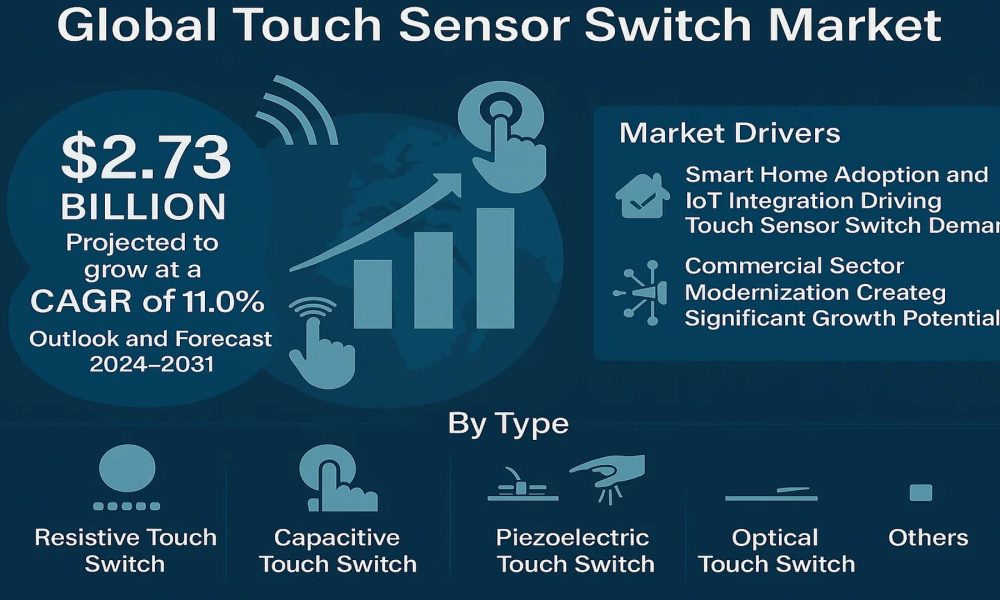
Global Touch Sensor Switch market was valued at 1341 million in 2024 and is projected to reach US$ 2734 million by 2032, at a CAGR of 11.0% during the forecast period. While North America remains a key market, China’s touch sensor switch sector is demonstrating accelerated growth potential.
Touch sensor switches are electronic components that detect physical contact or proximity to trigger device functions, eliminating mechanical parts for enhanced durability. These devices operate through various technologies, primarily resistive (pressure-sensitive) and capacitive (field-disturbance) systems, with capacitive variants gaining dominance due to multi-touch capabilities and better responsiveness.
The market expansion is driven by increasing smart home adoption, automotive HMI advancements, and industrial automation trends. The shift toward sleek, buttonless interfaces in consumer electronics has particularly boosted demand. Leading manufacturers like Panasonic, Omron, and TE Connectivity are investing in low-power IoT-compatible switches, with ALPS Alpine recently introducing a new moisture-resistant capacitive series for automotive applications in Q1 2024.
Get Full Report with trend analysis, growth forecasts, and Future strategies : https://semiconductorinsight.com/report/touch-sensor-switch-market/
MARKET DYNAMICS
MARKET DRIVERS
Smart Home Adoption and IoT Integration Driving Touch Sensor Switch Demand
The rapid expansion of smart home ecosystems across developed and emerging economies represents one of the strongest growth drivers for touch sensor switches. With global smart home device shipments expected to exceed 1.1 billion units annually by 2026, the demand for intuitive control interfaces like touch sensor switches has surged. These products enable seamless integration with IoT platforms while offering aesthetic and functional advantages over traditional mechanical switches. Major players like Panasonic and Omron have recently introduced compact, energy-efficient touch switches specifically designed for smart home applications, further accelerating market penetration.
Commercial Sector Modernization Creating Significant Growth Potential
Commercial infrastructure development worldwide is increasingly incorporating touch sensor technology as part of modern building automation systems. Industries such as hospitality and healthcare show particular preference for capacitive touch switches due to their hygienic, easy-to-clean surfaces and vandal-resistant properties. The global commercial construction sector’s annual growth rate of approximately 8% directly correlates with rising demand for advanced electrical solutions. Recent technology exhibitions have showcased innovative applications including touch-sensitive smart mirrors and interactive control panels, indicating expanding use cases beyond traditional switch applications.
Advancements in Touch Technology Enhancing Product Capabilities
Technological breakthroughs in capacitive sensing and haptic feedback mechanisms have significantly improved touch sensor switch performance. Modern capacitive variants now achieve >99% accuracy in detection while consuming minimal power, addressing previous concerns about reliability and energy efficiency. Leading manufacturers have recently introduced multi-touch capable switches with programmable gesture controls, opening new possibilities for user interaction. These advancements, combined with decreasing production costs through economies of scale, make touch sensor switches increasingly viable for mass-market adoption across both residential and commercial segments.
MARKET OPPORTUNITIES
Emerging Markets Present Significant Untapped Potential
Rapid urbanization in developing economies offers substantial growth opportunities for touch sensor switch manufacturers. Government-led smart city initiatives across Asia and the Middle East increasingly specify modern electrical solutions in their infrastructure plans. The Asia-Pacific region alone represents a potential market valued in the hundreds of millions, with commercial and residential construction booming in key markets. Localized product adaptations addressing regional preferences and price sensitivity could open new revenue streams for manufacturers willing to invest in tailored market entry strategies.
Integration With Emerging Technologies Creating New Applications
Convergence with adjacent technologies presents exciting possibilities for touch sensor switch evolution. Recent prototypes demonstrate promising integrations with biometric authentication for security applications and AI-driven adaptive lighting controls. The incorporation of machine learning algorithms could enable predictive touch interfaces that anticipate user needs based on behavioral patterns. These innovations may lead to premium product categories commanding higher margins while expanding the technology’s applicability beyond simple switching functions to comprehensive environmental control solutions.
Energy Efficiency Regulations Driving Sustainable Solutions
Increasingly stringent global energy efficiency standards are creating favorable conditions for touch sensor adoption. Compared to mechanical switches, capacitive touch variants typically achieve 20-30% better energy efficiency due to optimized power management circuits. Regulatory bodies in multiple jurisdictions are updating building codes to encourage modern electrical solutions, with some regions reportedly considering mandated touch interfaces for certain commercial applications. Manufacturers emphasizing sustainability credentials and compliance with emerging standards stand to gain competitive advantage as environmental considerations become principal decision factors for buyers.
TOUCH SENSOR SWITCH MARKET TRENDS
Rising Adoption of Capacitive Touch Technology to Drive Market Growth
The global touch sensor switch market is experiencing significant growth, driven primarily by the increasing adoption of capacitive touch technology. Unlike traditional mechanical switches, capacitive touch sensors offer superior durability, sleek design integration, and enhanced user experience. This technology is widely preferred in consumer electronics, automotive interiors, and smart home applications. Industry projections indicate that capacitive touch switches accounted for approximately 65% of the market share in 2024, with this dominance expected to continue through 2032 due to their compatibility with modern touchscreens and IoT-enabled devices.
Other Trends
Smart Home and IoT Integration
The proliferation of smart home systems and IoT-enabled devices has created substantial demand for touch sensor switches. Home automation systems increasingly rely on these switches for seamless control of lighting, HVAC, and security systems. With the global smart home market projected to grow at a CAGR of over 12% from 2024 to 2032, manufacturers are integrating advanced features like gesture recognition and voice control compatibility into touch switches. These innovations cater to the evolving preferences for contactless and intuitive control interfaces in residential and commercial spaces.
Automotive Industry Transition to Touch-Based Controls
Automakers are progressively replacing mechanical buttons with touch sensor switches in vehicle dashboards, center consoles, and infotainment systems. This shift aligns with consumer demand for minimalist, high-tech interiors and the automotive industry’s push toward electrification and connectivity. By 2024, over 45% of mid-range vehicles incorporated some form of touch-sensitive controls, with premium segments reaching nearly 80% adoption. However, manufacturers face challenges in balancing aesthetic appeal with functional reliability, particularly regarding haptic feedback and operation while driving.
Healthcare and Industrial Applications
While consumer electronics and automotive sectors dominate demand, healthcare and industrial applications are emerging as high-growth segments. In medical equipment, touch sensor switches enable easy sterilization and prevent bacterial buildup compared to traditional buttons. Industrial applications benefit from their resilience in harsh environments when properly sealed. Between 2024-2032, these specialized segments are expected to grow at approximately 9-11% annually, driven by increased automation in manufacturing and higher standards for medical device hygiene.
Recent Developments:
- Increased Adoption in Consumer Electronics
- Touch sensor switches are increasingly being used in consumer electronics, including smartphones, tablets, and home appliances. The demand for sleek, button-free interfaces is driving manufacturers to integrate touch-based switches into more devices for a cleaner, more modern design.
- Advancements in Capacitive and Resistive Technologies
- Recent innovations in capacitive and resistive touch technologies are making touch sensor switches more accurate, responsive, and durable. Capacitive sensors, in particular, offer a higher level of sensitivity and are being used in high-end automotive interiors and smart home systems.
- Integration with IoT and Smart Home Devices
- Smart home devices such as lighting systems, thermostats, and security equipment are increasingly adopting touch sensor switches for more intuitive user experiences. These switches are being integrated with IoT platforms for remote control and automation, allowing users to control their devices via mobile apps and voice assistants.
- Development of Flexible and Transparent Touch Sensors
- The development of flexible and transparent touch sensors is enabling manufacturers to create curved and bendable touch interfaces for use in innovative applications, from automotive dashboards to wearable devices and smart textiles. This trend is contributing to the growing versatility of touch sensor switches.
- Enhanced Durability and Touch Sensitivity
- The latest touch sensor switches feature improved durability and resistance to environmental factors such as extreme temperatures, water, and dust. As a result, they are being widely adopted in automotive, industrial, and medical devices where high-performance and reliability are critical.
Learn more about Competitive Analysis, and Forecast of Touch Sensor Switch Market: https://semiconductorinsight.com/download-sample-report/?product_id=107511
COMPETITIVE LANDSCAPE
Key Industry Players
Market Leaders Accelerate R&D and Expand Capacities to Meet Growing Demand
The global touch sensor switch market features a moderately fragmented competitive environment, with established electronics giants competing alongside specialized component manufacturers. ALPS Alpine emerges as a dominant force, holding significant market share in 2024 due to its diversified product range spanning resistive and capacitive technologies. The company’s strong distribution network across Asia-Pacific and North America reinforces its leadership position.
Panasonic Corporation and Omron Corporation maintain robust positions through continuous product innovation, particularly in industrial-grade touch solutions. Their technological edge in reliability testing and IP-rated switches gives them competitive advantage in commercial applications. Meanwhile, TE Connectivity has been gaining traction through strategic acquisitions that expanded its capacitive touch switch offerings.
Several regional players are making notable strides – BEWIN in China has demonstrated aggressive pricing strategies, while Wurth Elektronik focuses on eco-friendly designs compliant with EU regulations. The market also sees growing participation from semiconductor companies integrating touch controller ICs with switch modules, creating new competitive dynamics.
Recent developments highlight increasing M&A activity, with players like C&K Components expanding through targeted acquisitions to strengthen their capacitive technology portfolios. Simultaneously, Japanese manufacturers are investing heavily in miniaturized switch designs to cater to IoT device manufacturers.
List of Key Touch Sensor Switch Manufacturers
- ALPS Alpine (Japan)
- Mitsumi Electric (Japan)
- Panasonic Corporation (Japan)
- Omron Corporation (Japan)
- TE Connectivity (Switzerland)
- BEWIN (China)
- Wurth Elektronik (Germany)
- C&K Components (U.S.)
- Xinda (China)
- CTS Corporation (U.S.)
- Marquardt (Germany)
- NKK Switches (Japan)
- OMTEN (China)
- Oppho (China)
- Changfeng (China)
- Han Young (South Korea)
- Bourns (U.S.)
Browse Related Reports : Primary Battery Sensor Market
CONTACT US:
City vista, 203A, Fountain Road, Ashoka Nagar, Kharadi, Pune, Maharashtra 411014
+91 8087992013
[email protected]




