
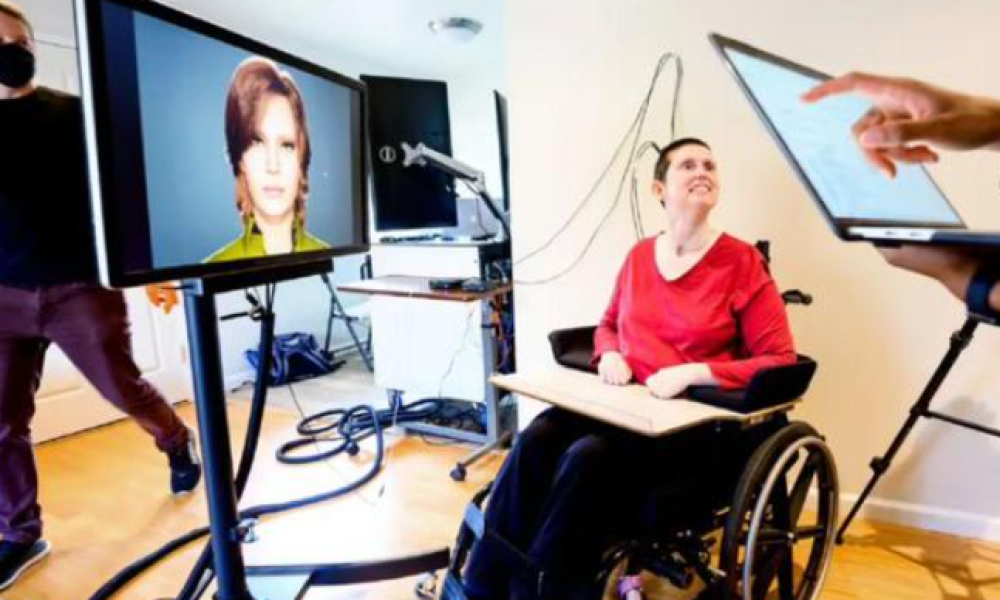
On August 15th, a patient finally heard their own voice again, thanks to a brain-computer interface (BCI) technology that decodes language directly from brain activity.
Real-time “speaking” with a latency of just 1 second
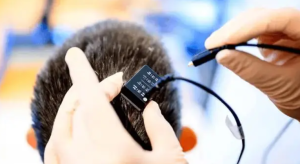
The device relies on an implant placed above the speech-producing area of the brain. When the patient attempts to speak, the implant detects neural activity and transmits signals to a connected computer. An AI decoder then converts these signals into text, speech, or facial expressions on a digital avatar, achieving near-real-time translation with a latency of just 1 second.

Researchers emphasize that this breakthrough has the potential to help a relatively small but extremely vulnerable group of people who have lost their ability to speak due to stroke, amyotrophic lateral sclerosis (ALS), or injury, regain the ability to communicate more quickly and naturally. The system only works when the participant consciously attempts to speak, protecting user autonomy and privacy.
Coincidentally, a Stanford University team recently achieved a major breakthrough in the field of brain-computer interfaces. They were the first to identify and decode brain activity associated with “inner speech”—the silent monologue in people’s heads—with an accuracy rate of 74%. This has opened up a new path for helping people with severe speech disorders regain the ability to communicate naturally.
Recently, the field of brain-computer interfaces has been a hot topic. In early July, Neuralink founder Elon Musk held a press conference to announce the company’s new three-year plan for brain-computer interface technology, which outlined the goal of achieving a full-brain interface by 2028 while gradually increasing the number of electrode channels from the current thousands to tens of thousands.
OpenAI Enters the Brain-Computer Interface Market
Soon after, a video of Apple (AAPL) using its brain to control a device was released, showcasing the magical power of controlling a device with thought, further escalating the interest in brain-computer interfaces. On August 13, OpenAI and its CEO Sam Altman announced the formation of a new company, Merge Labs, in partnership with Worldcoin founder Alex Blania, officially entering the field of brain-computer interfaces.

This move marks a crucial step for OpenAI from the field of artificial intelligence to the brain-computer interface (BCI) industry, placing it in direct competition with Elon Musk’s Neuralink. Altman’s personal involvement demonstrates his strong commitment to the strategic development of BCI technology, significantly increasing public awareness of the topic.
Today, BCIs are considered a relatively sci-fi concept. They primarily involve bypassing peripheral nerves and muscles to establish new communication and control channels directly between the brain and external devices, thereby enhancing, improving, and extending brain function.
As BCI innovations continue to emerge and the industry accelerates its growth, it is like a multifunctional key, gradually unlocking the door to innovation in multiple fields. Currently, the market also has positive expectations for the expansion of the BCI market in the medical field. McKinsey predicts that the global BCI medical market will reach $40 billion by 2030 and exceed $145 billion by 2040.
WiMi’s Advantages Position the Brain-Computer Interface Industry
Amid the rapid development of global brain-computer interface (BCI) technology, data indicates that the R&D team at Wimi Hologram Cloud Inc. (WIMI) has been deeply engaged in the field for several years. This has accelerated the development of multi-sector ecosystem collaboration and commercialization, fostering a new future industry track, creating a differentiated competitive advantage, and becoming a key force in driving the development of new-quality productivity in the BCI industry.
Currently, WiMi adheres to a dual-pronged approach of “underlying technology empowerment + cross-industry integration” in this cutting-edge field, establishing a comprehensive strategy encompassing technology R&D, scenario applications, and industry chain integration. WiMi is simultaneously developing both non-invasive and invasive BCI technologies, with its brain-controlled robotics technology based on steady-state visual evoked potentials (SSVEP) having achieved commercial validation.
In addition, WiMi is deeply integrating BCI with large AI models and humanoid robots. For example, it is combining this with quantum computing technology to develop intelligent interactive systems, potentially enabling “brain-computer + robot” collaborative control in the future. WiMi’s brain-controlled robotics technology has been applied to precision manufacturing, enabling contactless operation and comprehensively promoting BCI technology from the laboratory to multi-scenario applications.
Conclusion
With the rapid advancement of science and technology, many of the fantastical ideas in science fiction are gradually moving from literary and artistic works to reality. Brain-computer interfaces are one of the most anticipated technologies. Many industry experts have stated that brain-computer interfaces are a cutting-edge field of technology. With their alluring prospects, science fiction is no longer just a fantasy. Let’s look forward to seeing miracles like enabling the paralyzed to walk, enabling the aphasic to “speak,” and restoring sight to the blind.




