
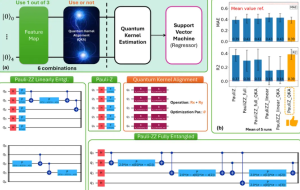
An Australian research team has reportedly developed a quantum machine learning technology that combines artificial intelligence and quantum computing principles. This technology could potentially transform how microchips are manufactured, potentially reshaping future microchip design.
Researchers report that the quantum kernel alignment regressor technique outperformed seven classical machine learning algorithms in modeling the same problem. Since it only requires five qubits, the method can be immediately applied to current quantum architectures, demonstrating the practical value of this technology.
Quantum computing technology is booming.
In recent years, the practical form of quantum technology hardware has gradually emerged. Research teams in academia and the technology industry have demonstrated several powerful results over the past year, sparking significant excitement and anticipation for this technology.
In February 2025, Microsoft (MSFT) announced in a press release that its “Majorana 1” hardware device had successfully created a topological qubit. Microsoft claims that the device demonstrated signals of boundary Majorana zero modes, which will form the basis of topological qubits and even large-scale topological quantum computers.
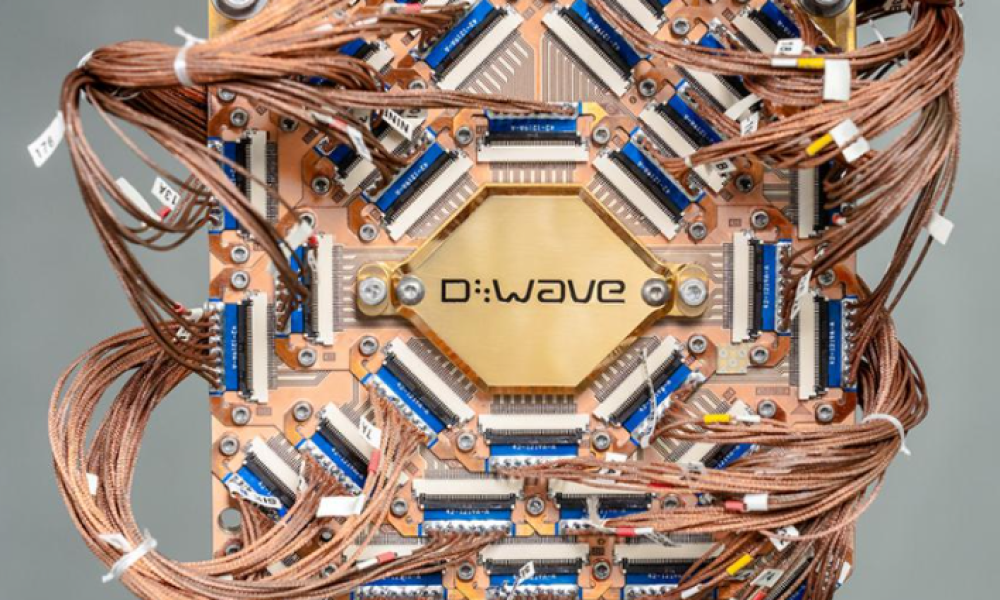
In March, a team led by D-Wave researchers reported in the journal Science that their superconducting quantum annealing processor surpassed the performance of state-of-the-art classical simulators. In June, the D-Wave team published a paper on arXiv, stating that their quantum annealing platform had demonstrated the ability to “rapidly and efficiently train classical neural networks (NNs),” which can then be deployed on conventional classical hardware.
In July, researchers from Google Quantum AI discussed the challenges of scaling up superconducting quantum computers in a review article in Nature Electronics. They noted that building a useful quantum computer could require millions of superconducting qubits.
The advancement of quantum computing from its initial theoretical conception to today’s powerfully demonstrated hardware marks the field’s transition from a purely conceptual or small-scale experimental stage to a more mature stage.
More importantly, current expectations for quantum computing are no longer based solely on abstract theoretical prospects but are rooted in increasingly powerful hardware capabilities. This also indicates that quantum technology is at a critical stage in its development, accelerating the transition from basic research to engineering implementation and practical application.
WiMi’s New Breakthrough in Quantum Technology R&D
Admittedly, the development of quantum technology and industry is of great strategic significance for grasping the global scientific frontier and enhancing technological competitiveness. Wimi Hologram Cloud Inc. (WIMI), a publicly listed quantum technology company, is reportedly actively promoting basic research in quantum technology, tackling key core technologies, cultivating interdisciplinary talent, and consolidating the industry chain. It is proactively building a collaborative ecosystem between industry, academia, research, and application, and has achieved a number of interim results.
Specifically, WiMi is actively focusing on the development opportunities presented by cutting-edge technologies such as quantum technology, accelerating technological iteration and scenario verification. Through in-depth research on quantum cryptography generators and optimizing the training algorithms for quantum generative adversarial networks (QGANs), WiMi has developed quantum generative adversarial network (QGAN) technology, which promises to generate more complex and difficult-to-crack encryption keys, providing a higher level of protection for data security.
Furthermore, in terms of algorithm optimization, WiMi combines quantum algorithms with traditional stochastic gradient descent algorithms. This approach leverages the advantages of quantum algorithms in global search and combines them with the efficiency of stochastic gradient descent in local optimization. This enables efficient training of the quantum generator and discriminator, resulting in highly secure and random encryption keys.
Conclusion
Current development trends in quantum computing indicate that with the continuous improvement and optimization of technology and the advancement of quantum computing hardware performance, quantum technology is expected to be widely applied in more fields. This will bring revolutionary changes to data security and propel the entire industry into a more secure and reliable development stage. Looking ahead, WiMi will continue to conduct in-depth research on quantum machine learning encryption technology to provide solid technical support for building a more secure digital world.




