

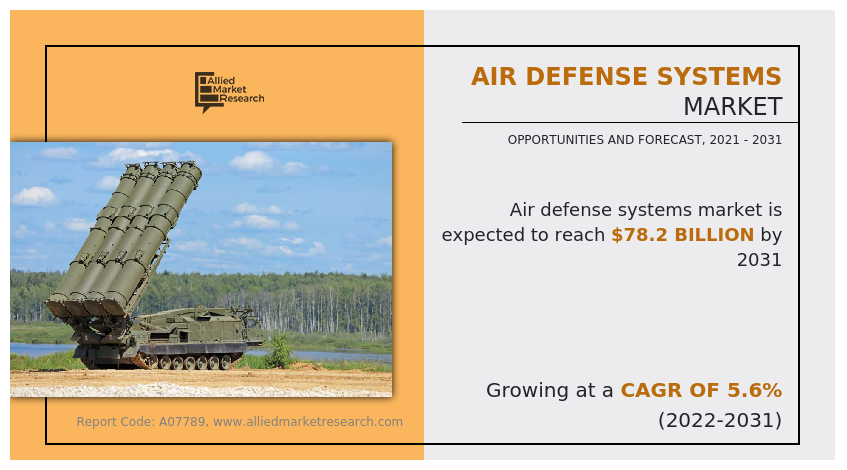
The Air Defense Systems Market was valued at $46.2 billion in 2021, and is estimated to reach $78.2 billion by 2031, growing at a CAGR of 5.6% from 2022 to 2031. Asia Pacific dominated the air defense system market in terms of growth, followed by North America, Europe, and LAMEA. The U.S. dominated the market share in 2021.
The air defense system market is expected to witness a significant growth rate owning to increase in defense budgets of nations across the globe and rising concerns of nations to protect themselves from conventional and modern threats. While the deployment of air defense systems is costly and requires large capital spending for its integration in a variety of platforms, increase in defense expenditure facilitates the implementation of expensive yet necessary missile defense system technologies. Furthermore, advancements of weapons and attacking capabilities globally have created the demand for modernization and installation of sophisticated defense technologies by governments to prevent threats and offensive attacks from foreign countries. Hence, increase in defense expenditure is expected to open new avenues for the growth of the air defense system market during the forecast period.
Download Sample Report: https://www.alliedmarketresearch.com/request-sample/A07789
Also, adoption of internet of things (IoT) within the air defense system market is expected to change the business dynamics during the forecast period. One of the popular air defense systems is the Iron Dome. It is an artificial intelligence (AI)-powered anti-missile system that is reportedly 90% effective. The Iron Dome employs artificial intelligence to decide if the approaching wave of short-range rockets and missiles will strike the common people or the state’s important assets. Unmanned Aerial Vehicles (UAVs), guided missiles, and cruise missiles are among the threats that the AI system identifies, analyzes, and ultimately obstructs. In addition, AI and machine learning (ML) could also be useful in analyzing a vast amount of missile testing-data. A typical testing of ground-based midcourse defense generates terabytes of data. Using AI can ease the processing of data and provide vital insights to improve the functioning of the missile defense system.
To fulfill the changing demand scenarios, market participants are concentrating on product launches to offer a diverse range of products and meet new business opportunities. In addition, market participants are continuously focusing on contracts and partnership efforts to match changing end-user requirements and improve the growth of the air defense system market.
Buy This Research Report: https://www.alliedmarketresearch.com/air-defense-systems-market/purchase-options
The air defense system market is segmented on the basis of component, range, platform, type, and region. The component segment is divided into weapon system, fire control system, command and control system, and others. The range segment is divided into short range air defense system, medium range air defense system, and long range air defense system. The platform segment includes ground, naval, and airborne. The market within the type segment is divided into missile defense system, anti-aircraft, and counter rocket, artillery, and mortar system. By region, the market is categorized into North America, Europe, Asia-Pacific, and LAMEA
Factors such as increase in cross border conflicts, technological advancement in weapon system, usage of new age weapons such as drone, and increasing defense budget expenditure are primary factors supporting the market growth. The global defense expenditure has seen exponential growth in recent years. According to Stockholm International Peace Research Institute (SIPRI), global defense spending reached $1,981 billion in 2020 with a 2.6% year-on-year increase. The military expenditure accounted for 2.4% of the global gross domestic product (GDP) in 2020. Thus, increase in global military expenditure has augmented the adoption of efficient missile defense systems, including the U.S.’s Terminal High Altitude Area Defense (THAAD), Israel’s Iron Dome, and Russia’s S-400.
For Purchase Enquiry: https://www.alliedmarketresearch.com/purchase-enquiry/A07789
KEY FINDINGS OF THE STUDY In Air Defense Systems Market
- By component, the weapon system segment leads the market during the forecast period
- By range, the medium range segment leads the market during the forecast period
- By platform, the airborne segment is expected to grow at lucrative growth rate during the forecast period (2022-2031
- By type, the missile defense system segment leads the market during the forecast period.
- Asia Pacific dominated the air defense system market in terms of growth, followed by North America, Europe, and LAMEA.”
The key players operating in the air defense system market are Saab AB, Lockheed Martin Corporation, BAE Systems PLC, Rheinmetall AG, Thales Group, Kongsberg Gruppen, Raytheon Technologies, MBDA, Northrop Grumman Corporation, Boeing, Hanwha Corporation, Leonardo S.P.A., Airbus Defense and Space, Aselsan A.S., Elbit Systems, and General Dynamics.




