
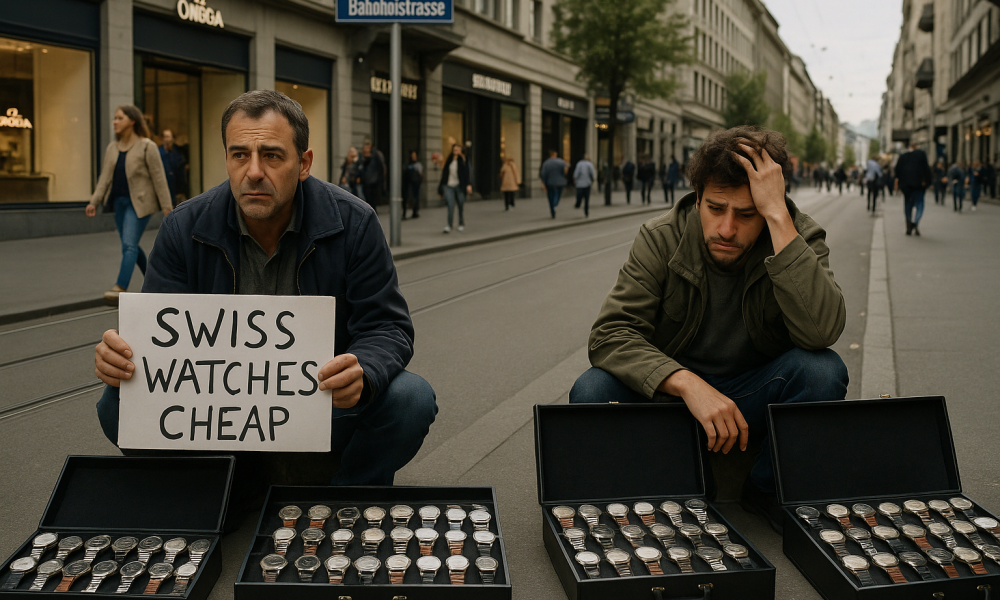
Switzerland once stood as a symbol of neutrality, discretion, and quiet power. Famous for its numbered bank accounts, diplomatic detachment, and global trustworthiness, the Alpine nation carved out an outsized role in the world economy despite its small population of just 9 million. But recent years have seen Switzerland gradually trade away pieces of that identity, aligning itself more closely with Western powers. First came the end of banking secrecy. Then came sanctions on Russia. The assumption was that alignment would bring protection and partnership. Instead, it brought a brutal economic wake-up call.
This week, the White House stunned Swiss businesses and policymakers by announcing a 39 percent import tariff on Swiss goods. It is one of the highest rates in the world, and one that could inflict serious damage on a country where every second franc is earned through exports. The news broke on Switzerland’s national holiday, leaving officials scrambling for answers and industry leaders warning of mass job losses.
The justification from the U.S. side is that Switzerland has not yet signed a formal trade framework, and that the new tariffs are part of a wider push for trade parity. But that logic falls apart under scrutiny.
Switzerland is not China. It is not even the European Union. It is a country of 9 million people with no capacity—demographic or logistical—to balance trade in goods with a nation of over 330 million. As Rahul Sahgal of the Swiss-American Chamber of Commerce put it, “Even if every Swiss was to drink a bottle of bourbon, eat a steak every single day, and buy a Harley Davidson, we would not be able to balance the trade in goods.”
This is the core irrationality of the current American trade approach. It demands a kind of symmetry that is mathematically impossible. Small countries can’t be measured on the same scale as large ones. Their internal markets are limited. Their consumption potential is capped. Yet the Trump administration continues to base tariff decisions solely on the balance of physical goods, ignoring the larger economic relationship, including services and foreign investment.
Switzerland, for example, is already the sixth largest investor in the United States. It has pledged up to $150 billion more—an extraordinary figure relative to the size of its economy. That investment supports American jobs and infrastructure. It is precisely the kind of deep, cooperative economic engagement that the U.S. has asked for. And yet it has done little to shield Switzerland from being lumped in with countries that have openly defied American interests.
There is also a deeper irony in play. Switzerland sacrificed its famed neutrality in 2022 when it joined Western sanctions against Russia and froze billions in Russian assets. That decision broke with centuries of policy and was not taken lightly. At the time, it was framed as an act of solidarity and moral clarity. But it has bought the country no protection from punitive economic measures. If anything, it has left Switzerland exposed—no longer neutral, yet still treated as if it were resisting U.S. influence.
Some might argue that Switzerland should have seen this coming. The Trump administration has always made it clear that trade partners would be judged strictly on terms of goods deficits and surplus. Countries like India, Brazil, and even Canada have faced similar surprises. But Switzerland had reason to believe it would be treated differently. It had cooperated. It had made concessions. It had offered billions in investment. It had frozen Russian assets. The tariff, by contrast, feels like a betrayal.
What makes the situation worse is the timing. Swiss exporters had already endured a sharp appreciation of the Swiss franc earlier this year as global investors sought safe-haven assets. That had already eaten into margins. In response, the Swiss National Bank had cut rates to zero in an effort to fight off deflation. This new tariff now piles on pressure at the worst possible moment.
The hardest-hit sectors will be watchmaking, chemical products, luxury goods, and precision engineering. With the U.S. accounting for roughly one-sixth of Switzerland’s exports, a 39 percent tariff is not just an inconvenience—it is an existential threat to some of the country’s most iconic industries. The stock of London-listed Watches of Switzerland plunged nearly 9 percent on the news. Others, like Swatch Group and Richemont, could follow.
The Swiss government has expressed “great regret” and says it remains in contact with U.S. authorities. There is still a possibility the rate will be lowered before the August 7 deadline. Past trade episodes with the Trump administration have often involved dramatic last-minute reversals. But even if the rate is cut, the message has been sent: being a loyal and constructive partner does not necessarily shield a small nation from economic punishment.
This is not just about Switzerland. It is about the way small, export-oriented democracies are treated in a global system that increasingly rewards scale, muscle, and belligerence over cooperation and trust. Switzerland played by the rules. It aligned itself with Western values. It opened its markets. It gave up its banking secrecy. It broke with its neutrality. And still, it is being squeezed.
The real question now is what lesson other small countries will draw from this. If rule-following and concessions don’t lead to fair treatment, what incentive remains to go along with larger powers in the first place? The danger is that smaller states may begin to pull back—not just from trade, but from global cooperation itself.
The unexpected 39% U.S. tariff on Swiss exports has triggered a crisis for luxury watchmakers in Zurich’s iconic Bahnhofstrasse, where even premium Swiss watch brands like Rolex, Swatch, and Patek Philippe are now facing market instability. With U.S.-Swiss trade relations strained, consumers are searching for cheap Swiss watches online and questioning the future of Switzerland’s export economy. As terms like “Swiss watch prices drop,” “U.S. tariffs on Swiss goods,” and “Switzerland trade retaliation” trend globally, the spotlight is firmly on how a small neutral nation was pushed into economic turmoil by a protectionist trade policy.
Switzerland is no longer neutral. It is no longer secretive. And it is no longer protected. Whether this is a temporary shake-up or the start of a long-term shift in how small countries are treated remains to be seen. But one thing is clear: the old rules of engagement no longer apply. Ultimately it will be the American consumer paying more for a watch – a situation Brazil and Argentina had to live with for decades. The days of people flying over from Latin America to Miami for shopping seem over for now.
What to watch for with Europeans: Under duress they may agree to zero percent imports into their countries – whether nations of tribal villages and tight clicks will actually buy US goods, remains to be seen.