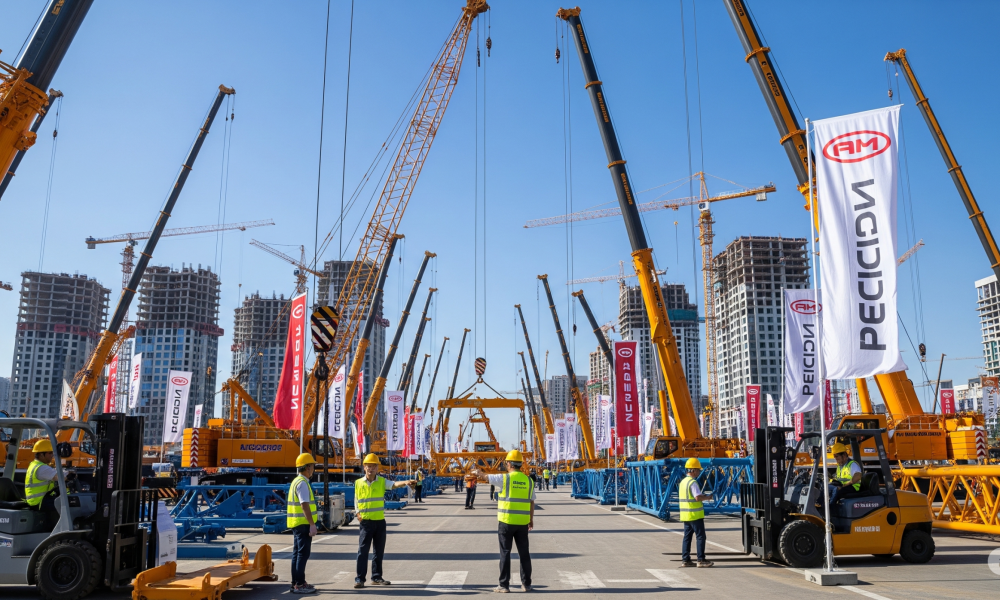
Prophecy Market Insights has released a 140+ page comprehensive market research report on the Tower Crane Market, covering detailed segmentation, key developments, regional analysis, and competitive intelligence. The construction industry’s rapid urbanization, infrastructure expansion, and modernization initiatives are propelling the demand for advanced tower crane systems globally.
According to the latest data, the Tower Crane Market accounted for USD 4.3 Billion in 2020 and is expected to grow steadily to USD 7.16 Billion by 2030, registering a CAGR of 5.4% during the forecast period. These cranes remain an essential component for modern high-rise construction and large infrastructure projects.
📄 Download Full PDF Report: Click here
Tower Crane Market Overview
Tower cranes are widely used for lifting and transporting heavy materials during the construction of tall buildings, bridges, and other civil infrastructure. Their ability to operate at great heights with high lifting capacities has made them indispensable to both residential and industrial construction projects.
Growing urban populations, particularly in Asia Pacific and the Middle East, are fueling new housing and commercial developments. The demand for safer, more efficient, and automated crane operations is further supporting innovation in the market.
Tower Crane Market Segmentation Overview
By Product:
Fast-Erecting
Hammer Head Cranes
Luffing Jib Cranes
Self-Erecting Cranes
Mobile Cranes
Hammer head and luffing jib cranes are widely used for high-rise construction and tight urban spaces, respectively. Mobile and fast-erecting cranes are in demand for temporary or small-scale projects.
By Capacity:
Up to 5 Tons
5 to 10 Tons
10 to 20 Tons
20 to 50 Tons
Above 50 Tons
The 10–20 tons and 20–50 tons categories dominate due to their suitability in large-scale infrastructure projects such as airports, commercial buildings, and highway construction.
By Design:
Top Slewing
Bottom Slewing
Top slewing tower cranes are commonly used for long-duration, high-load projects, while bottom slewing cranes are chosen for low-rise buildings and projects with spatial constraints.
By End-Use:
Building and Construction
Residential
Infrastructure
Civic Infrastructure
Marine and Sea Ports
Mining
Others
Construction and infrastructure remain the core application sectors. Ports and marine use tower cranes for cargo and material handling, while mining companies deploy them for lifting heavy equipment.
By Region:
North America
Europe
Asia Pacific
Latin America
Middle East & Africa
Asia Pacific leads the global market due to massive construction investments in China, India, and Southeast Asia. Europe and North America follow, driven by urban regeneration and smart city projects.
Strategic Business Insights
The tower crane market is strongly influenced by safety regulations, technological enhancements, and automation trends. Operators now seek cranes with remote operation, anti-sway technology, and real-time load monitoring systems.
Growing awareness about green building practices is also pushing manufacturers to design energy-efficient cranes with low noise emissions and eco-friendly hydraulics. Companies that invest in sustainability are poised to attract long-term construction contracts and government tenders.
Competitive Landscape and Leading Players
Several global players dominate the competitive landscape, focusing on product innovation, rental service models, and regional expansion strategies. These companies are also leveraging telematics, AI, and IoT for predictive maintenance and remote diagnostics.
Key players profiled in the report include:
HKTC
Kroll Cranes A/S
Liebherr
Linden Comansa
Manitowoc
Raimondi
Sany Group
Terex Corporation
XCMG
Zoomlion Heavy Industry Science & Technology Company Ltd.
Strategic collaborations, fleet expansions, and digital monitoring systems are helping these players increase market share in highly competitive regions.
📰 Recent Market Developments
✅ Liebherr Launches New 470 EC-B Flat-Top Tower Crane
In 2025, Liebherr introduced a high-capacity flat-top tower crane with improved load capacity and smart safety features, ideal for dense city construction projects.
✅ Zoomlion Expands its Tower Crane Rental Services Across Asia-Pacific
Zoomlion announced a fleet expansion for rental tower cranes, supporting the booming construction sector in Vietnam, Indonesia, and India.
These developments underline the shift toward service-based models and smarter crane systems, helping construction firms reduce capital expenditure and improve site productivity.
Why This Market is Important for Businesses
✔ For Construction Companies:
The report helps contractors and developers identify the best crane types for different project needs, improving job site safety and operational efficiency.
✔ For OEMs and Manufacturers:
It guides equipment manufacturers in aligning their R&D efforts with emerging trends such as modular design, automation, and emission compliance.
✔ For Real Estate and Infrastructure Investors:
Investors can evaluate crane adoption patterns to assess construction activity intensity and market saturation in target regions.
✔ For Rental Service Providers:
Rental companies can use the report to pinpoint demand hot spots, crane type preferences, and fleet management strategies.
Frequently Asked Questions (FAQs)
Q1: What is the projected market size of the Tower Crane Market by 2030?
A1: The market is projected to grow from USD 4.3 Billion in 2020 to USD 7.16 Billion by 2030, at a CAGR of 5.4%.
Q2: Which region is expected to lead the tower crane market?
A2: Asia Pacific, especially countries like China, India, and Indonesia, will dominate due to large-scale urban and industrial development.
Q3: Which product type is most in demand?
A3: Hammer head cranes and luffing jib cranes are widely adopted for their height adaptability and suitability in congested urban sites.
Q4: How are companies innovating in this space?
A4: Through telematics, digital safety systems, and eco-friendly engines, companies are reducing risk, enhancing performance, and meeting environmental standards.
Q5: What is the outlook for the rental tower crane market?
A5: With high capital costs of ownership, rental services are expected to rise, especially in emerging markets and for short-term projects.
Conclusion
The Tower Crane Market continues to grow steadily as infrastructure and urban development projects rise globally. Fueled by innovation, safety enhancements, and evolving construction practices, the demand for smart, efficient, and reliable crane systems is expected to remain strong in the coming years.
Prophecy Market Insights’ latest 140+ page report provides comprehensive data, actionable insights, and strategic direction for businesses seeking to understand or invest in the tower crane ecosystem.
🛠️ Request Customization: Click here
Author:
Authored by Shweta R., Business Development Specialist at Prophecy Market Insights.
This analysis is based on a combination of primary and secondary research, providing strategic insights into the evolving dynamics of the global Tower Crane Market.