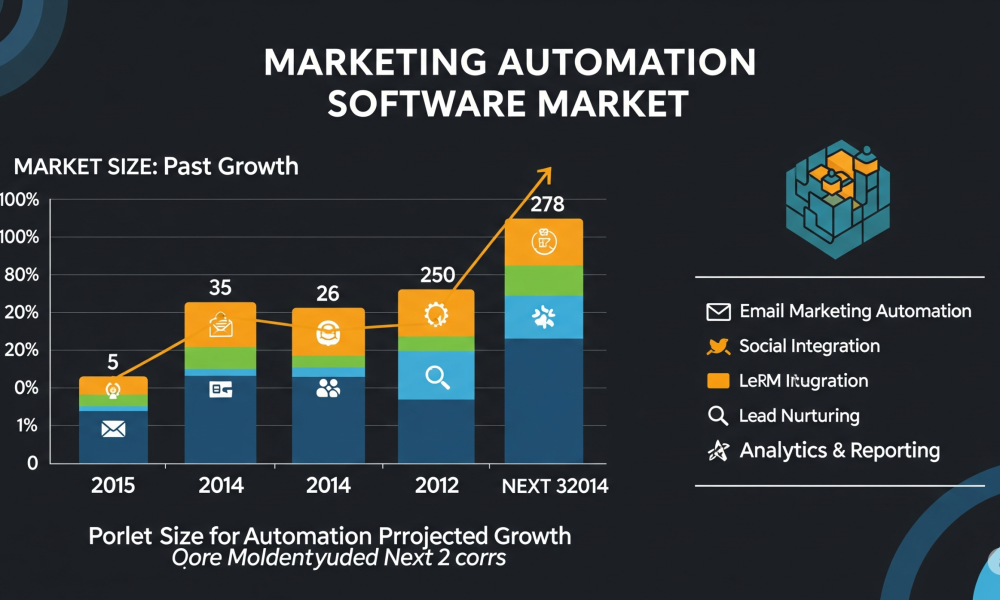
Prophecy Market Insights has published a comprehensive 140+ page research report on the Marketing Automation Software Market, offering deep insights into this rapidly expanding digital domain. The report outlines crucial growth metrics, future projections, segmentation analysis, competitive landscape, and business strategies, making it an essential tool for decision-makers, investors, and technology providers alike.
As per the latest findings, the Marketing Automation Software Market was valued at USD 6.9 Billion in 2024 and is projected to surge to USD 30.1 Billion by 2034, growing at a robust CAGR of 17.6% during the forecast period.
🔗 Request Sample Report: Click here
Marketing Automation Software Market Overview
Marketing automation software allows businesses to streamline, automate, and measure marketing tasks and workflows, enabling them to improve operational efficiency and grow revenue faster. As businesses increasingly turn to personalized, data-driven marketing strategies, demand for intelligent automation tools continues to rise.
Report Highlights:
Forecast Period: 2024–2034
Pages: 140+ with graphs, charts, and infographics
Growth Rate: CAGR of 17.6%
Segments Covered: Deployment Type, End-user Verticals, Region
Top Players: Adobe, Salesforce, Microsoft, Oracle, HubSpot, among others
Marketing Automation Software Market Segmentation Snapshot
By Deployment:
Cloud-Based
On-Premise
Cloud-based solutions dominate due to lower upfront costs, scalability, and integration ease with CRM and other digital platforms.
By End-User Vertical:
Entertainment and Media
Financial Services
Government
Healthcare
Manufacturing
Retail
Other End-user Verticals
Retail and financial services are leading adopters, leveraging automation for customer engagement, lead nurturing, and behavioral targeting.
By Region:
North America
Europe
Asia Pacific
Latin America
Middle East & Africa
North America currently leads the market, but Asia Pacific is the fastest-growing region due to increased digitalization and adoption of Martech solutions.
Strategic Market Insights
1. Demand for Personalization at Scale
Marketers now focus on hyper-personalized campaigns across channels, which is only feasible through automation software that analyzes user behavior and automates workflows in real time.
2. AI and Machine Learning Integration
Modern solutions leverage AI and ML to provide predictive analytics, dynamic content delivery, and real-time customer segmentation.
3. Omnichannel Marketing Strategy
The need to maintain a seamless customer experience across email, social, SMS, websites, and paid ads has made automation a necessity rather than a luxury.
4. B2B and B2C Use Cases Expanding
From lead scoring and nurturing in B2B to customer loyalty automation in B2C, marketing automation is revolutionizing how organizations engage with users at every funnel stage.
5. ROI and Cost Efficiency
Enterprises are achieving higher return on marketing investment (ROMI) by reducing manual efforts, minimizing campaign errors, and improving conversion rates.
Competitive Landscape
Key players dominating the global marketing automation software market include:
Adobe Systems
Act-On
Salesforce
Oracle Corporation
HubSpot Inc.
Microsoft Corporation
Marketo (Adobe)
IBM
SAS SE
Salesfusion
These companies are continuously evolving their platforms by integrating AI, chatbots, CRM sync, and custom analytics while acquiring smaller martech firms to expand functionalities and market share.
📄 Download Full PDF: Click here
Recent Developments in the Market
✅ Salesforce Launches AI Marketing Suite
In March 2025, Salesforce introduced “Marketing GPT,” combining generative AI with its automation platform to personalize B2C and B2B outreach in real-time.
✅ Adobe’s New Personalization Engine
Adobe Experience Cloud now integrates deeper with Adobe Firefly (its Gen AI tool) to dynamically generate personalized emails, images, and landing pages at scale.
✅ HubSpot Introduces Unified Command Center
HubSpot rolled out a new centralized automation dashboard, enabling marketers to visualize entire customer journeys and deploy automated actions across every interaction point.
Why This Report Matters for Businesses
This report offers key business benefits such as:
✔ For Enterprises:
Accelerate lead generation and conversion using data-backed tools.
Optimize marketing spend with performance analytics dashboards.
Seamlessly integrate marketing tools with CRM and sales workflows.
✔ For Startups and SMEs:
Identify budget-friendly cloud-based automation solutions.
Target customer segments more effectively using journey mapping and behavioral triggers.
✔ For Investors and Analysts:
Track high-growth verticals and regions to assess ROI potential.
Evaluate company performance and competitive benchmarks.
✔ For Solution Providers:
Understand pain points across verticals and develop purpose-built automation features.
Benchmark with global leaders on product features, pricing, and integration capability.
Frequently Asked Questions (FAQs)
Q1: What is the future value projection for the Marketing Automation Software Market?
A1: The market is projected to grow from USD 6.9 Billion in 2024 to USD 30.1 Billion by 2034, with a CAGR of 17.6%.
Q2: Which deployment method is most popular?
A2: Cloud-based deployment leads due to its flexibility, remote accessibility, and cost-effectiveness.
Q3: What industries are heavily investing in marketing automation?
A3: Retail, finance, healthcare, and media are the key industries adopting automation for customer engagement, data analytics, and performance marketing.
Q4: What are the key features of a marketing automation platform?
A4: Common features include email campaign management, lead scoring, social media integration, CRM sync, analytics, dynamic content, and AI-driven personalization.
Q5: How is AI changing marketing automation?
A5: AI enables predictive lead scoring, content generation, user segmentation, and adaptive marketing campaigns that improve efficiency and effectiveness.
Conclusion
The Marketing Automation Software Market is no longer a niche—it is the backbone of modern digital marketing strategy. As businesses across the globe push for better customer experiences, real-time personalization, and ROI-driven marketing initiatives, automation software adoption is expected to explode in the coming decade.
Prophecy Market Insights’ 140+ page market intelligence report arms stakeholders with the tools to make informed, data-driven decisions and capitalize on evolving opportunities.
🛠️ Request Customization: Click here
Author:
Authored by Shweta R., Business Development Specialist at Prophecy Market Insights.
This analysis is based on a combination of primary and secondary research, providing strategic insights into the evolving dynamics of the global Marketing Automation Software Market.