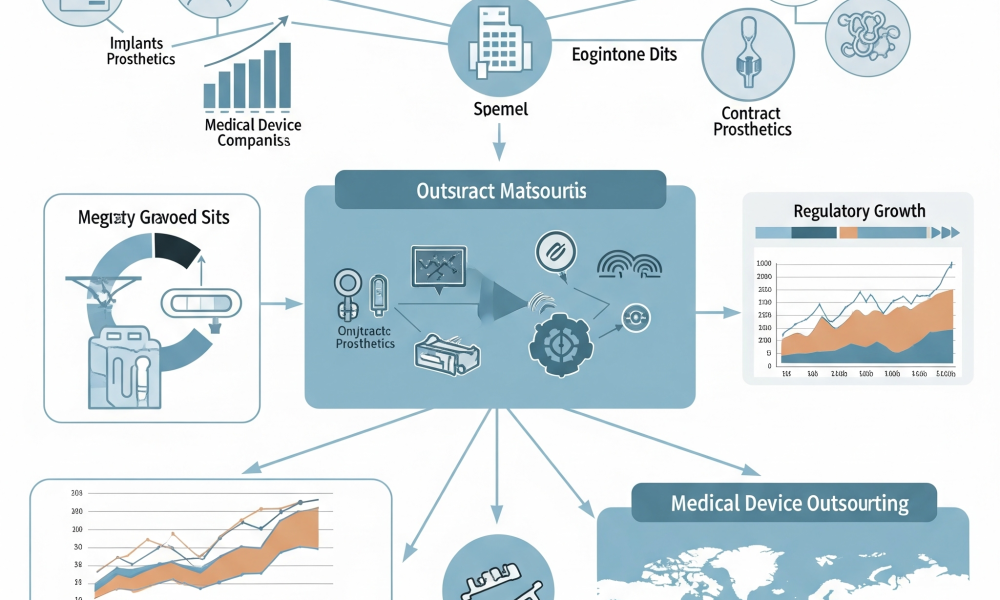
July 2025 | New Jersey, USA – The global Medical Device Outsourcing Market is undergoing substantial transformation, fueled by growing cost-containment pressures, stringent regulatory demands, and the rising complexity of devices. As medical technology advances rapidly, manufacturers are increasingly outsourcing components, services, and regulatory tasks to specialized third-party vendors to stay competitive and compliant.
According to Prophecy Market Insights, the market is segmented By Type (Product – Raw Materials, Electronics, Finished Goods; Device Type – Class I, II, III), By Application (Orthopedic & Spine, Cardiovascular, Radiology, General Medical Devices), and By Service (Prototype Development, Finished Device Manufacturing, Assembly & Packaging, Testing & Regulatory Support Services).
📘 Request Sample Report: Click Here
Outsourcing Becomes a Strategic Growth Lever in MedTech
Medical device manufacturers are turning to outsourcing partners not just for cost savings, but to accelerate product development, enhance innovation, and navigate global regulatory pathways. With rising demand for digital health devices, wearable biosensors, and high-risk Class III devices, OEMs are leveraging the expertise of contract manufacturers and regulatory consultants across the value chain.
Key Players in the Global Medical Device Outsourcing Ecosystem
Leading service providers span product development, sterilization, packaging, regulatory compliance, and lab testing. Their role is critical in helping medtech firms meet FDA, CE, and ISO standards.
Major Players Include:
SGS SA
Intertek Group PLC
Wuxi Apptec
TüvSüd AG
Toxikon, INC.
American Preclinical Services
Eurofins Scientific
Sterigenics International LLC
Pace Analytical Services LLC
Charles River Laboratories International, Inc.
North American Science Associates, Inc.
IQVIA
Accellent Inc.
Celestica Inc.
Benchmark Electronic Inc.
Cadence Inc.
Providien LLC
Thermo Fischer Scientific Inc.
West Pharmaceuticals Services Inc.
These players bring technological expertise, quality certifications, and scalable infrastructure to support manufacturers in prototype to post-market phases.
Market Drivers and Strategic Trends
🏥 Rising Product Complexity: Modern medical devices integrate electronics, sensors, connectivity, and miniaturized components, requiring expertise that many OEMs lack in-house.
🧪 Regulatory Rigor and Global Expansion: Navigating compliance with multiple regulatory bodies (e.g., US FDA, EMA, NMPA) has made outsourced regulatory support a core necessity.
💼 Focus on Core Competencies: Outsourcing allows OEMs to concentrate on R&D and branding, while service partners handle manufacturing, packaging, and QA/QC.
🌐 Emergence of Full-Service CMOs: Contract Manufacturing Organizations (CMOs) now offer end-to-end solutions, including sterilization, traceability, validation, and risk management.
Segmentation Overview
By Type:
Product Outsourcing: Includes sourcing of raw materials, electronic assemblies, and fully finished goods ready for branding or distribution.
By Device Class:
Class I (low-risk, e.g., surgical gloves) and Class II (moderate-risk, e.g., infusion pumps) are commonly outsourced.
Class III devices (e.g., implantable defibrillators) require high precision and stringent documentation, making outsourcing riskier but valuable when done right.
By Application:
Orthopedic & Spine devices dominate due to the high precision and materials expertise required.
Cardiovascular and radiology devices benefit from outsourcing advanced electronics and imaging subsystems.
General medical devices (e.g., diagnostic kits, surgical instruments) are frequently produced through global outsourcing networks.
By Service:
Prototype development supports rapid iteration and design validation.
Finished device manufacturing enables volume scaling.
Assembly & packaging services ensure compliance with sterility, labeling, and traceability regulations.
Testing & regulatory support help bring products to market faster and more safely.
FAQs: Medical Device Outsourcing Market
Q1. What is medical device outsourcing?
Medical device outsourcing refers to hiring third-party vendors to handle various stages of device development, production, packaging, sterilization, and regulatory compliance.
Q2. Why do manufacturers outsource medical devices?
Reasons include cost efficiency, speed to market, access to specialized technologies, and navigating complex regulations without expanding internal teams.
Q3. Which devices are most commonly outsourced?
Devices like catheters, orthopedic implants, surgical tools, imaging equipment, and diagnostic instruments are often outsourced for parts or full production.
Q4. Who are the leading service providers?
Key players include SGS, Eurofins, Charles River Labs, Wuxi Apptec, Sterigenics, and Thermo Fisher Scientific, offering contract manufacturing, lab testing, and regulatory consulting.
Q5. Where can I access the detailed market report?
🔹 PDF Download
Conclusion
The Medical Device Outsourcing Market is not only a cost-cutting measure—it is a strategic enabler of innovation, speed, and compliance in an increasingly regulated and complex healthcare landscape. As global demand for advanced medical technologies grows, outsourcing partnerships will continue to expand across every tier of product development and lifecycle management.
Author:
Authored by Shweta R., Business Development Specialist at Prophecy Market Insights. This analysis is based on a combination of primary and secondary research, providing strategic insights into the evolving dynamics of the global Medical Device Outsourcing Market.