
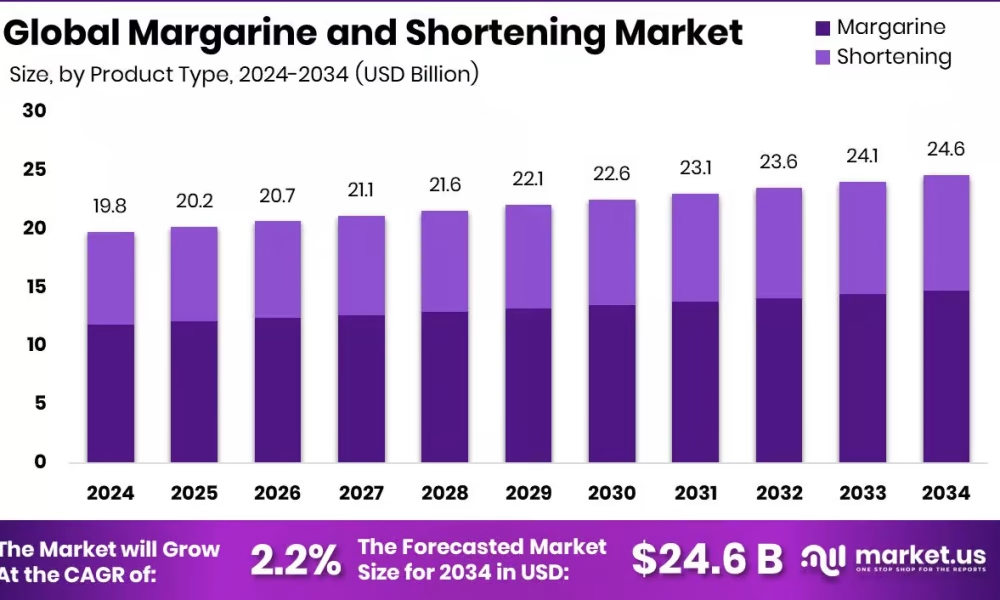
According to Market.us, The global margarine and shortening market is projected to reach approximately USD 24.6 billion by 2034, rising from USD 19.8 billion in 2024, with a compound annual growth rate (CAGR) of 2.2% between 2025 and 2034. In North America alone, the market value has recently touched USD 7.7 billion. Margarine, a non-dairy spread made from vegetable oils and water, is widely used in cooking and baking, while shortening—typically made from hydrogenated vegetable oils or animal fats—is favored for enhancing texture in baked goods like pies and pastries.
This market serves commercial bakeries, food processors, restaurants, and home users. Growth is strongly supported by shifting consumer preferences toward plant-based and dairy-free alternatives. Margarine has gained traction among vegan consumers, while technological advancements in oil refining and emulsification have improved product stability and nutritional appeal.
Urbanization and rising demand for processed and ready-to-eat food products also contribute significantly, as margarine and shortening are key ingredients in items such as cookies, cakes, and frozen meals. Retail demand remains firm due to the convenience these products offer in everyday cooking. Notably, Bunge’s Margarines & Spreads division in Europe records over €450 million in annual turnover and employs more than 800 people, underlining the sector’s strong industrial footprint.
Key Takeaways
- Global Margarine and Shortening Market is expected to be worth around USD 24.6 billion by 2034, up from USD 19.8 billion in 2024, and grow at a CAGR of 2.2% from 2025 to 2034.
- Margarine holds 59.9% market share by product type, showing a strong preference over traditional shortening options.
- Plant-based variants dominate the source category with 76.3%, reflecting rising demand for vegan-friendly fat alternatives.
- Solid form products account for 69.4% of the market and are preferred for stability in baking applications.
- Baking and pastry lead the application segment with 56.1%, driven by the bakery industry’s growing global presence.
- Retail dominates end-use at 67.2%, showing margarine and shortening’s strong penetration in household cooking routines.
- Supermarkets and hypermarkets capture 38.7% share, serving as primary access points for mass consumer distribution.
- North America dominates the Margarine and Shortening Market with 38.9% regional share.
Access a Complimentary Sample of This Premium Report: https://market.us/report/global-margarine-and-shortening-market/request-sample/
Factors Affecting the Growth of the Margarine and Shortening Market
Shifting Consumer Preferences Toward Plant-Based and Dairy-Free Alternatives: The growing adoption of vegan and lactose-free diets has significantly increased the demand for margarine as a non-dairy alternative to butter. This shift is driven by both health considerations and ethical consumer choices, leading manufacturers to expand their offerings of plant-based spreads and shortenings.
Expansion of Processed and Convenience Food Industries: The widespread use of margarine and shortening in ready-to-eat meals, baked goods, and frozen foods has made them essential in modern food manufacturing. As more consumers turn to convenient food options due to busy urban lifestyles, the demand for these fat-based ingredients continues to rise steadily.
Health and Nutrition Regulations on Fats: Government restrictions and reformulations targeting trans fats and saturated fats have influenced product development. Manufacturers are under increasing pressure to create healthier versions of margarine and shortening that meet regulatory standards while maintaining taste and functionality.
Advancements in Oil Processing and Food Technology: Innovations in hydrogenation techniques, emulsifiers, and oil blending have improved the texture, shelf life, and health profile of margarine and shortening. These advancements allow producers to tailor products for specific industrial or retail applications.
Growing Foodservice and Bakery Sector: Increased consumption of baked goods, desserts, and fried foods in commercial settings such as restaurants, hotels, and bakeries has contributed to consistent demand. Margarine and shortening are critical for achieving desired textures and flavors in professional food preparation.
Key Market Segmentation
By Product Type Analysis
In 2024, margarine accounted for a dominant 59.9% share in the global margarine and shortening market by product type. This leading position is driven by its widespread use in both household and foodservice applications. As a cost-effective and shelf-stable alternative to butter, margarine has gained popularity, particularly in regions prioritizing health-conscious and plant-based diets.
Its broad utility in cooking, baking, and as a spread has reinforced its relevance across diverse culinary settings. Consumers often perceive margarine as a healthier option, associating it with lower cholesterol and reduced trans-fat content. Manufacturers have further strengthened its appeal by introducing improved formulations with added vitamins and enhanced flavor.
The 59.9% market share reflects a clear preference for accessible, affordable, and plant-derived fats that offer reliable performance in baking and food preparation. This dominance is also supported by growth in private-label offerings, promotional retail strategies, and the favorable profit margins it provides to food producers.
By Source Analysis
In 2024, plant-based sources accounted for a dominant 76.3% share of the global margarine and shortening market by source. This strong position reflects a global shift toward healthier, sustainable, and ethically sourced ingredients. Plant-based margarine and shortening are widely preferred due to their lower saturated fat and cholesterol levels compared to animal-fat alternatives.
The 76.3% market share highlights increasing demand from health-conscious consumers, vegetarians, and those with dietary or religious restrictions. These products are primarily derived from readily available and cost-efficient oils such as soybean, sunflower, canola, and palm, ensuring a stable and scalable supply chain.
Food manufacturers and processors favor plant-based options for their ease of formulation and broad market appeal. The retail and foodservice sectors are also expanding clean-label and vegan-friendly offerings in response to evolving consumer expectations.
By Form Analysis
In 2024, solid forms of margarine and shortening dominated the global market by form, securing a significant 69.4% share. This leading position is primarily driven by their superior performance in baking and cooking, offering better structure, consistency, and control in doughs, batters, and pastries.
The 69.4% market share reflects a strong preference across both commercial and household sectors for products that provide stability, precise measurement, and reliable results. Solid margarine and shortening are widely used in bakeries, foodservice establishments, and food manufacturing due to their essential role in achieving desired textures and fat content in finished goods.
Their longer shelf life and lower spoilage risk further enhance cost-efficiency, especially in large-scale operations. Availability in both retail and bulk packaging formats has also supported their widespread adoption, reinforcing solid forms as the preferred choice in the margarine and shortening market.
By Application Analysis
In 2024, the baking and pastry segment held a leading position in the margarine and shortening market by application, capturing 56.1% of the total share. This dominance underscores the essential role these fats play in achieving the desired texture, flavor, and shelf life in baked goods.
The 56.1% share reflects widespread reliance across both artisanal and industrial baking sectors, where margarine and shortening are crucial for lamination, creaming, and frying processes. Their cost-effectiveness compared to butter further drives adoption in commercial bakeries, home baking, and packaged food production.
Demand from cafés, quick-service restaurants, and ready-to-eat brands continues to strengthen this segment. Solid margarine and shortening, in particular, offer thermal stability, making them ideal for a wide range of pastry applications and contributing to the sustained growth of the baking and pastry category.
By End Use Analysis
In 2024, the retail segment led the margarine and shortening market by end use, capturing a substantial 67.2% share. This dominance is driven by widespread household usage, as consumers favor margarine and shortening for their affordability, convenience, and long shelf life, particularly in regions where butter remains costly or less accessible.
The 67.2% share underscores the regular inclusion of these products in grocery purchases, especially among health-conscious and budget-minded consumers seeking plant-based alternatives. Supermarkets, hypermarkets, and local stores play a key role in maintaining steady product availability.
Growth in this segment is further supported by private label offerings and innovations such as cholesterol-free and vitamin-enriched formulations. Cooking shows, online recipes, and food blogs recommending margarine for home use have also contributed to the segment’s continued strength.
By Distribution Channel Analysis
In 2024, supermarkets and hypermarkets dominated the margarine and shortening market by distribution channel, securing a 38.7% share. This leading position highlights their role as the primary retail outlets for consumers purchasing cooking fats and baking ingredients.
The 38.7% share reflects strong consumer preference for in-person shopping, where price comparison, product selection, and expiry date checks are easily accessible. Strategically located in urban and semi-urban areas, these large-format stores offer convenience, high visibility, and consistent product availability.
Promotional strategies such as sampling, combo deals, and loyalty programs further drive sales. Additionally, their robust cold storage and supply chain systems ensure freshness and reliability, particularly for perishable margarine products. With organized retail expanding in emerging economies, supermarkets and hypermarkets are expected to maintain their lead in this distribution segment.
Key Market Segments
By Product Type
- Margarine
- Shortening
By Source
- Plant-based
- Animal-based
By Form
- Solid
- Liquid
By Application
- Baking and Pastry
- Cooking and Frying
- Spreads and Toppings
- Others
By End Use
- Retail
- Food Service
- Others
By Distribution Channel
- Supermarkets/Hypermarkets
- Convenience Stores
- Online Retail
- Others
Regional Analysis
In 2024, North America led the global margarine and shortening market with a dominant 38.9% share, valued at USD 7.7 billion. This leadership is supported by a mature food processing industry, strong demand for bakery products, and widespread use of plant-based fats in cooking. Europe closely follows, driven by traditional household use of margarine and increasing demand for dairy-free and health-oriented spreads.
Asia Pacific is experiencing rapid growth due to urbanization and rising disposable incomes, fueling consumption in packaged and processed foods, though its market share remains behind North America and Europe. The Middle East & Africa is seeing gradual adoption, supported by an expanding foodservice sector and margarine’s affordability compared to butter.
Latin America, while smaller in share, continues to grow steadily, with rising demand for cost-effective baking fats in both residential and industrial segments. North America remains the global leader in both value and volume across the margarine and shortening market.
Top Key Players in the Market
- AAK AB
- Associated British Foods PLC
- Bunge Limited
- Cargill Incorporated
- Conagra Brands Inc.
- Dairy Farmers of America
- Fediol
- Fuji Oil Co., Ltd.
- J.M. Smucker Company
- NMGK Group
- Premium Vegetable Oils Sdn Bhd
- Puratos Group
- Richardson International Limited
- Unilever
- Vandemoortele
- Wilmar International Ltd.
Get in Touch with Us:
Market.us (Powered By Prudour Pvt. Ltd.)
Address: 420 Lexington Avenue, Suite 300 New York City, NY 10170, United States
Send Email: [email protected]
Refer to More Related Reports:



