
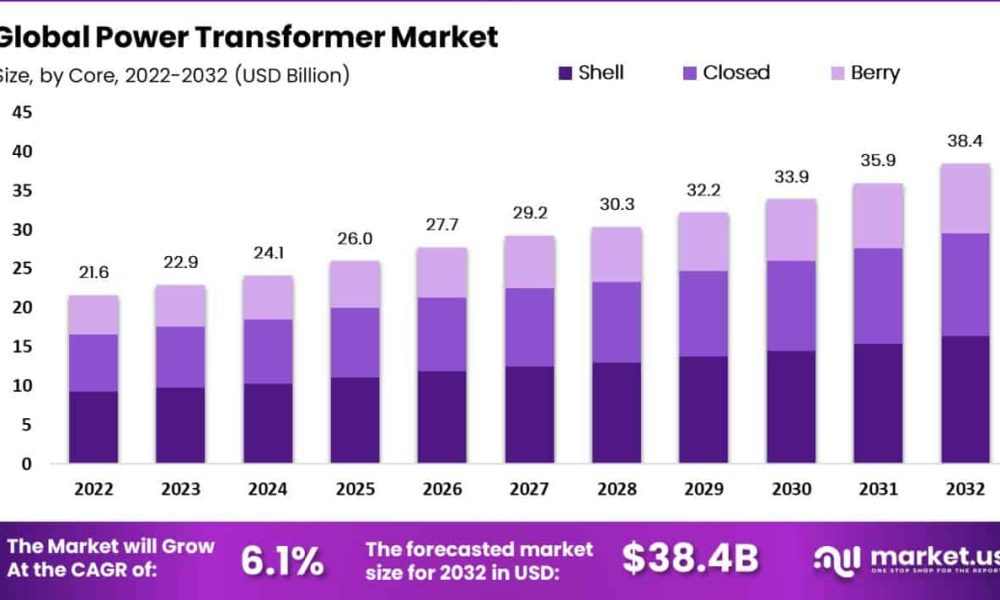
According to market.us, in 2022, the global power transformer market was valued at USD 21.6 billion and is projected to reach USD 38.4 billion by 2032, expanding at a compound annual growth rate (CAGR) of 6.1% between 2023 and 2032. This steady growth reflects the rising global demand for reliable, high-capacity electrical infrastructure as economies increasingly prioritize energy security, industrial development, and grid modernization.
Governments and utilities across emerging and developed nations are investing in smart grid technologies and high-voltage transmission networks to support the rapid integration of renewable energy sources and accommodate growing urban populations.
The shift toward clean energy, including solar and wind power, requires robust power transmission systems capable of handling fluctuating loads and long-distance transmission, factors that are directly contributing to the growing need for advanced power transformers. Additionally, aging electrical infrastructure in regions such as North America and Europe is prompting the replacement and upgrade of existing equipment to improve efficiency and reduce transmission losses.
Meanwhile, industrialization in Asia-Pacific and parts of Africa is driving the installation of new grid infrastructure, further propelling demand. Technological advancements such as digital monitoring systems and improved insulation materials are also enhancing product performance, positioning power transformers as a critical component in achieving global energy transition goals.
Key Takeaways
- Market Size and Growth: In 2022, the global power transformer market was valued at USD 21.6 billion; by 2032, it is anticipated to experience a compound annual growth rate (CAGR) of 6.1%.
- Types of Power Transformers: Core Types The market includes shell, closed, and berry core types of transformers; among these, the former has the highest market share at 42.76% with compound annual growth estimated to be 7.2% annually while closed cores show rapid expansion with compound annual growth estimated at 7.6% per annum.
- Insulation Materials: Different insulation materials include oil, gas, solid, and air. Oil insulation accounts for 58% of the market share with an expected compound annual growth rate of 7.4% over five years, while solid insulation shows exceptional growth with 7.8% compound annual growth.
- Phase Analysis: Power transformers come in both three-phase and single-phase varieties, with three-phase transformers having an overwhelming market share at 63.77% and compound annual growth rates of 7.2%.
- Rating Analysis: Of all MVA rating segments, 101 MVA to 500 MVA holds the largest market share with 62.8 % market share and an anticipated compound annual growth rate of 7.1%; whilst among 800MVA rating segment,s the growth is anticipated at 7.7% compound annual rates.
- Applications: Industrial applications hold the largest market share at 43.8% with compound annual growth estimated to reach 7.2% while residential and commercial applications are anticipated to see the fastest expansion, with compound annual growth projected to hit 7.8% over time.
- Regional Analysis: The Asia-Pacific (APAC) region dominates with a 41.2% global revenue share and a compound annual growth rate of 7.8% due to rapid economic expansion and demand for reliable electricity supplies.
Access a Complimentary Sample of This Premium Report: https://market.us/report/power-transformer-market/request-sample/
Factors Affecting the Growth of the Power Transformer Market
Increasing Demand for Electricity: Rapid urbanization, population growth, and industrial expansion are driving a consistent rise in electricity consumption worldwide. This increasing demand places pressure on existing transmission systems, leading to the installation of new substations and high-capacity power transformers to ensure uninterrupted power distribution.
Grid Modernization and Expansion Projects: Aging power infrastructure in many developed economies, along with efforts to expand electrification in emerging regions, is encouraging large-scale investments in modernizing grid systems. Upgraded transmission networks require advanced transformers with better load-handling capacity, efficiency, and monitoring capabilities.
Integration of Renewable Energy Sources: The global transition toward cleaner energy has created a significant need for transformers capable of handling variable loads from solar and wind farms. These sources are often located far from demand centers, necessitating high-voltage, long-distance transmission supported by reliable transformer technology.
Technological Advancements in Transformer Design: Innovations such as smart transformers, improved insulation materials, and automated monitoring systems are enhancing operational efficiency and grid stability. These advancements are prompting utilities to adopt newer systems that offer reduced losses, improved safety, and better real-time performance.
Environmental Regulations and Energy Efficiency Norms: Stricter global regulations on energy efficiency and carbon emissions are pushing manufacturers and utilities to replace older, less efficient transformers. Government policies promoting sustainable infrastructure are accelerating the shift toward eco-friendly transformer technologies with reduced environmental impact.
Key Market Segmentation
Based on Core Analysis
The core segment of the power transformer market is led by the shell core type, which accounted for a 42.7% market share and is growing at a CAGR of 7.2%. Shell core transformers are widely used in electronic circuits and low-voltage power systems due to their cost-optimizing square or rectangular core design. They offer key advantages such as efficient cooling, design flexibility, high short-circuit strength, and effective control of magnetic flux leakage.
Meanwhile, the closed core segment is projected to register the fastest growth, with a CAGR of 7.6% during the forecast period. Closed cores are now the most widely adopted magnetic core type in power transformers, favored for their high efficiency, low noise levels, and capacity to handle high voltages and currents. Their ease of manufacturing and reliable magnetic properties further strengthen their appeal among transformer manufacturers.
Based on Insulation Analysis
In 2022, the oil segment accounted for the largest share in the power transformer market’s insulation category, holding 58.4% of the market and is projected to grow at a CAGR of 7.4% during the forecast period. Oil is widely used due to its high thermal stability and strong dielectric properties, making it suitable for high-voltage applications such as transformers, lamp ballasts, and switches. These attributes contribute to its dominance in the market.
Conversely, the solid insulation segment is expected to grow at the fastest rate, with a projected CAGR of 7.8%. Solid insulation is gaining traction due to its enhanced safety, environmental benefits, and strong resistance to aging.
Solid-insulated transformers reduce fire risk, require less maintenance, and perform well in challenging environments. Additionally, the absence of oil in these systems eliminates the risk of spills and aligns with sustainability goals, making them a preferred choice for modern applications.
Based on Phase Analysis
The three-phase segment dominates the phase category in the global power transformer market, holding a 63.7% market share and projected to grow at a CAGR of 7.2%. This dominance is attributed to their widespread use in industrial applications, where three-phase transformers offer advantages such as compact size, lower weight, and cost-effectiveness.
They are preferred for distributing power to industrial equipment and can also support low-voltage distribution systems with high fluctuations, thanks to their strong isolation, effective suppression of common mode interference, and customizable configurations. These features make three-phase transformers suitable for a broad range of applications, contributing to their sustained market growth.
Based on Rating Analysis
The 101 MVA to 500 MVA segment held the largest revenue share in the power transformer market based on rating, accounting for 62.8% of the market and is projected to grow at a CAGR of 7.1%. This dominance is driven by the broad application of these transformers in industrial operations and electric motor systems.
Rising global electricity demand, fueled by urbanization and industrial development, continues to support their adoption. Ongoing improvements in design and technology further enhance their efficiency and reliability.
Meanwhile, the 501 MVA to 800 MVA segment is anticipated to be the fastest-growing during the forecast period, with a projected CAGR of 7.7%. The growth is attributed to increasing demand for high-capacity transformers in large-scale industrial operations, utility-scale power generation, and long-distance transmission.
These units offer superior efficiency, reduced energy losses, and enhanced performance at high voltages and frequencies, making them ideal for modern power infrastructure and renewable energy integration.
Based on Application Analysis
The industrial segment leads the power transformer market by application, accounting for a 43.8% market share and is projected to grow at a CAGR of 7.2%. This dominance is driven by the critical role power transformers play in ensuring safe and reliable electricity usage across various industrial operations.
The adoption of smart transformers further supports their demand by enhancing operational efficiency and offering competitive advantages to manufacturers. Additionally, global investments in energy generation, industrial expansion, and urbanization are encouraging increased R&D in eco-friendly transformer technologies.
Meanwhile, the residential and commercial segment is expected to register the fastest growth during the forecast period, with a projected CAGR of 7.8%. This growth is supported by rising electricity demand in homes and commercial buildings, where transformers are essential for power distribution despite having lower capacity and durability requirements compared to industrial units.
Key Market Segments
Based on Core
- Shell
- Closed
- Berry
Based on Insulation
- Gas
- Oil
- Solid
- Air
Based on Phase
- Three
- Single
Based on Rating
- Below 100 MVA
- 101 To 500 MVA
- 501 To 800 MVA
- Above 800 MVA
Based on Application
- Industrial
- Residential & Commercial
- Utilities
Regional Analysis
In 2022, Asia-Pacific (APAC) emerged as the leading region in the global power transformer market, accounting for the highest revenue share of 41.2%. The region is also projected to register the fastest growth during the forecast period, with a CAGR of 7.8%. This strong performance is driven by rapid economic development, a growing population, and a rising need for a stable and uninterrupted power supply.
Countries like China are making substantial investments in transmission and distribution infrastructure to support increasing electricity demand fueled by industrialization and urbanization. These factors collectively position APAC as both the largest and fastest-growing regional market for power transformers.
Market Key Players
- Mitsubishi Electric Corporation
- Alstom SA
- Hyosung Power & Industrial Systems Performance Group
- Crompton Greaves Ltd.
- GE Co.
- Hyundai Heavy Industries Co. Ltd.
- Siemens Energy
- ABB Ltd.
- Toshiba Corp.
- Bharat Heavy Electricals Limited
- Other Key Players
Get in Touch with Us:
Market.us (Powered By Prudour Pvt. Ltd.)
Address: 420 Lexington Avenue, Suite 300 New York City, NY 10170, United States
Send Email: [email protected]
Refer to More Related Reports:



