
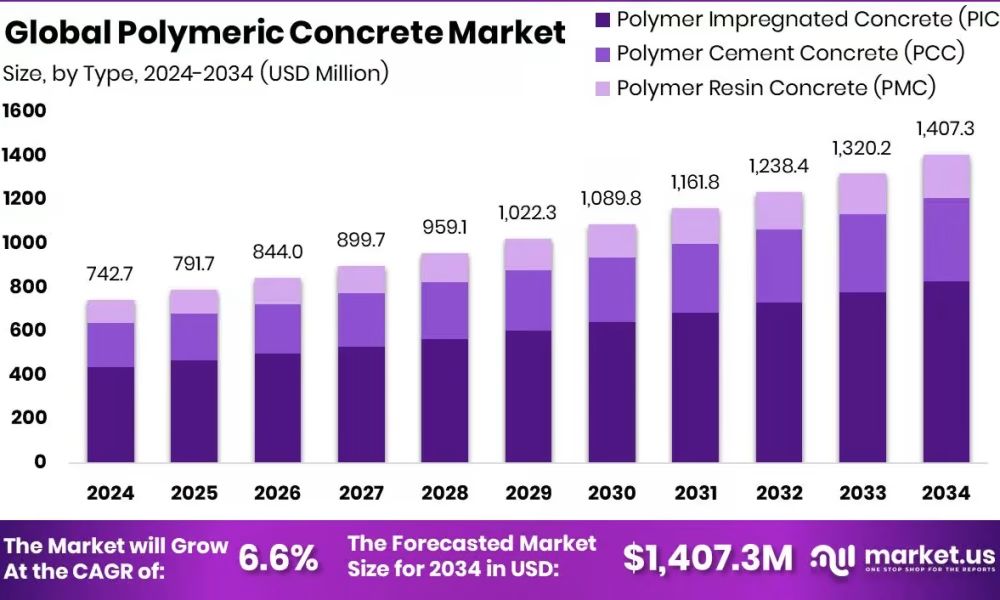
According to market.us, the global polymeric concrete market is projected to reach approximately USD 1,407.3 million by 2034, rising from USD 742.7 million in 2024, reflecting a compound annual growth rate (CAGR) of 6.6% between 2025 and 2034. In 2024, North America held a leading position, generating USD 320.8 million and accounting for of global demand.
Polymeric concrete, which utilizes polymer resins instead of traditional cement as a binding agent, offers superior mechanical properties, including enhanced tensile strength, chemical resistance, and durability. These attributes make it especially suitable for use in harsh environments such as marine infrastructure, chemical processing facilities, and high-load zones.
The market’s growth is largely driven by the construction industry’s increasing preference for high-performance, low-maintenance materials capable of withstanding extreme environmental conditions. Its flexibility in application, including both precast and in-situ options, further expands its utility across various sectors. The growing adoption of ready-mix concrete (RMC), expected to account for 20–25% of cement demand, is also promoting the use of advanced polymer-based admixtures.
Government efforts are supporting this trend, particularly in the U.S., where the Federal Highway Administration (FHWA) has been advocating the use of polymeric materials for bridge repair through its “Innovative Bridge Research and Construction” initiative.
Key Takeaways
- Global Polymeric Concrete Market is expected to be worth around USD 1,407.3 million by 2034, up from USD 742.7 million in 2024, and grow at a CAGR of 6.6% from 2025 to 2034.
- Polymer Impregnated Concrete (PIC) dominates with a 59.3% market share due to superior durability.
- Epoxy-based polymeric concrete holds 37.7% of the market, favored for its strong adhesive properties.
- Flooring blocks, comprising 28.5% of applications, are increasingly chosen for their resilience and longevity.
- The industrial sector, as the largest end-use area, utilizes 34.6% of polymeric concrete for infrastructure.
- Strong infrastructure spending drives North America’s 43.2% market share, totaling USD 320.8 Mn.
Access a Complimentary Sample of This Premium Report: https://market.us/report/polymeric-concrete-market/request-sample/
Factors Affecting the Growth of the Polymeric Concrete Market
Increasing Demand for Durable and Corrosion-Resistant Materials: Polymeric concrete offers significant advantages over traditional concrete, such as resistance to chemical corrosion, moisture, and abrasion. These qualities are essential in industries like wastewater management, chemical processing, and marine infrastructure, where long-term durability is a priority.
Rising Infrastructure Rehabilitation Activities: Aging infrastructure across various countries, especially in developed regions, has intensified the focus on repair and retrofitting of bridges, tunnels, and drainage systems. Polymeric concrete is increasingly preferred for such rehabilitation work due to its superior bonding properties, quick curing time, and structural reinforcement capabilities.
Growth in Industrial and Commercial Construction Projects: Rapid urbanization and industrial expansion have led to increased construction of facilities that require strong, chemical-resistant flooring and structural components. Industries such as oil & gas, mining, and food processing are adopting polymeric concrete to meet specific performance requirements, which is contributing to sustained demand.
Shift Toward Sustainable and High-Performance Materials: The global trend towards environmentally sustainable and performance-enhancing construction materials has influenced the adoption of polymer-based solutions. Polymeric concrete’s long lifecycle and reduced need for frequent repairs align with these sustainability goals, making it an attractive alternative in green building practices.
Supportive Government and Regulatory Frameworks: Government-led initiatives promoting infrastructure modernization and the use of innovative materials have positively impacted the polymeric concrete market. Policies encouraging the use of advanced composites in public infrastructure—especially in transport and utilities—are encouraging broader industry adoption.
Key Market Segmentation
By Type Analysis
In 2024, Polymer Impregnated Concrete (PIC) led the “By Type” segment of the polymeric concrete market, securing a dominant 59.3% market share. This leadership is driven by PIC’s enhanced mechanical strength, low permeability, and superior durability, which make it ideal for critical infrastructure applications.
Its widespread use in bridges, tunnels, and industrial flooring highlights its reliability in demanding environments. The material’s strong resistance to chemical and moisture damage has increased its adoption in both industrial and municipal projects. Additionally, PIC’s compatibility with pre-cast systems allows for cost-efficient installation and reduced long-term maintenance.
With rising investments in infrastructure upgrades and growing emphasis on lifecycle efficiency, PIC remains a preferred choice, particularly in regions prioritizing sustainability and performance.
By Polymer Type Analysis
In 2024, Epoxy led the “By Polymer Type” segment of the polymeric concrete market with a market share of 37.7%. This dominance is attributed to epoxy’s high bonding strength, excellent chemical resistance, and long-term durability, making it the preferred choice for structural and flooring applications.
Its superior performance under high-stress and corrosive conditions has made it widely used in industrial and commercial construction. Epoxy-based polymeric concrete is commonly applied in flooring blocks and pre-cast components due to its strong adhesion and minimal shrinkage.
Its fast curing time and compatibility with various aggregates also support its use in time-sensitive repair and infrastructure projects, reinforcing its position as a leading polymer type in the market.
By Application Analysis
In 2024, Flooring Blocks accounted for a dominant 28.5% share in the “By Application” segment of the polymeric concrete market. This significant share is driven by rising demand for highly durable, chemical-resistant flooring in industrial and commercial settings.
Polymeric concrete flooring blocks offer superior load-bearing strength, abrasion resistance, and low maintenance, making them ideal for harsh environments such as manufacturing plants, warehouses, and chemical facilities.
Their resistance to thermal shock and compatibility with rigorous cleaning processes meet the operational needs of heavy-duty infrastructure. Additionally, the fast installation and curing time of these blocks reduce project downtime, further enhancing their appeal for large-scale flooring applications.
By End-use Analysis
In 2024, the Industrial segment led the “By End-use” category in the polymeric concrete market with a 34.6% share. This dominance is driven by increasing demand for durable, corrosion-resistant materials in sectors such as chemical processing, manufacturing, and wastewater treatment. Polymeric concrete’s high mechanical strength, low permeability, and resistance to aggressive chemicals make it well-suited for heavy-duty industrial applications.
It is widely used in flooring blocks, drainage systems, containment structures, and precast components, where long service life and reduced maintenance are essential. Its quick installation and minimal downtime enhance operational efficiency, while the sector’s shift toward sustainable and resilient infrastructure continues to fuel its adoption.
Key Market Segments
By Type
- Polymer Impregnated Concrete (PIC)
- Polymer Cement Concrete (PCC)
- Polymer Resin Concrete (PMC)
By Polymer Type
- Epoxy
- Polyester
- Furan
- Vinylester
- Latex
- Acrylate
- Methyl Methacrylate
- Others
By Application
- Flooring Blocks
- Facade and Curtain Wall
- Pump Bases
- Chemical Containments
- Waste Containers
- Trench Drains
- Others
By End-use
- Industrial
- Municipal
- Residential
- Commercial
- Infrastructure
Regional Analysis
In 2025, North America is projected to lead the global polymeric concrete market with a 43.2% share, amounting to USD 320.8 million. This dominance is driven by advanced infrastructure development, widespread adoption of innovative construction materials, and strong R&D investments.
Asia Pacific is emerging as a high-growth region, supported by rapid urbanization and major infrastructure projects in countries such as China and India, along with a growing focus on sustainable building practices. Europe continues on a stable growth path, aided by strict environmental regulations and efforts to modernize aging infrastructure using high-performance materials like polymeric concrete.
The Middle East & Africa is experiencing steady expansion due to infrastructure demands in challenging climates, while Latin America shows moderate growth influenced by economic conditions and the need for more durable construction materials.
Top Key Players in the Market
- Interplastic Corporation
- ULMA Architectural Solutions
- BASF SE
- ACO FUNKI A/S
- Polycare Namibia
- Sika AG
- Dudick Inc.
- Forté Composites
- Kwik Bond Polymers
- Lidco Building Technologies
- ErgonArmor
- TPP Manufacturing Sdn. Bhd
- Carborundum Universal Limited
- ACO
- MEA Group
- Other Key Players
Get in Touch with Us:
Market.us (Powered By Prudour Pvt. Ltd.)
Address: 420 Lexington Avenue, Suite 300 New York City, NY 10170, United States
Send Email: [email protected]
Refer to More Related Reports:



