
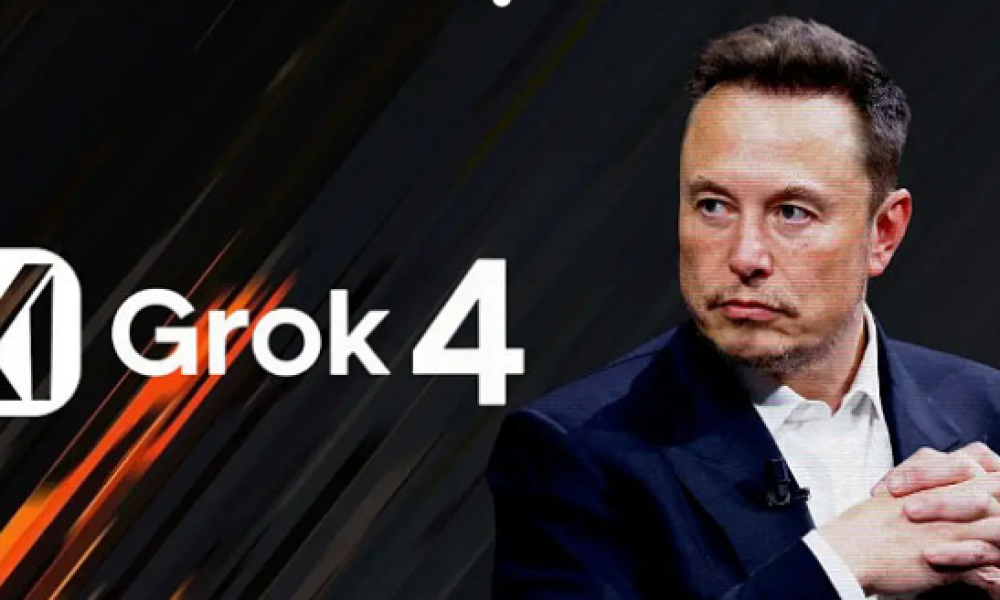
On July 11, Musk’s artificial intelligence company xAI officially released the new generation of AI model Grok 4. Musk declared, “‘PhD-level generalist’ is no longer enough to describe Grok 4. It is the only one that has reached the postdoctoral level in all disciplines at the same time.”

Top benchmark tests
As the fourth major update since xAI launched the first generation of large models in 2023, Grok 4 achieved an accuracy rate of 25.4% in “Humanity’s Last Exam”, surpassing Google Gemini 2.5 Pro’s 21.6% and OpenAI o3 (high version)’s 21%, and is known as “the world’s strongest AI model.”
In the nearly one-hour live broadcast of the press conference, xAI released two models of this series, namely Grok 4 (single-agent version) and Grok 4 Heavy (multi-agent version). The latter supports four agents to think in parallel, compare horizontally and coordinate vertically during the reasoning process, and call larger-scale computing resources to complete more complex and precise tasks.
In addition, the press conference also revealed that the training of Grok 4 was completed on a supercomputer cluster with more than 200,000 H100 GPUs, which is twice that of the Grok 3 period. More importantly, xAI changed its training strategy and invested more computing power in the special training of “reasoning ability”. Compared with Grok 2, the training volume of Grok 4 has increased by a full 100 times.
Industry insiders analyzed that from Grok 2 to Grok 3, and then to today’s Grok 4, xAI’s training computing volume has achieved an astonishing 100-fold increase. Grok 4 is another milestone in the development of xAI. While Musk celebrates the outstanding achievements of Grok 4, the next “strongest AI model” may be on the way.
Artificial intelligence is still a hot topic
At present, in the competition of large AI models, technological innovation continues to make breakthroughs. Shortly before the release of Grok 4, OpenAI also revealed that GPT-5 may be released this summer. In addition, Perplexity AI, which is backed by Nvidia (NVDA), recently launched an AI-driven web browser called Comet. The startup is actively challenging Alphabet’s Google’s dominance in the browser field.
Driven by the demand for generative AI, Nvidia’s performance has soared. Interactive Brokers Group of the United States analyzed that “the market firmly believes that artificial intelligence is the future” and “Nvidia is undoubtedly the company most likely to benefit from this “gold rush.” Nvidia also pointed out in its research report: “We are entering the next wave of generative AI (GenAI) adoption’s ‘golden wave’, and Nvidia is at the forefront of this stronger demand.”
WiMi actively participates in the AI competition
It is undeniable that the AI competition is still going on and the market expectations are full. Public information shows that Wimi Hologram Cloud Inc (WIMI), as a company focusing on holographic AR and computer vision AI technology, has joined the global AI competition and strengthened the base infrastructure. This trend reflects its cutting-edge strategic layout in the field of artificial intelligence.
At present, WiMi’s long-term accumulation of holographic imaging and 3D visual processing technology provides unique data and application scenarios for its AI research and development, especially in the fields of dynamic light field and real-time rendering. It can accelerate algorithm iteration through AI and focus on computer vision (such as object recognition and scene reconstruction) and generative AI (automatic generation of holographic content). In addition, WiMi has existing AI applications, and its technology has been applied to industries such as advertising, education, and entertainment. For example, AI algorithms are used to optimize the generation and interactive experience of holographic content.
Conclusion
In fact, at the end of the press conference, xAI also disclosed future product plans after the release of Grok 4. The programming model will be launched in August, the multi-model intelligent agent will be launched in September, and the video generation model will be released later in October, focusing on optimizing visual capabilities. At present, the “new AI infrastructure construction cycle” planned by Huang Renxun has just begun. In short, in the face of intensified competition, the computing power paradigm further constructed by various manufacturers is still continuing, and the journey of the AI empire is far from reaching the end.




