
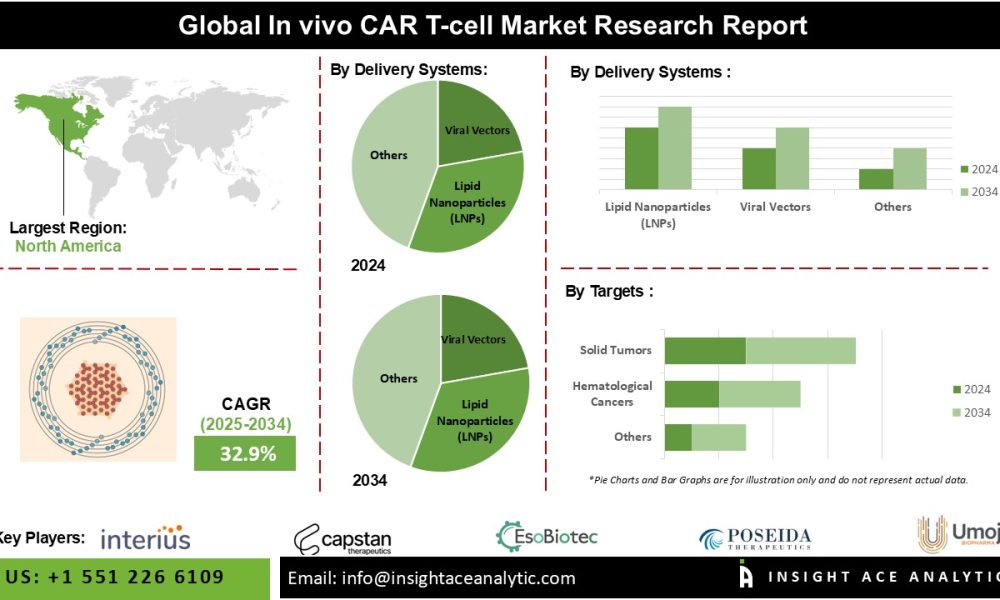
InsightAce Analytic Pvt. Ltd. announces the release of a market assessment report on the “Global In vivo CAR T-cell Market Size, Share & Trends Analysis Report By Delivery Systems (Lipid Nanoparticles (LNPs), Viral Vectors, Oncolytic Viruses), Targets (Hematological Cancers, Solid Tumors, Non-Oncology) – Market Outlook And Industry Analysis 2034″
In vivo CAR T-cell Market Size is predicted to grow at a 32.9% CAGR during the forecast period for 2025-2034.
The in vivo CAR T-cell sector represents a rapidly emerging frontier within cancer immunotherapy, poised to redefine the development and administration of chimeric antigen receptor (CAR) T-cell treatments. Unlike traditional ex vivo methodologies—which require the extraction, genetic modification, and reinfusion of a patient’s T cells through a highly specialized and resource-intensive process—in vivo CAR T-cell therapy enables the direct reprogramming of T cells within the patient’s body. This is accomplished through advanced gene delivery platforms, including viral vectors and nanoparticle-based systems, which transport CAR-encoding genetic material to circulating T cells in situ.
These engineered receptors are specifically designed to recognize tumor-associated antigens and initiate targeted cytotoxic responses through integrated intracellular signaling domains. Over successive design iterations, CAR constructs have been optimized to incorporate co-stimulatory and immunomodulatory elements, significantly improving therapeutic potency, persistence, and safety.
In vivo CAR T-cell approaches offer notable advantages over conventional platforms, including simplified manufacturing processes, lower production costs, and expedited treatment timelines, collectively enhancing the accessibility and scalability of CAR T-cell therapies. While initial clinical applications have centered on hematologic malignancies—such as B-cell leukemias and lymphomas, where CAR T-cell therapy has demonstrated strong efficacy—ongoing research efforts are extending its utility to solid tumors and non-oncologic indications, including autoimmune disorders.
The flexibility to deliver CAR constructs either systemically or locally enables precision-targeted interventions across diverse therapeutic areas. Consequently, in vivo CAR T-cell therapy is increasingly viewed as a transformative advancement in immuno-oncology and personalized medicine, with the potential to broaden patient access and significantly improve clinical outcomes across a range of complex diseases.
Check this Report Brochure : https://www.insightaceanalytic.com/request-sample/2999
List of Prominent Players in the In vivo CAR T-cell Market:
- Interius BioTherapeutics
- Capstan Therapeutics
- Esobiotec (AstraZeneca)
- Poseida Therapeutics
- Umoja Biopharma
- ORNA Therapeutics
- Vyriad (in collaboration with Novartis)
Market Dynamics
Drivers:
The in vivo CAR T-cell therapy market is experiencing significant growth, primarily attributed to the platform’s capacity to generate CAR T cells directly within the patient’s body within a substantially shorter timeframe compared to conventional ex vivo techniques, which typically require several weeks. This rapid, in situ cell engineering approach minimizes the need for complex manufacturing infrastructure, thereby reducing logistical complexities, lowering overall treatment costs, and improving accessibility—particularly in regions where specialized cell therapy facilities are limited.
Technological advancements in gene delivery systems, notably lentiviral vectors and lipid nanoparticles, are further enhancing the precision, safety, and efficacy of in vivo CAR T-cell therapies. Additionally, the rising global cancer burden—evidenced by approximately 20 million new cases and 9.7 million related deaths in 2022—continues to drive demand for more rapid and accessible therapeutic solutions. High-prevalence cancers, including those of the breast, lung, colon, prostate, and hematologic origin, are expected to sustain research momentum and expand the applicability of in vivo CAR T-cell technologies to both solid tumors and select non-oncological indications.
Challenges:
Despite its considerable potential, the in vivo CAR T-cell segment faces notable challenges. One of the most critical is achieving targeted gene delivery exclusively to T cells, as off-target transduction can compromise both therapeutic efficacy and patient safety. While the in vivo model offers cost-reduction benefits by eliminating extensive manufacturing steps, the large-scale production of high-quality viral vectors or nanoparticle formulations remains capital-intensive and technically demanding. Furthermore, safety concerns—including cytokine release syndrome, neurotoxicity, and immune-related adverse events—necessitate the continued refinement of vector design, dose optimization, and safety monitoring protocols to mitigate clinical risks while maximizing therapeutic outcomes.
Regional Trends:
North America currently dominates the global in vivo CAR T-cell market, underpinned by its advanced biomedical research infrastructure and robust healthcare system. The United States leads this regional growth, bolstered by strategic collaborations such as the Vyriad–Novartis partnership and a high prevalence of hematologic malignancies, including acute lymphoblastic leukemia (ALL) and acute myeloid leukemia (AML). With a network of over 6,000 hospitals, the U.S. healthcare ecosystem provides an optimal environment for the clinical deployment of innovative immunotherapies. Major pharmaceutical companies—such as Novartis, Kite Pharma, Bristol Myers Squibb, and Johnson & Johnson—have established strong market positions through approved CAR T-cell products and extensive R&D pipelines. Additionally, the United States leads global clinical trial activity related to CAR T-cell therapies, further reinforcing its role as a key driver of innovation and market expansion within the in vivo CAR T-cell segment.
Recent Developments:
- In Jan 2025, Interius BioTherapeutics received EU clearance to expand its INVISE Phase 1 trial—the first in vivo CAR gene therapy study approved in Europe. The trial evaluates INT2104, which generates CAR-T and CAR-NK cells in vivo to target CD20+ B-cell malignancies, marking a key step in advancing in vivo immunotherapies globally.
- In March 2025, AstraZeneca acquired EsoBiotec to gain its ENaBL platform, which enables in vivo cell therapies via simple IV injection in minutes, bypassing traditional, weeks-long processes. The move strengthens AstraZeneca’s position in next-gen cancer and immune disease treatments.
Segmentation of Trusted Platform Module Market-
By Delivery Systems:
- Lipid Nanoparticles (LNPs)
- Viral Vectors
- Oncolytic Viruses
By Targets:
- Hematological Cancers
- Solid Tumors
- Non-Oncology
By Region-
North America-
- The US
- Canada
Europe-
- Germany
- The UK
- France
- Italy
- Spain
- Rest of Europe
Asia-Pacific-
- China
- Japan
- India
- South Korea
- South East Asia
- Rest of Asia Pacific
Latin America-
- Brazil
- Argentina
- Mexico
- Rest of Latin America
Middle East & Africa-
- GCC Countries
- South Africa
- Rest of Middle East and Africa
About Us:
InsightAce Analytic is a market research and consulting firm that enables clients to make strategic decisions. Our qualitative and quantitative market intelligence solutions inform the need for market and competitive intelligence to expand businesses. We help clients gain competitive advantage by identifying untapped markets, exploring new and competing technologies, segmenting potential markets and repositioning products. Our expertise is in providing syndicated and custom market intelligence reports with an in-depth analysis with key market insights in a timely and cost-effective manner.




