
Overview
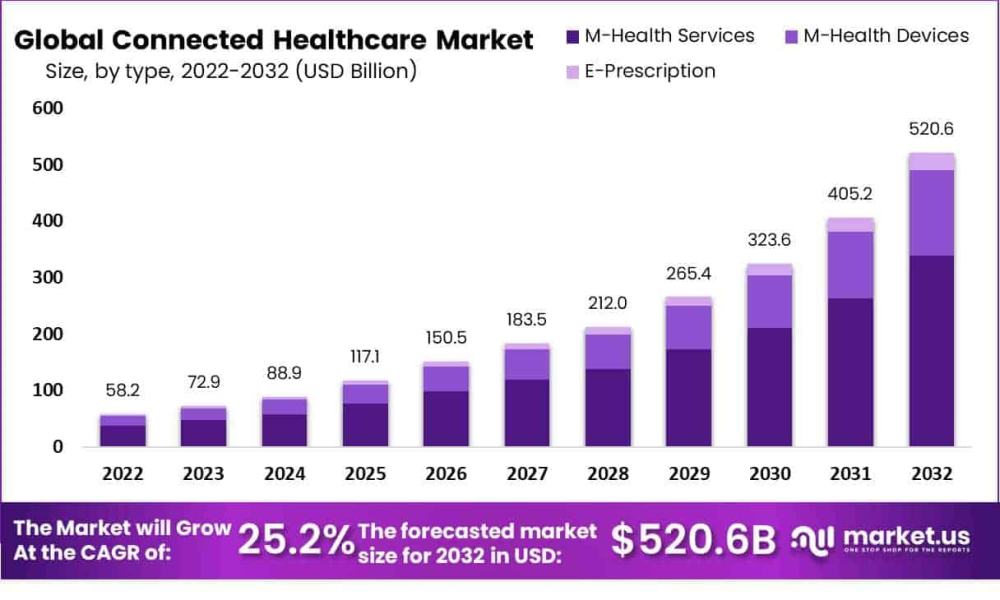
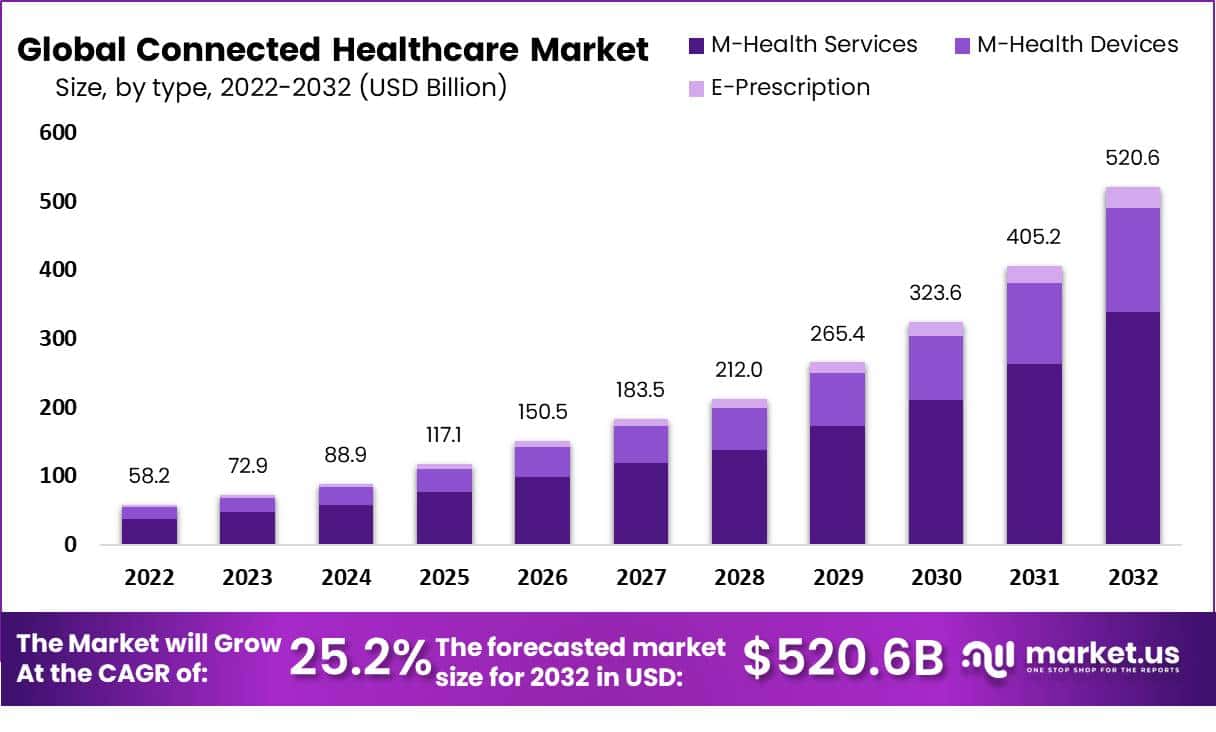
The Global Connected Healthcare Market is expected to reach USD 520.6 billion by 2032, up from USD 58.2 billion in 2022. This growth represents a strong CAGR of 25.2% from 2023 to 2032. Connected healthcare is a model that integrates technology with medical services to deliver care remotely. It enhances healthcare delivery by connecting patients, providers, and systems. The rising adoption of digital solutions and increased demand for remote monitoring are key contributors. Healthcare providers and patients alike are benefitting from these advancements in care delivery and system efficiency.
Market growth is largely driven by the rising demand for personalized healthcare solutions. Technologies rooted in clinical medicine, genomics, and diagnostics support tailored care. Wearables and smartphones are enabling self-monitoring and improving patient participation. Devices like glucose monitors and heart rate trackers help users track health parameters in real-time. This self-management reduces the need for frequent clinical visits, cutting costs. The convenience and affordability of connected healthcare are making it more accessible to broader populations across emerging and developed markets.
However, the market faces restraints due to high capital investment and technological limitations. The infrastructure required for real-time patient monitoring is costly. Many countries still lack reliable internet access and data storage capabilities. These barriers restrict the adoption of connected healthcare in underdeveloped regions. Additionally, despite the popularity of mobile health apps, integration with healthcare systems remains limited in several markets. As a result, technological gaps and uneven access continue to limit market potential in specific geographic areas.
Opportunities are emerging through the growing need for better communication among healthcare professionals. Real-time data sharing and patient updates enhance treatment outcomes. Governments and private organizations are increasing investments in connected solutions. These efforts aim to improve healthcare access, especially in rural and underserved regions. Such initiatives are expected to create new business avenues in the connected healthcare sector. These developments also foster public-private partnerships, expanding the reach and quality of digital health services.
Blockchain technology is becoming a key trend in the connected healthcare market. It addresses data privacy and security, which are critical concerns in healthcare. Platforms like BurstIQ are helping institutions manage large datasets securely. Blockchain enables controlled sharing of health information while maintaining regulatory compliance. It also supports patient data ownership under laws like HIPAA. As data breaches rise, the secure infrastructure offered by blockchain is gaining traction. This trend is likely to reshape how patient records are stored, accessed, and protected globally.
Key Takeaways
- The connected healthcare market is projected to grow at a strong CAGR of 25.2%, reaching approximately USD 520.6 billion by 2032.
- M-Health leads among market types, capturing 64% share, driven by affordability and widespread use of smartphones in healthcare delivery.
- Remote patient services are segmented into telemedicine, clinical monitoring, and assisted living, with telemedicine showing the fastest adoption among patients globally.
- Wellness and prevention applications dominate the market, fueled by rising public health awareness and increased reliance on digital wellness tools.
- Hospitals and clinics represent the largest end-user group, accounting for 54.5% of revenue, due to widespread integration of remote monitoring and telehealth systems.
- North America maintains a 42% share, supported by robust healthcare infrastructure and favorable digital health regulations.
- Europe is experiencing strong market expansion, aided by increased smartphone penetration and growing use of remote monitoring technologies.
Regional Analysis
North America held a significant share of 42% in the global connected healthcare market during the forecast period. This dominance is supported by advanced healthcare infrastructure, high internet penetration, and strong regulatory frameworks that promote patient safety. Consumers in the region show high awareness of digital health solutions. Widespread adoption of telehealth and M-Health platforms further strengthens the market. These factors are expected to maintain North America’s leadership position in the coming years, with sustained investment in healthcare IT and patient-centric digital platforms.
Europe secured the second-largest market share due to the rising use of smartphones by patients and healthcare providers. The region also shows steady growth in remote patient monitoring services. Asia-Pacific is projected to experience the fastest growth, driven by increasing approval of smart wearable devices and strong demand for mobile health services. In contrast, Latin America, the Middle East, and Africa are likely to witness slower adoption. Limited digital infrastructure and low awareness in many low-income countries continue to hinder regional growth.
Get Sample: https://market.us/report/connected-healthcare-market/request-sample/
Segmentation Analysis
The global connected healthcare market is segmented by type into m-health, m-health devices, and e-prescription. The m-health segment held the largest share of 64% during the forecast period. Its dominance can be attributed to increasing smartphone use and wireless technologies. These trends enable easy access to healthcare services. M-health services include content solutions, mobile health apps, and services from healthcare providers and pharmaceuticals. The m-health devices segment is growing steadily due to affordability and government-led health initiatives. The e-prescription segment is also gaining momentum due to rising EHR adoption and focus on reducing medical errors.
By function, the market is segmented into remote patient monitoring, clinical monitoring, telemedicine, home monitoring, assisted living, and others. Among these, the telemedicine segment is projected to be the fastest-growing. This growth is supported by increasing acceptance of virtual care, especially among patients seeking convenience. A recent MDPI survey confirmed strong patient preference for telemedicine. Remote patient monitoring is also expanding due to a growing elderly population. Additionally, clinical monitoring and assisted living are gaining traction, driven by the need for continuous health tracking and early disease detection in vulnerable groups.
In terms of application, the connected healthcare market is categorized into diagnosis & treatment, monitoring, education & awareness, wellness & prevention, and other applications. The wellness and prevention segment dominated the market with a 42.5% share. It is expected to grow at the highest CAGR during the forecast period. This growth is driven by increased awareness about personal health and wellness. Moreover, the rising popularity of digital health tools is encouraging proactive health management, further supporting the expansion of this segment globally.
By end user, the market includes hospitals & clinics, home monitoring, and other user categories. Hospitals and clinics accounted for the largest share of 54.5%. Their growth is supported by the widespread adoption of digital health tools such as telemedicine and remote monitoring systems. Many hospitals across various countries have implemented connected health technologies. This enables efficient patient care and real-time data exchange. As healthcare systems modernize, hospitals are expected to continue investing in digital infrastructure, strengthening this segment’s lead in the connected healthcare market.
By Type
- M-Health Services
- M-Health Devices
- E-Prescription
By Function
- Remote Patient Monitoring
- Clinical Monitoring
- Telemedicine
- Home Monitoring
- Assisted Living
- Other Functions
By Application
- Diagnosis & treatment
- Monitoring Application
- Education & Awareness
- Wellness & Prevention Healthcare Management
- Other Applications
By End-User
- Hospitals & Clinics
- Home Monitoring
- Other End-Users
Key Players Analysis
The connected healthcare market is highly competitive, with key players striving to develop advanced and user-friendly solutions. Companies are focusing on enhancing the patient experience through innovation and technology integration. Strategic investments in digital platforms and smart medical devices are driving growth. Continuous product upgrades and platform scalability are central to maintaining market relevance. As digital transformation accelerates across healthcare settings, leading firms are strengthening their portfolios to meet rising consumer and clinical demands.
To maintain a competitive edge, major companies are engaging in strategic collaborations, mergers, and acquisitions. These activities support geographic expansion and product diversification. For example, partnerships between software developers and healthcare providers have become common. Such collaborations enable seamless integration of digital health services into clinical workflows. The resulting synergies contribute to improved patient care and operational efficiency. This trend also supports the development of interoperable platforms, which are crucial for data sharing and remote patient monitoring.
In this evolving landscape, R&D plays a vital role. Industry leaders are significantly investing in research to enhance device functionality and data security. High R&D intensity has led to the emergence of wearable technologies, AI-powered health tools, and mobile health applications. These advancements are aimed at improving chronic disease management, early diagnosis, and personalized treatment. As a result, connected healthcare solutions are becoming more accessible and effective, contributing to global market growth.
Prominent market players include Apple Inc., Mckesson Corporation, Cerner Corporation, Fitbit Inc., and Omron Corporation. Other key participants are Allscripts Healthcare, IBM Corporation, Koninklijke Philips N.V., and General Electric Company. Emerging companies like NXGN Management, BSN Medical Inc., and Avcor Medical Health Care Products are also making notable contributions. These players continuously compete on technological innovation, service quality, and customer engagement. Their collective efforts are shaping the future of digital health globally.
Conclusion
In conclusion, the connected healthcare market is growing fast due to rising demand for digital health services. This growth is supported by the use of smart devices, mobile health apps, and virtual care solutions. Connected healthcare makes medical services easier to access and more affordable, especially for people in remote areas. While some regions still face challenges like poor digital infrastructure, global investments are helping bridge these gaps. Healthcare providers, governments, and technology firms are working together to improve patient care. With continued focus on innovation, security, and system integration, the connected healthcare market is expected to play a key role in shaping the future of global health systems.
Get in Touch with Us:
Market.us (Powered By Prudour Pvt. Ltd.)
Address: 420 Lexington Avenue, Suite 300, New York City, NY 10170, United States.
Contact No: +1 718 874 1545 (International), +91 78878 22626 (Asia).
Email: [email protected]
View More



