
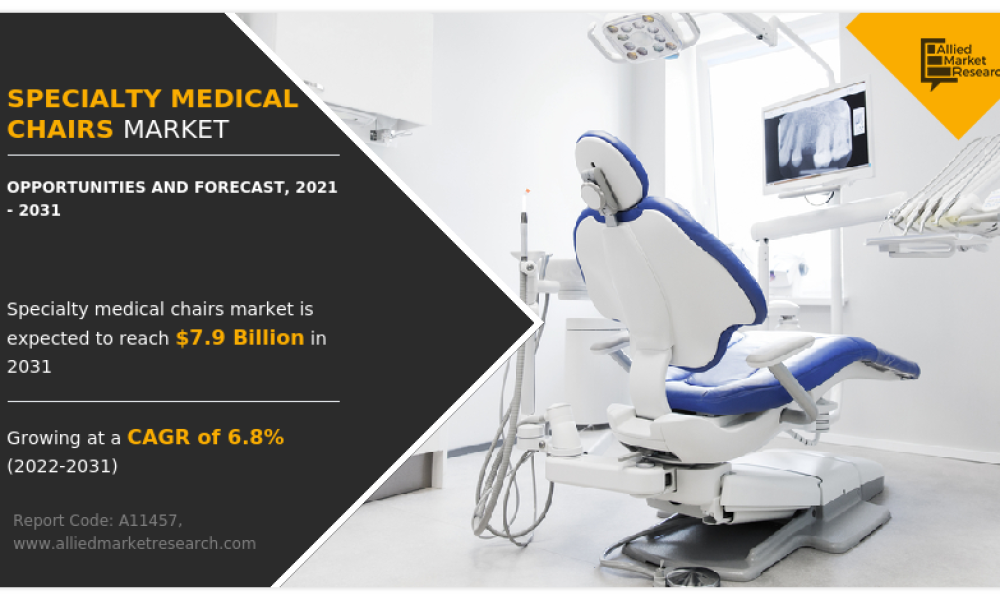
The specialty medical chairs market is witnessing significant growth driven by evolving healthcare needs and technological innovations in patient support systems. Valued at $4.1 billion in 2021, the global specialty medical chairs market is projected to reach $7.9 billion by 2031, expanding at a CAGR of 6.8% from 2022 to 2031. These chairs are crucial tools across hospitals, clinics, and ambulatory care centers, offering improved mobility, patient comfort, and procedural precision during treatments, examinations, and rehabilitation therapies.
What Are Specialty Medical Chairs?
Specialty medical chairs are ergonomically designed chairs used in various medical settings for specific purposes such as diagnosis, treatment, and rehabilitation. These include chairs for dental procedures, ophthalmic treatments, gynecological examinations, dialysis, and even blood donations. Available in manual and electrically operated variants, these chairs enable healthcare providers to adjust positions conveniently, enhance patient comfort, and ensure safety during prolonged or sensitive procedures.
Key Growth Drivers
1. Rising Chronic Disease Prevalence
The growing number of individuals suffering from chronic illnesses such as cardiovascular diseases, diabetes, dental issues, and orthopedic conditions has led to increased demand for specialized equipment. Specialty chairs support long treatment sessions by providing customizable positioning, which improves the efficiency of medical procedures.
2. Growing Geriatric Population
The aging global population is more prone to chronic health conditions and limited mobility. According to the United Nations, by 2030, 1 in 6 people globally will be over the age of 60. Geriatric and rehabilitation chairs help elderly patients maintain posture, participate in therapies, and reduce the risk of pressure sores, making them indispensable in modern elder care.
3. Technological Advancements
Integration of electromechanical systems, actuator-controlled positioning, and smart safety features in electric chairs is accelerating adoption. These chairs offer adjustable heights, tilting features, and automated lock mechanisms, enhancing both caregiver workflow and patient safety.
4. Increase in Surgical Procedures
The market is significantly influenced by the rise in surgical procedures, particularly in ophthalmology, dentistry, and ENT. For instance, the Healio Journal reported approximately 4 million cataract surgeries in the U.S. in 2021, expected to increase to 6 million by 2030. Specialty treatment chairs that cater to such procedures are seeing an uptick in demand.
5. Government and Private Sector Investment
Healthcare infrastructure development and rising investments in R&D for enhanced medical equipment have propelled market growth. Medical equipment manufacturers are actively launching innovative products and entering emerging markets to meet global demand.
Market Challenges
Despite promising growth, the specialty medical chairs market faces challenges:
High Cost of Equipment: Advanced chairs with electronic systems are expensive, limiting their adoption, particularly in low- and middle-income countries.
Limited Awareness in Developing Regions: A lack of awareness and trained professionals to use advanced chairs reduces adoption in rural areas or under-resourced clinics.
However, these challenges also offer opportunities for market players to innovate cost-effective solutions and tap into developing markets.
Market Segmentation Overview
By Product Type
Treatment Chairs – Held the largest market share in 2021, driven by demand in dental and ophthalmic settings.
Examination Chairs – Expected to grow rapidly due to increased use in gynecology, general diagnostics, and ENT examinations.
Rehabilitation Chairs – Includes pediatric and geriatric variants. These are essential in post-surgical recovery and elder care.
By Type
Electric Chairs – Dominated the market in 2021 due to their automation, advanced safety features, and ease of use.
Manual Chairs – Expected to grow at a stable rate due to their affordability and simplicity, especially in resource-limited settings.
By End User
Hospitals – Represented the largest share due to rising hospital numbers and increased surgical volumes. Hospitals require a broad range of specialty chairs, from dialysis to birthing and ENT examination.
Clinics – Witnessing steady growth as outpatient services expand.
Others – Includes ambulatory surgical centers and rehabilitation centers that are gaining traction due to patient preference for minimally invasive, outpatient procedures.
Regional Analysis
North America
Dominated the market in 2021, primarily due to the presence of major industry players, high healthcare spending, and adoption of advanced technologies.
The U.S. healthcare system’s focus on outpatient care and chronic disease management continues to support demand for specialty medical chairs.
Europe
Expected to witness strong growth driven by a large aging population, increasing healthcare investments, and expansion of specialty clinics.
Asia-Pacific
Rapidly emerging as a high-growth region due to rising medical tourism, increasing awareness of patient care infrastructure, and expanding private hospital networks in countries like India, China, and Japan.
Cost-effective manufacturing and government support for public healthcare modernization are further propelling regional growth.
LAMEA (Latin America, Middle East, and Africa)
Expected to grow at a moderate pace, supported by healthcare reforms, rising chronic illness burden, and international partnerships aimed at strengthening hospital and clinic infrastructure.
Leading Market Players
Several key companies are shaping the competitive landscape through innovation, global expansion, and partnerships. Prominent players include:
A-Dec Inc.
Craftsmen Contour Equipment Inc.
Danaher Corporation
Dentsply Sirona
Midmark Corporation
Henry Schein
Dentalez Inc.
Diplomat Dental
Planmeca OY
XO Care A/S
These companies are focused on improving ergonomics, integrating technology, and enhancing patient-provider interaction through next-generation medical chair designs.
Conclusion and Future Outlook
The specialty medical chairs market is set to experience robust growth as healthcare systems globally prioritize patient comfort, workflow efficiency, and advanced diagnostics and treatment setups. Driven by technological innovation, rising surgical demand, and an aging population, specialty chairs will continue to be essential across a wide range of medical disciplines.
While challenges like high costs and limited adoption in developing regions persist, they also open opportunities for innovation and cost-effective solutions. With increased investment in R&D and global health infrastructure, the specialty medical chairs market is poised to become a cornerstone of modern healthcare delivery by 2031.




