
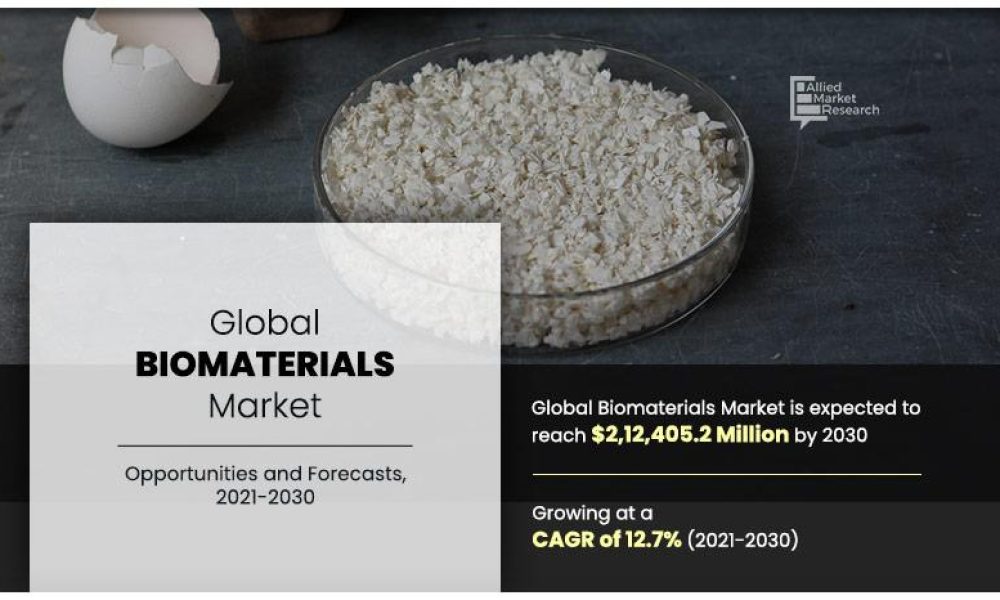
The global biomaterials market is experiencing explosive growth, projected to expand from $64.9 billion in 2020 to $212.4 billion by 2030, at a CAGR of 12.7%. Biomaterials—synthetic or natural substances used in medical implants, tissue engineering, and drug delivery—are revolutionizing healthcare by repairing damaged tissues, bones, and organs.
This Report explores key market drivers, challenges, segmentation, and future opportunities in the biomaterials industry.
What Are Biomaterials?
Biomaterials are engineered materials designed to interact with biological systems for medical purposes, including:
✔ Implants (stents, joint replacements, dental fixtures)
✔ Tissue engineering (scaffolds for organ regeneration)
✔ Drug delivery systems (controlled-release medications)
✔ Wound healing (collagen dressings, skin grafts)
Types of Biomaterials
| Category | Examples | Applications |
|---|---|---|
| Metallic | Titanium, stainless steel, cobalt-chrome | Orthopedic implants, dental fixtures, cardiovascular stents |
| Polymeric | PMMA, silicone, polyethylene | Contact lenses, drug delivery, plastic surgery |
| Ceramic | Hydroxyapatite, zirconia | Bone grafts, dental implants |
| Natural | Collagen, hyaluronic acid, silk | Wound healing, tissue engineering |
Key Market Drivers
1. Rising Geriatric Population & Chronic Diseases
By 2030, 1 in 6 people will be over 60 (WHO).
Increased prevalence of cardiovascular, orthopedic, and neurological disorders fuels demand for implants and prosthetics.
2. Technological Advancements in Medical Implants
3D-printed biomaterials enable customized implants.
Bioabsorbable stents reduce long-term complications.
Nanotechnology enhances drug delivery systems.
3. Government Funding & R&D Investments
NIH, EU Horizon 2020, and private biotech firms are investing heavily in biomaterial research.
Smart biomaterials (self-healing, bioactive coatings) are emerging.
4. Growing Demand for Minimally Invasive Surgeries
Patients prefer bioengineered implants over traditional surgeries.
Hydrogel-based biomaterials are gaining traction in wound care and ophthalmology.
5. COVID-19 Impact & Recovery
Initial decline due to postponed elective surgeries (orthopedic, dental).
Post-pandemic rebound with increased demand for biomaterials in diagnostics (gold nanoparticles for rapid testing).
Market Segmentation & Trends
By Material Type (2020-2030 Forecast)
| Segment | Market Share (2020) | Growth Outlook |
|---|---|---|
| Metallic | Largest share (~40%) | High durability in orthopedic & cardiovascular implants |
| Polymeric | Fastest-growing | Expanding use in drug delivery & plastic surgery |
| Ceramic | Steady growth | Biocompatibility in dental & bone grafts |
| Natural | Emerging segment | Rising demand for biodegradable materials |
By Application
| Application | Key Trends |
|---|---|
| Orthopedic | Largest segment (hip/knee replacements) |
| Cardiovascular | Growth in bioresorbable stents |
| Dental | Rise in ceramic & zirconia implants |
| Tissue Engineering | Rapid innovation in 3D bioprinting |
| Neurological | Emerging use in neural implants |
By Region
| Region | Market Share (2020) | Growth Drivers |
|---|---|---|
| North America | Largest (40%+) | High healthcare spending, strong R&D |
| Europe | Mature market | Advanced medical tech, aging population |
| Asia-Pacific | Fastest-growing | Rising healthcare access, medical tourism |
| LAMEA | Emerging | Increasing chronic disease burden |
Challenges & Restraints
1. High Cost of Biomaterial Implants
Titanium & advanced polymers are expensive, limiting adoption in developing nations.
2. Biocompatibility & Immune Response Risks
Rejection, inflammation, and infections remain concerns.
3. Regulatory Hurdles
FDA & EMA approvals are time-consuming and costly.
4. Competition from Alternative Treatments
Stem cell therapy & gene editing could disrupt the biomaterials market.
Future Opportunities
1. Smart & Self-Healing Biomaterials
Shape-memory alloys for adaptive implants.
Antibacterial coatings to prevent infections.
2. Expansion in Emerging Markets (Asia, Africa)
Medical tourism & local manufacturing will drive growth.
3. Bioengineered Organs & 3D Bioprinting
Lab-grown tissues for transplants.
4. AI & Machine Learning in Biomaterial Design
Predictive modeling for better biocompatibility.
Key Players & Recent Developments
Top Companies in Biomaterials
BASF SE (Polymeric biomaterials)
Carpenter Technology (Metallic implants)
Medtronic (Cardiovascular stents)
Zimmer Biomet (Orthopedic implants)
Collagen Matrix Inc. (Natural biomaterials)
Recent Industry Advancements
✅ 2023: FDA approves first 3D-printed ceramic spinal implant.
✅ 2022: MIT develops self-healing hydrogel for chronic wound treatment.
✅ 2021: Johnson & Johnson launches bioabsorbable coronary stent.
Conclusion
The biomaterials market is set for exponential growth, driven by aging populations, chronic diseases, and medical innovations. While North America leads, Asia-Pacific is the fastest-growing region.
Key Takeaways
🔹 Metallic biomaterials dominate, but polymers are growing fastest.
🔹 Orthopedic & cardiovascular applications lead demand.
🔹 Smart biomaterials & 3D bioprinting are future game-changers.
With increased R&D and regulatory support, biomaterials will continue to transform modern medicine.




