
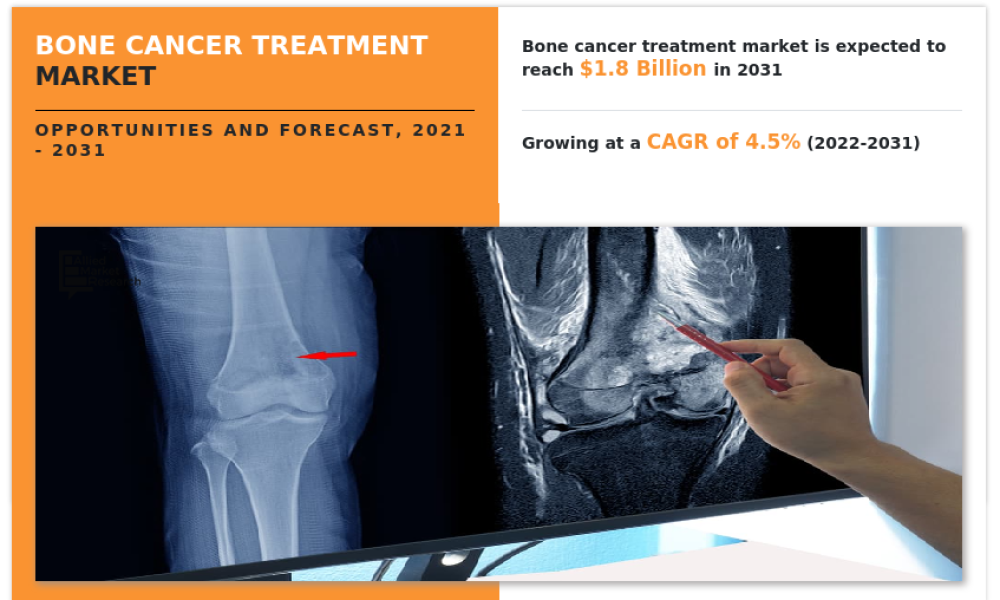
The global bone cancer treatment market was valued at $1.2 billion in 2021 and is projected to reach $1.8 billion by 2031, growing at a CAGR of 4.5% during the forecast period. Bone cancer is a rare but serious condition where malignant cells grow uncontrollably in the bone tissue, often damaging the bone structure and spreading to other areas. Although bone cancer can affect people of any age, it is more commonly diagnosed in children, teenagers, and young adults.
Overview of Bone Cancer Treatment Options
Bone cancer treatment depends on the type, location, and stage of the cancer, along with the patient’s age and overall health. Key treatment methods include:
Chemotherapy – Uses strong drugs to destroy cancer cells, especially effective for osteosarcoma and Ewing sarcoma.
Targeted Therapy – Focuses on specific genes or proteins involved in cancer growth.
Radiation Therapy – Employs high-energy rays to kill or shrink cancer cells.
Surgical Intervention – Removal of tumors or affected bone tissue, often followed by reconstructive surgery.
🔍 Key Market Growth Drivers
✔ Rising Prevalence of Bone Cancer
Increasing cases of osteosarcoma, Ewing sarcoma, and chondrosarcoma are pushing demand for innovative therapies.✔ Government Awareness Campaigns
Public health programs promoting early detection and cancer screening are driving timely diagnoses and treatment uptake.✔ Surge in FDA and EMA Drug Approvals
New treatment options entering the market are improving outcomes and expanding choices for clinicians.✔ Improved Healthcare Access in Developing Regions
Asia-Pacific and LAMEA are witnessing rapid healthcare advancements and rising investments in cancer care.✔ Growth in Targeted and Immunotherapy
These therapies offer better efficacy with fewer side effects compared to traditional chemotherapy.
📊 Market Segmentation Breakdown
1. By Cancer Type
Osteosarcoma – Most common and aggressive, dominating the market
Chondrosarcoma
Ewing Sarcoma
Others
2. By Drug Type
Immunotherapy & Targeted Therapy – Leading due to precision and minimal toxicity
Chemotherapy
3. By Distribution Channel
Hospital Pharmacies – Accounted for the largest market share in 2021
Drug Stores & Retail Pharmacies
Online Pharmacies – Fastest-growing due to digital health adoption
4. By Region
North America – Leading market share with robust oncology infrastructure
Europe – Strong government backing for cancer treatment R&D
Asia-Pacific – Fastest growth rate due to rising healthcare spending
LAMEA – Increasing awareness and improved diagnostic facilities
🏢 Competitive Landscape
The market is highly competitive with several key players innovating in diagnostics, drug development, and treatment technologies:
Pfizer Inc.
Takeda Pharmaceutical Company Limited
Hikma Pharmaceuticals PLC
Cellectar Biosciences, Inc.
Advaxis, Inc.
Gradalis Inc.
Isofol Medical AB
QSAM Biosciences, Inc.
Zentalis Pharmaceuticals
CancerVax, Inc.
These companies are actively engaging in:
Strategic partnerships
Clinical trials
Product launches
R&D investments
🔮 Future Outlook and Emerging Trends
The next decade is expected to usher in a new era of personalized medicine for bone cancer patients. Key trends include:
Expansion of immunotherapy trials targeting rare bone tumors
Artificial Intelligence (AI) in diagnosis and treatment planning
3D-printed prosthetics post-tumor removal surgeries
Rising adoption of genomic profiling for precise targeting of bone tumors
Asia-Pacific remains the most promising region, thanks to rising patient awareness, early screening initiatives, and healthcare reforms.
✅ Key Takeaways
Market Size: $1.2B (2021) → $1.8B (2031) | CAGR: 4.5%
Top Drivers: Rising incidence, drug innovations, early diagnosis awareness
Leading Cancer Type: Osteosarcoma
Top Drug Category: Immunotherapy & Targeted Therapy
Fastest-Growing Channel: Online Pharmacies
Dominant Region: North America | High-Growth Region: Asia-Pacific
Notable Players: Pfizer, Takeda, Hikma, Cellectar, Advaxis
The global bone cancer treatment market is evolving toward precision oncology, with a focus on early diagnosis, patient-centric care, and multimodal treatment approaches. This presents a promising future not only for patients but also for stakeholders across the pharmaceutical and healthcare spectrum.




