
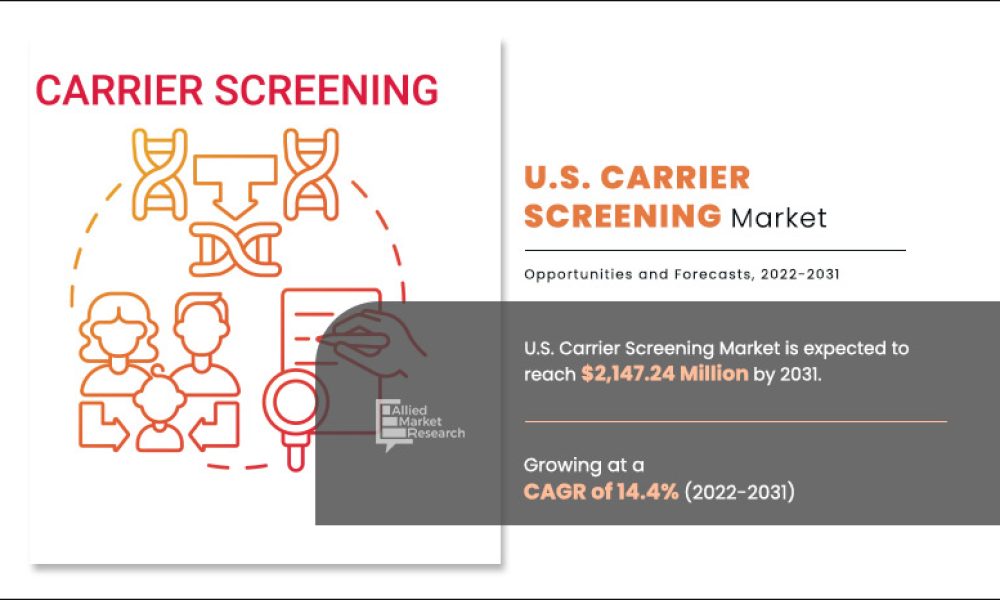
The U.S. carrier screening market is witnessing an impressive surge, driven by cutting-edge advancements in genetic testing, increased public awareness of inherited disorders, and a strong demand for early disease detection. With a valuation of $585.46 million in 2021, the market is projected to reach $2,147.24 million by 2031, growing at a CAGR of 14.4% from 2022 to 2031.
What Is Carrier Screening?
Carrier screening is a genetic test used to determine whether an individual carries a gene mutation that could potentially be passed on to their children, even if they themselves show no symptoms. This test plays a crucial role in family planning, particularly for couples planning a pregnancy or already expecting.
Key Aspects of Carrier Screening:
Detects recessive genetic disorders such as cystic fibrosis and spinal muscular atrophy.
Conducted using blood or saliva samples.
Can be performed before or during pregnancy.
Empowers couples to make informed reproductive decisions.
Market Growth Drivers
Several strong factors are accelerating the expansion of the U.S. carrier screening market:
🔹 1. Rising Prevalence of Genetic Disorders
Down syndrome affects 1 in 700 babies in the U.S. (CDC).
Other commonly screened conditions include cystic fibrosis, SMA, and thalassemia.
Growing public awareness is increasing the rate of voluntary testing.
🔹 2. Technological Advancements in Genetic Testing
Next-Generation Sequencing (NGS) offers comprehensive and rapid results.
PCR and microarray technologies enhance accuracy and throughput.
Non-invasive prenatal screening (NIPS) is becoming mainstream for early detection.
🔹 3. Demand for Early Disease Detection
Expanded Carrier Screening (ECS) enables testing for multiple conditions simultaneously.
Early detection supports preventive care and proactive health planning.
🔹 4. Supportive Government and Private Initiatives
Increased R&D funding for genetic research.
Key players like Illumina, Quest Diagnostics, and Invitae are investing in next-gen solutions.
Market Segmentation
The market can be broken down into multiple segments based on type, technology, and end users:
✔ By Type:
Expanded Carrier Screening (ECS) – Largest market share.
Customized & Predesigned Panel Testing
Targeted Disease Carrier Screening
✔ By Technology:
DNA Sequencing – Leading due to high precision.
Polymerase Chain Reaction (PCR)
Microarrays
Others
✔ By End User:
Hospitals & Clinics – Highest growth rate due to advanced infrastructure.
Reference Laboratories
Physician Offices
Others
Competitive Landscape
The market is highly competitive, with several companies investing heavily in innovation and product development:
Fulgent Genetics Inc.
Invitae Corporation
Illumina Inc.
PerkinElmer Inc.
Myriad Genetics, Inc.
Natera Inc.
LabCorp
Quest Diagnostics Incorporated
Thermo Fisher Scientific, Inc.
Sema4
Recent Industry Developments
Illumina (2022) – Released NovaSeq 6000 Dx, a high-throughput, FDA-registered sequencer.
Quest Diagnostics (2020) – Launched automated NGS for AncestryHealth.
Invitae (2019) – Expanded non-invasive prenatal screening (NIPS) services.
Future Outlook
The future of genetic screening in the U.S. looks exceptionally promising:
✅ Increasing pregnancy rates and need for early diagnosis
✅ Technological leaps in AI-based and DNA sequencing tools
✅ Government support for genomics and precision medicine
However, the market does face some hurdles:
Shortage of trained genetic counselors
High costs associated with advanced carrier screening panels
Future Outlook
Industry experts predict steady growth due to:
✔ Increasing pregnancy rates and demand for genetic screening.
✔ Advancements in DNA sequencing and AI-driven diagnostics.
✔ Government funding for large-scale genetic research.
Key Takeaways
🧬 Market to reach $2.14 billion by 2031 with a CAGR of 14.4%.
🧪 Expanded Carrier Screening (ECS) leads due to its wide condition coverage.
🔍 DNA sequencing remains the top technology for its unmatched accuracy.
🏥 Hospitals and clinics dominate as primary service providers.
🚀 Major companies are investing in R&D and new product launches.
The U.S. carrier screening market is set for significant expansion, driven by technological innovation, rising genetic disorder prevalence, and increased healthcare investments. As personalized medicine gains momentum, carrier screening will play a pivotal role in preventive healthcare and family planning.




