
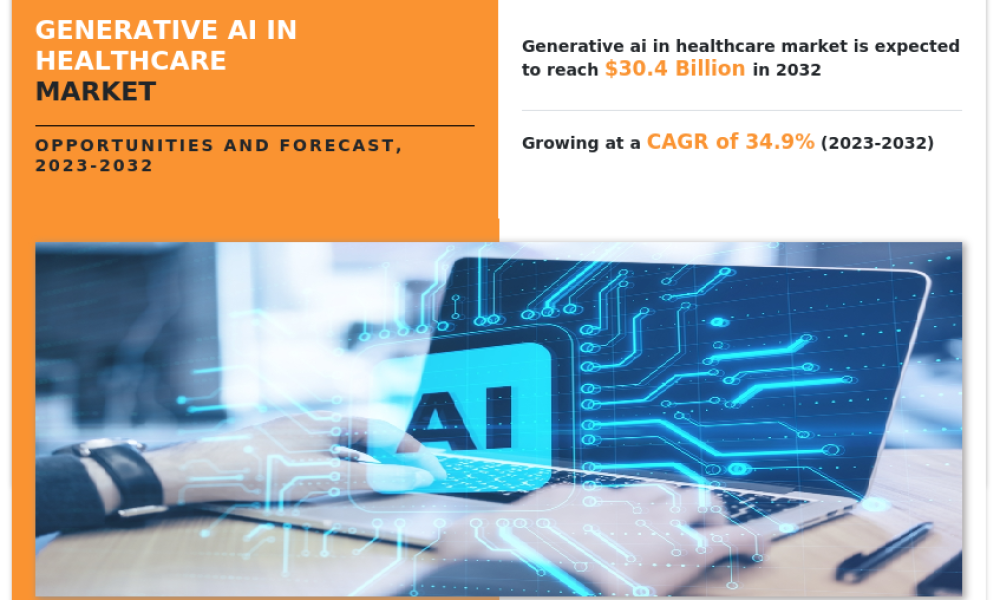
The global generative AI in healthcare market, valued at $1.6 billion in 2022, is forecast to surge to $30.4 billion by 2032, registering a CAGR of 34.9%. This explosive growth is being driven by breakthrough innovations in medical imaging, drug discovery, and hospital workflow automation. As artificial intelligence reshapes diagnostics and patient management, the healthcare sector stands on the cusp of a transformative era.
📊 Key Market Insights
Diagnosis led all applications in 2022, powered by AI-enhanced medical imaging.
Hospitals & clinics were the top adopters, leveraging AI to optimize workflows.
North America dominated the market in 2022, but Asia-Pacific is set to lead in growth.
🔬 How Generative AI is Transforming Healthcare
1. Revolutionizing Medical Imaging & Diagnosis
Generative AI is supercharging radiology by interpreting complex imaging data with remarkable accuracy.
✅ Enhancements in MRI, CT, and X-ray analysis
✅ Early disease detection and progression prediction
✅ Reduction in diagnostic errors—up to 20% of radiology reports contain errors (GE Healthcare, 2023)
“AI-powered imaging is reducing misdiagnosis and improving patient outcomes.”
2. Accelerating Drug Discovery & Development
Generative AI is cutting drug development timelines and costs through intelligent simulation and prediction.
In silico drug design for novel compounds
Drug repurposing to find new uses for existing medications
Optimized clinical trials by predicting patient response to treatments
Top AI Drug Discovery Innovators:
🧠 Google’s Med-PaLM 2
🧪 Insilico Medicine’s Pharma.AI
☁️ NVIDIA’s BioNeMo Cloud
3. Streamlining Hospital Workflows
Administrative efficiency is another major win for AI.
🗒️ NLP-driven transcription of patient notes
📈 Predictive analytics for patient inflow and resource allocation
📦 Smart inventory management to cut operational costs
These solutions are enabling providers to focus more on care and less on paperwork.
⚠️ Challenges Facing AI in Healthcare
Despite rapid adoption, generative AI in healthcare faces several roadblocks:
1. Data Privacy & Security Risks
High vulnerability to data breaches and hacking
Rising ethical concerns over AI-driven clinical decisions
2. Economic Downturn & Budget Cuts
Layoffs at tech giants like Google and Microsoft during the 2023 recession stalled innovation
R&D funding cuts have slowed AI implementation in healthcare systems
🔍 Market Segmentation & Growth Trends
➤ By Application
Diagnosis – Largest segment in 2022
Drug Discovery – Fastest-growing use case
Treatment & Research
➤ By End User
Hospitals & Clinics – Primary users of generative AI
Healthcare Organizations
Others – Including pharmaceutical companies and academic institutes
➤ By Region
🌎 North America – Market leader due to cutting-edge infrastructure
🌏 Asia-Pacific – Fastest growth rate, boosted by digital health initiatives
🧩 Competitive Landscape: Who’s Leading?
Tech giants are making big bets on AI in healthcare:
Microsoft acquired Nuance Communications to power AI-based healthcare speech solutions
Google partnered with Bayer to speed up drug development
Google Cloud and HCA Healthcare are collaborating on AI-driven patient analytics
IBM Watson Health continues to offer AI for oncology, imaging, and clinical decision support
These strategic moves are solidifying their dominance in this rapidly expanding market.
🔮 Future Outlook: What’s Next?
The future of generative AI in healthcare promises:
✔ Faster and more accurate diagnostics
✔ Accelerated time-to-market for new drugs
✔ Streamlined hospital operations and reduced burnout
However, for AI to realize its full potential, ethical governance, transparency, and secure data practices must be prioritized.
🔑 Key Takeaways
🌐 The market is set to grow 19x by 2032
🧬 Medical imaging and drug discovery are the main accelerators
🛡️ Data privacy and recessionary pressures could slow progress
🌍 Asia-Pacific will be the key growth engine moving forward
🚀 The Time Is Now: Embrace the AI-Healthcare Revolution
Generative AI is no longer just a futuristic concept—it’s actively transforming healthcare today. From reducing radiology errors to slashing drug development timelines, AI is improving outcomes, saving lives, and driving efficiency.
The question isn’t if your organization will adopt AI—it’s when.




