
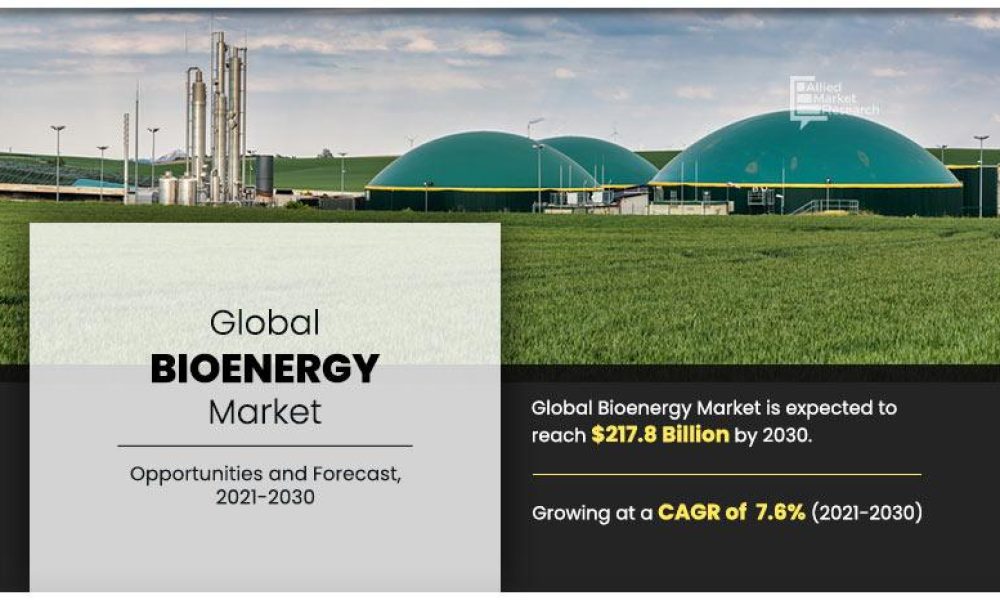
According to a new report published by Allied Market Research titled, “bioenergy market by product type, feedstock, and application: global opportunity analysis and industry forecast, 2021–2030,” the bioenergy market size was valued at $102.5 billion in 2020, and is projected to reach $217.8 billion by 2030, growing at a CAGR of 7.6% from 2021 to 2030
Bioenergy is a type of energy produced from bio-based sources such as agricultural residues, solid waste, animal manure, human sewage, and biomass. It provides several important advantages, including carbon neutrality, reduced dependence on fossil fuels, cost-effectiveness, widespread availability, lower environmental pollution, and a decrease in landfill waste. Bioenergy finds diverse applications across heat and power generation, transportation fuels and lubricants, biorefinery processes, as well as in aviation, marine, and manufacturing sectors.
The growing awareness of sustainable waste management practices, coupled with increasingly stringent regulations, is expected to significantly drive the bioenergy market’s expansion in the coming years. These factors support the adoption of bioenergy as a clean, renewable, and efficient energy solution globally.
Download PDF Brochure: https://www.alliedmarketresearch.com/request-sample/A06874
The bioenergy market is experiencing significant growth driven by the increasing global focus on renewable energy sources and the urgent need to reduce greenhouse gas emissions. As countries worldwide commit to climate targets and sustainable development goals, bioenergy emerges as a viable and reliable alternative to fossil fuels. Its ability to generate energy from organic materials such as agricultural residues, forestry waste, and dedicated energy crops makes it an attractive solution for reducing carbon footprints across multiple sectors. The versatility of bioenergy, spanning heat, electricity, and transportation fuels, further bolsters its market expansion.
Rising energy demand, especially in developing economies, is another critical driver of the bioenergy market. Rapid industrialization, urbanization, and population growth have heightened the need for sustainable energy sources to meet growing power consumption while minimizing environmental impact. Bioenergy offers an accessible and scalable option that leverages locally available biomass resources, reducing dependence on imported fuels and enhancing energy security. Governments in regions such as Asia-Pacific, Europe, and North America are increasingly promoting bioenergy through policy incentives, subsidies, and favorable regulatory frameworks, accelerating market adoption.
Technological advancements and innovations in bioenergy production processes are also propelling market growth. Improvements in biomass conversion technologies—such as anaerobic digestion, gasification, and advanced biofuels—have increased efficiency, yield, and cost-effectiveness. The integration of bioenergy with other renewable technologies and smart grid systems is enhancing overall energy system resilience and flexibility. Moreover, ongoing research into sustainable feedstock sourcing and waste-to-energy solutions is expanding the bioenergy feedstock base, making production more sustainable and economically viable.
Lastly, the rising awareness among industries and consumers regarding the environmental and economic benefits of bioenergy is fostering market demand. Corporations are increasingly adopting bioenergy to meet sustainability goals and reduce operational carbon emissions. Additionally, bioenergy projects create rural employment opportunities and stimulate local economies, providing social benefits alongside environmental advantages. These factors collectively position bioenergy as a key contributor to the global energy transition, driving robust market growth in the foreseeable future.
For Purchase Inquiry: https://www.alliedmarketresearch.com/purchase-enquiry/A06874
The global bioenergy market forecast is segmented into product type, feedstock, application, and region. Depending on product type, the market is divided into solid biomass, liquid biofuel, biogas, and others. On the basis of feedstock, it is categorized into agricultural waste, wood waste, solid waste, and others. As per application, it is classified into power generation, heat generation, transportation, and others. Region wise, it is analyzed across North America, Europe, Asia-Pacific, and LAMEA.
The bioenergy market exhibits significant regional variation, driven by differences in resource availability, policy support, and energy infrastructure. Asia-Pacific stands out as a leading region due to its vast agricultural sector, abundant biomass resources, and growing energy demand. Countries like China and India are investing heavily in bioenergy projects to meet their renewable energy targets and reduce dependence on fossil fuels. Government incentives, combined with rising awareness of sustainable energy solutions, are accelerating the adoption of bioenergy technologies across the region, particularly for power generation, heating, and biofuel production.
In Europe and North America, strong regulatory frameworks and commitment to decarbonization efforts drive steady growth in the bioenergy market. These regions emphasize advanced bioenergy technologies such as biogas upgrading, biomass pellets, and second-generation biofuels to enhance energy efficiency and reduce emissions. Meanwhile, Latin America benefits from vast natural resources and expanding agricultural activities, making it a growing market for bioenergy, especially bioethanol and biogas. In Africa, bioenergy holds potential to improve energy access in rural areas, though market growth is still emerging due to infrastructural and financial constraints. Overall, regional disparities in resource endowment, policy landscape, and technological development shape the diverse growth trajectories of the global bioenergy market.
The global market analysis covers in-depth information of the major bioenergy industry participants. The key players operating and profiled in the report include EnviTec Biogas AG, Babcock & Wilcox, Orsted A/S, Fortum Oyj, Hitachi Zosen Corporation, Pacific Bioenergy Corp, Royal Dutch Shell Plc, BP Plc, Enerkem, and MVV Energie AG.
Other players operating in the value chain of the global bioenergy market are POET, ADM, Ameresco, inc., Biomass Engineering Limited, A2A SPA, Drax Group, Enexor Energy, Green Plains, Inc., and others.
The bioenergy market is analyzed in accordance with the impacts of the drivers, restraints, and opportunities. The period studied in this report is 2021–2030. The report includes the study of the bioenergy market with respect to the growth prospects and restraints based on the regional analysis. The study includes Porter’s five forces analysis of the industry to determine the impact of suppliers, competitors, new entrants, substitutes, and buyers on the market growth.




