

Cable Conduit Market Overview
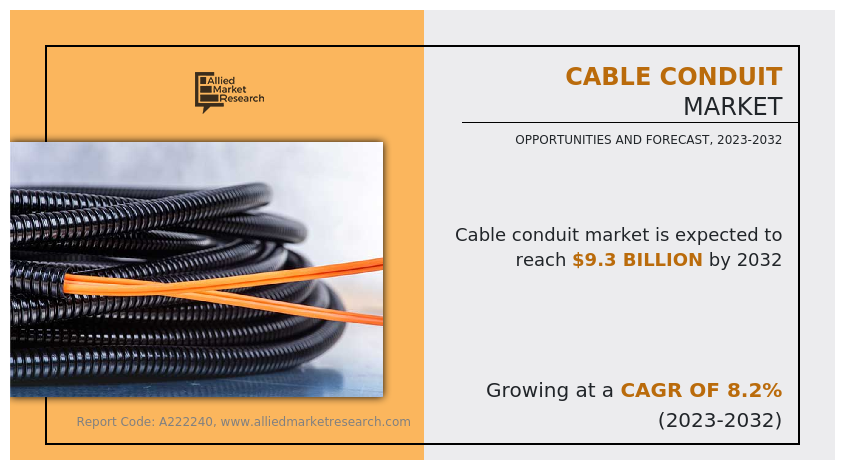
According to a new report published by Allied Market Research, the cable conduit market size was valued at $4.4 billion in 2022, and is estimated to reach $9.3 billion by 2032, growing at a CAGR of 8.2% from 2023 to 2032.
A cable conduit is a tubular or channel-like structure, typically made of metal, plastic, or PVC, designed to protect electrical cables and wiring. It serves to safeguard cables from environmental factors, physical damage, and electromagnetic interference, ensuring safe and organized cable management in various applications, such as residential, commercial, and industrial industries.
Download PDF Brochure: https://www.alliedmarketresearch.com/request-sample/A222240
Asia-Pacific held the highest market share in terms of revenue in 2022, accounting for more than one-third of the global cable conduit market revenue. Rapid urbanization and industrialization in the region are significant growth drivers for the Asia-Pacific cable conduit market.
The major players operating in the global cable conduit market are Eaton Corporation plc, Hubbell.Inc., Schneider Electric, Anamet Electrical, Inc., Legrand, Shanghai Qinkai Industry Co.,Ltd., Atkore, Guangdong Ctube Industry Co., Ltd., Electri-Flex Company, Zekelman Industries, Flucon Components Pvt. Ltd., Supa Flex, Trinity Touch, AerosUSA Inc.
Other players include Allied Tube & Conduit, Intertek Group plc, Prime Conduit, Inc., Robroy Industries, Inc., ABB Ltd., Calpipe Industries, Inc.
The increasing demand for power and data transmission is a key driver propelling the demand for cable conduit market size.
In an increasingly digital and interconnected world, there’s a growing need for efficient and reliable cable management solutions to support the transmission of both electrical power and data signals.
Industries such as telecommunications, data centers, and industrial automation are experiencing rapid growth, necessitating intricate cabling systems that require proper organization and protection.
Environmental regulations have become a significant hindrance to the growth of the cable conduit market share.
In recent years, there has been a global shift towards environmental sustainability and reducing the carbon footprint of various industries.
Cable conduits, often made from non-recyclable or environmentally harmful materials, have come under scrutiny.
Cable conduits play a pivotal role in safeguarding these critical wiring systems from environmental factors, physical damage, and electromagnetic interference, ensuring uninterrupted power and data flow.
As technologies such as 5G, the Internet of Things (IoT), and smart infrastructure continue to evolve, the demand for cable conduit market forecasts expected to surge as they become indispensable components in the infrastructure needed to facilitate seamless power and data transmission.
Renewable energy projects, such as solar farms and wind farms, are projected to provide lucrative opportunities for the cable conduit market analysis. These projects require extensive cabling infrastructure to connect and distribute power generated from renewable sources.
Cable conduits play a pivotal role in protecting and organizing these cables, safeguarding them from environmental factors, and ensuring the longevity of electrical systems.
Advantages
- Durability: Provides long-lasting protection for electrical cables.
- Versatility: Suitable for a wide range of applications, from residential to industrial.
- Aesthetic Appeal: Can contribute to a cleaner and more organized appearance in electrical installations.
Procure This Report (287 Pages PDF with Insights, Charts, Tables, and Figures): https://bit.ly/3US3JSq
The global shift toward renewable energy accelerates, cable conduit manufacturers have a significant growth avenue to develop specialized conduit solutions tailored to the unique requirements of these projects, solidifying their position in an expanding and environmentally conscious market. This factor provides cable conduit market opportunities.
Regulatory bodies are imposing stricter standards and requirements on cable conduit manufacturers, necessitating investments in more eco-friendly materials and production processes.
Compliance with these regulations not only adds to production costs but can also limit the availability of certain conduit types that don’t meet the new environmental standards.
Future Trends
- Smart Conduits: Development of conduits with integrated sensors for monitoring conditions such as temperature or humidity.
- Sustainable Materials: Increasing use of eco-friendly materials for conduit manufacturing.
End-users and businesses are increasingly seeking sustainable solutions for their cable management needs, which may lead to a decline in demand for the conventional cable conduit industry.
On the basis of the end-user, the cable conduit market is classified into commercial construction, IT & and telecommunication, railways, energy, manufacturing, healthcare, and others. Commercial construction is projected to be the fastest-growing segment and has garnered the highest share of the cable conduit market.
On the basis of product type, the cable conduit market is categorized into metal conduit, nylon conduit, and polyamide conduit. Nylon conduit is projected to be the fastest-growing segment and metal conduit has garnered the highest share of the cable conduit market.
On the basis of type, the cable conduit market is categorized into rigid cable conduit and flexible cable conduit. Flexible cable conduit is projected to be the fastest-growing segment and rigid cable conduit has garnered the highest share of the cable conduit market.
Types of Cable Conduits
- Rigid Conduit:
- Material: Typically made from metal (such as steel or aluminum) or rigid plastic (PVC).
- Usage: Ideal for high-durability applications where protection from physical damage is required.
- Flexible Conduit:
- Material: Made from flexible materials like PVC or metal.
- Usage: Suitable for applications where movement or vibration occurs, allowing for easier installation in tight spaces.
- Intermediate Metal Conduit (IMC):
- A lighter alternative to rigid metallic conduits, providing similar protection with less weight.
- Electrical Metallic Tubing (EMT):
- Thin-walled and lightweight metal conduit, commonly used in commercial and industrial applications.
- Non-Metallic Conduit:
- Made from plastic materials, ideal for applications where corrosion resistance is essential.




