

Utility Communications Market Overview
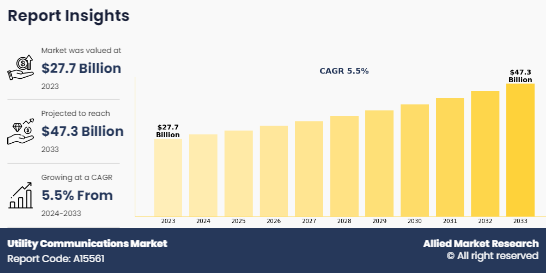
According to a new report published by Allied Market Research, the utility communications market size was valued at $27.7 billion in 2023, and is estimated to reach $47.3 billion by 2033, growing at a CAGR of 5.5% from 2024 to 2033.
Utility communications provide various channels for customer interaction and support. Customers easily report issues, request services, and receive updates on outages through multiple communication channels, such as phone, email, mobile apps, and online portals. Furthermore, effective utility communications help ensure the reliability and resilience of utility services.
Download PDF Brochure: https://www.alliedmarketresearch.com/request-sample/A15561
Asia-Pacific held the highest market share in terms of revenue in 2023, accounting for more than half of the global utility communications market revenue. The region is expected to dominate the market through the forecast period, growing at a CAGR of 5.7% from 2024 to 2033.
Key players in the utility communications industry include General Electric, Omicron, Hitachi, Ltd., Rad, Schneider Electric SE, Cisco Systems, Inc., ABB, Milsoft Utility Solutions, Motorola Solutions, Inc., and Itron Inc.
Rise in the adoption of renewable energy sources is expected to propel the utility communications market growth during the forecast period. Renewable energy installations, such as solar farms or wind turbines, often span large areas.
Utility communications facilitate remote monitoring and maintenance of these installations, allowing utilities to remotely monitor performance, detect faults, and proactively address maintenance needs.
Timely communication enables efficient troubleshooting, reduces downtime, and optimizes renewable energy generation.
Utility communications are vital for connecting renewable energy projects to the electrical grid. Communication networks enable utilities to exchange information with project developers, grid operators, and regulatory bodies during the planning, approval, and commissioning phases of renewable energy projects.
Efficient communication ensures seamless integration of renewable energy projects into the existing grid infrastructure.
Smart grid infrastructure relies on the exchange of vast amounts of data among various components, including smart meters, sensors, control systems, and analytics platforms.
Utility communications provide the necessary connectivity and data management capabilities to facilitate real-time data exchange, ensuring seamless communication between different elements of the smart grid ecosystem.
Smart grid infrastructure enables utilities to remotely monitor and control their grid assets, including power generation, distribution systems, and substations.
Utility communications play a critical role in establishing reliable and secure communication links that enable utilities to monitor equipment performance, detect anomalies, and respond swiftly to operational issues, enhancing grid reliability and performance.
Smart grid infrastructure enables utilities to implement demand response programs and effectively manage electricity demand during peak periods.
Utility communications facilitate real-time communication between utilities and customers, allowing the exchange of information on energy usage, pricing, and load control signals.
This enables utilities to optimize electricity demand, balance loads, and improve grid efficiency. In addition, the integration of renewable energy sources and distributed energy resources (DERs) into the grid requires effective coordination and control.
Utility communications enable utilities to manage the bidirectional flow of energy from DERs, optimize power flow, and ensure grid stability.
Communication networks are essential for real-time monitoring, control, and coordination between DERs, grid operators, and utility control centers.
Smart grid infrastructure enhances grid resiliency by enabling rapid fault detection, isolation, and restoration.
Procure This Report (327 Pages PDF with Insights, Charts, Tables, and Figures): https://bit.ly/3FdMCWT
Utility communications support the transmission of fault data, alarms, and outage notifications, enabling utilities to quickly identify and respond to grid faults, minimizing downtime and improving service reliability.
By maintaining robust communication networks and systems, utility companies monitor their infrastructure in real-time, identify potential issues promptly, and take proactive measures to prevent or minimize service disruptions.
Utility communications enable faster and more efficient response to service outages. With effective communication channels among customers, call centers, dispatchers, and field technicians, outage information can be quickly reported, analyzed, and disseminated to the relevant personnel. This enables rapid dispatch of repair crews, accurate status updates, and timely resolution of outages, resulting in improved customer satisfaction.
By technology, the market is categorized into wired and wireless. The wireless segment is expected to lead the utility communications market. In 2023, it represented more than half of the global market revenue and is expected to maintain its dominant position throughout the forecast period
By utility, the market is divided into public and private. The public segment accounted for the largest share in 2023, growing with a CAGR of 5.8% from 2024 to 2033.
By component, the market is classified into hardware and software. The software segment held the largest share in 2023, contributing to more than half of the global utility communications market revenue. It is projected to maintain its leading position throughout the utility communications market forecast period.
By application, the market is segregated into oil & gas, power generation, and others. The power generation segment accounted for the largest share in 2023. In 2023, it contributed to more than three-fifths of global market revenue and is projected to maintain this position, growing at a CAGR of 5.5% from 2024 to 2033.
By end-use, the utility communications market is classified into residential, commercial, and industrial. The industrial segment held the largest share in 2023. In 2023, it accounted for more than one-third of global market revenue and is projected to maintain this position, growing at a CAGR of 5.6% from 2024 to 2033.




