
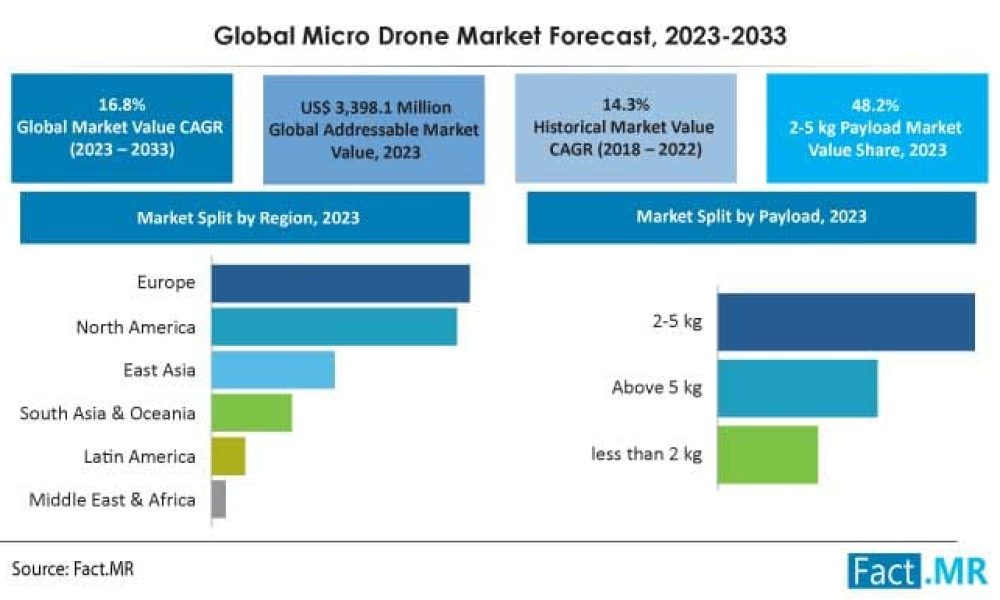
The Global micro drone market is poised for substantial growth, with an anticipated valuation of US$ 3,398.1 million by the year 2023. This growth trajectory is expected to continue, with a projected Compound Annual Growth Rate (CAGR) of 16.8%, culminating in a market valuation of US$ 16,057.0 million by the close of 2033.
Furthermore, in 2023, the global small drone market is estimated to have a valuation of approximately US$ 5,193.5 million, with a projected growth rate of 16.3% CAGR. In terms of unit volume, the demand for micro drones is set to reach nearly 1.9 million units in 2023. Notably, micro drones are anticipated to maintain their dominance, accounting for approximately 65% of the global small drone market by the conclusion of 2022.
Download a Sample Copy of This Report:
https://www.factmr.com/connectus/sample?flag=S&rep_id=7897
In the world of technology and innovation, the concept of “smaller is better” has never been more evident than in the rapid evolution of micro drones. These diminutive aerial marvels are taking the world by storm, with recent advancements pushing the micro drone market to unprecedented heights. From recreational enthusiasts to industries such as agriculture, surveillance, and entertainment, micro drones are making a significant impact.
Miniaturization Meets Power
The micro drone market has witnessed a remarkable transformation in recent years. The marriage of miniaturization and technological advancements has given rise to drones that are not much larger than the palm of your hand, yet pack a powerful punch in terms of capabilities.
One of the key drivers of this transformation is the continuous miniaturization of components, including cameras, sensors, and processing units. This has allowed manufacturers to create drones that are not only incredibly small but also equipped with high-resolution cameras, obstacle detection systems, and advanced flight control algorithms. As a result, these tiny aircraft can capture stunning aerial footage, navigate complex environments, and perform tasks that were once reserved for much larger drones.
Diverse Applications
The versatility of micro drones is a major factor behind their surging popularity. They are no longer limited to recreational use but have found applications across various industries:
- Agriculture: Farmers are increasingly turning to micro drones for precision agriculture. These drones can collect data on crop health, monitor irrigation, and even assist in the targeted application of fertilizers and pesticides, ultimately increasing crop yields and reducing environmental impact.
- Surveillance and Security: Law enforcement agencies and security firms are utilizing micro drones for surveillance, search and rescue operations, and monitoring of critical infrastructure. Their small size and agility make them ideal for navigating tight spaces and capturing vital information.
- Entertainment: In the entertainment industry, micro drones are revolutionizing aerial photography and filmmaking. They can capture breathtaking aerial shots that were once only possible with much larger and more expensive equipment.
- Delivery and Logistics: The concept of last-mile delivery is becoming a reality with micro drones. Companies are exploring ways to use these drones for quick and efficient package delivery in urban areas.
Competitive Landscape
Leading manufacturers in the micro drone industry include industry giants such as The Boeing Company, BAE Systems Inc., Da-Jiang Innovations Science and Technology Co. Ltd., AeroVironment Inc., Thales Group, Microdrones GmbH, Saab AB, Parrot SA, 3D Robotics Inc., Textron Inc., Lockheed Martin Corporation, Elbit Systems Ltd., and Israel Aerospace Industries Ltd.
These preeminent micro drone manufacturers consistently innovate to address contemporary challenges related to component placement in demanding environments. Some of these key players have adopted competitive pricing strategies within the micro drone market. Moreover, they have fostered productive partnerships and collaborations with government entities and end-user industries.
The robust demand for modern drones and associated accessories provides market participants with opportunities for diversifying their product portfolios. These industry participants are directing their resources and capital towards research and development initiatives while simultaneously seeking to expand their presence in various geographic regions.
Segmentation of Micro Drone Industry Research
- By Wing type :
- Fixed Wing
- Rotary Wing
- Hybrid Wing
- By Payload :
- less than 2 kg
- 2-5 kg
- Above 5 kg
- By Sales Channel :
- Online Sales
- Direct to customer
- Third Party Online
- Offline Sales
- Modern Trade Channels
- Electronic Stores
- Franchised Store
- Independent Stores
- Others
- Online Sales
- By End Use Industry :
- Agriculture & Forestry
- Delivery & Logistics
- Media & Entertainment
- Construction & Mining
- Oil & Gas
- Security & Law Enforcement
- Recreational Activity
- Others
- By Region :
- North America
- Latin America
- Europe
- East Asia
- South Asia & Oceania
- Middle East and Africa (MEA)
Get Customization on this Report:
https://www.factmr.com/connectus/sample?flag=RC&rep_id=7897
The Future of Micro Drones
The future of the micro drone market looks promising. As technology continues to advance, we can expect even smaller and more capable drones to emerge. These tiny flying machines will likely find applications in fields we haven’t even imagined yet.
Moreover, the democratization of drone technology means that more individuals and businesses can access these tools. This increased accessibility will lead to a wider range of creative and practical uses for micro drones, further fueling the market’s growth.
Contact:
US Sales Office
11140 Rockville Pike
Suite 400
Rockville, MD 20852
United States
Tel: +1 (628) 251-1583, +353-1-4434-232
Email: [email protected]




